


The financial landscape of the last several years has been nothing short of extraordinary. For the average retail investor, the S&P 500—the bedrock of most retirement portfolios—has delivered an astounding 57% return in just the last two years, more than doubling in value over the past five. For many, this has transformed their financial trajectory: those who felt they were merely halfway to their retirement goals during the uncertainty of the COVID-19 pandemic may find themselves staring down the barrel of an early finish line.
However, this rapid appreciation has ignited a fierce debate among analysts and everyday savers alike: Is this an era of genuine prosperity driven by technological revolution, or are we witnessing a classic financial illusion, a bubble waiting to burst?

The Mechanics of Market Valuation: A Reality Check
To understand the current market, one must return to the foundational principles of equity. A stock is, at its core, a business arrangement—a fractional ownership stake in a company. It is best understood through the lens of a rental property.
When you own a rental house, your financial return is derived from the net rent collected after expenses. If property values in your neighborhood skyrocket but the rent remains stagnant, your "on-paper" net worth increases, but your actual cash flow—the income that funds your retirement—does not. To increase your income, you must fundamentally improve the asset: finish a basement, renovate the kitchen, or streamline operations.

The stock market currently mirrors this rental property analogy in a cautionary way. While the S&P 500 has surged, the actual earnings of the companies within that index have not kept pace. If you invested $100,000 in the market in 2019 and reinvested dividends, your portfolio would be worth roughly $256,960 today—a 157% gain. Yet, the underlying earnings of that same basket of companies have only grown by about 42%.
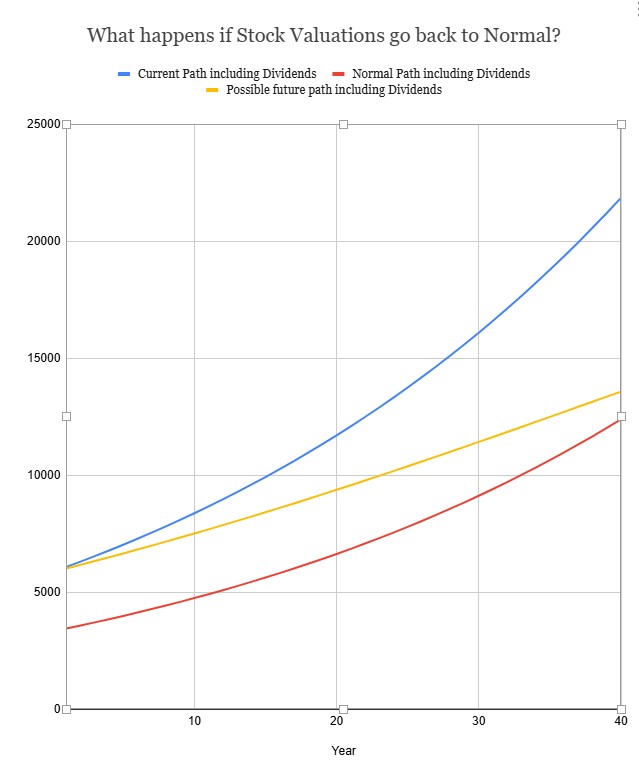
This discrepancy is reflected in the Price-to-Earnings (P/E) ratio, which has expanded from approximately 20 in 2019 to 30 today. In simple terms, investors are paying significantly more for every dollar of corporate earnings than they were five years ago. While this does not guarantee a crash, it mathematically dictates that future returns will likely be lower, as the "entry price" for those earnings is historically elevated.

The Chronology of the Magnificent Seven
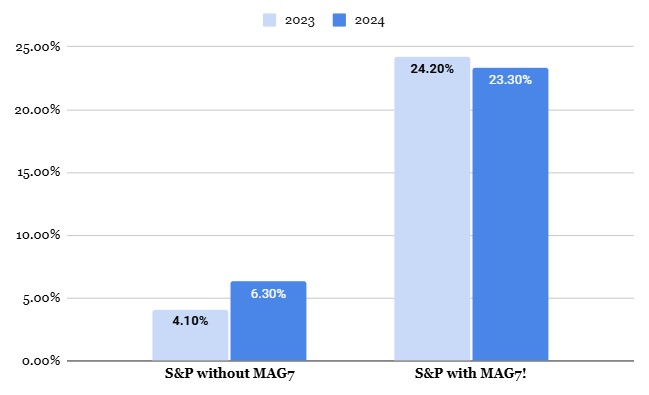
The current bull market is not a uniform rise across all sectors. Instead, it is highly concentrated. Approximately three-quarters of the recent market gains can be traced back to the "Magnificent Seven": Apple, Nvidia, Microsoft, Amazon, Google, Meta, and Tesla.
The Rise of the Tech Titans
- 2020–2021: The COVID-19 pandemic accelerated the digital transformation. Companies like Peloton saw massive spikes in demand, which investors mistakenly extrapolated as permanent shifts in consumer behavior.
- 2022: A period of inflation-driven correction where tech valuations faced significant pressure.
- 2023–2025: The "AI Pivot." The emergence of Large Language Models (LLMs) and generative AI triggered a massive capital expenditure cycle.
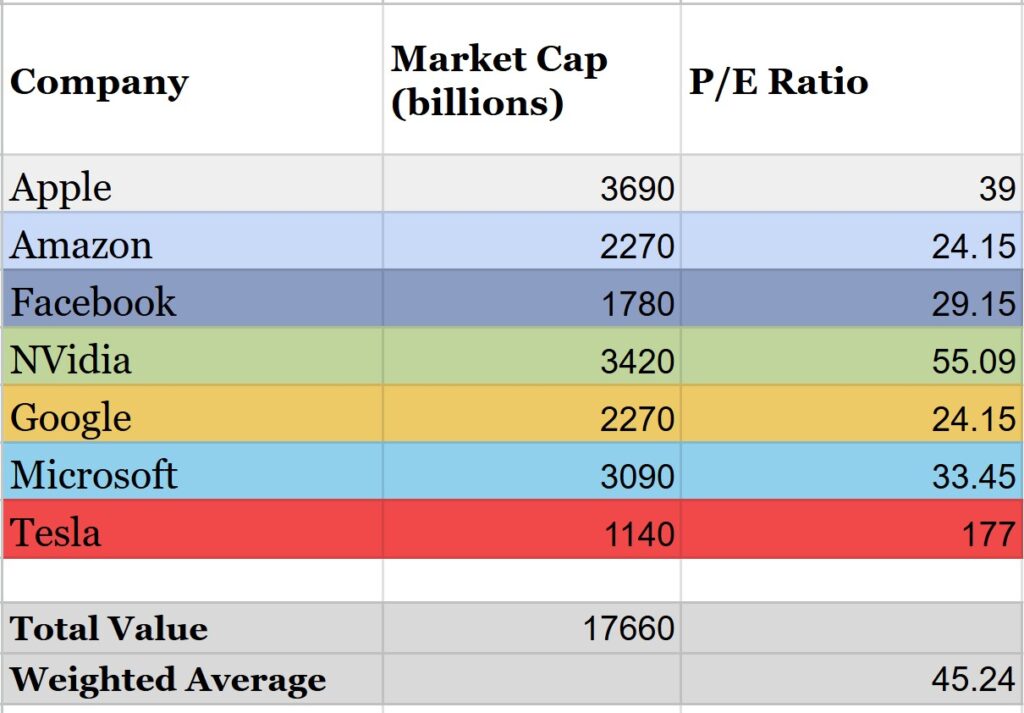
These seven companies now account for over 25% of the total S&P 500 market capitalization, a staggering $17.66 trillion. Their weighted average P/E ratio sits at 45, far above the rest of the index. If one excludes these giants, the remaining 493 companies in the S&P 500 trade at a more modest P/E of 20. This suggests that the "market" is not necessarily a monolith; it is a tale of two economies—one driven by AI-heavy tech, and the other by traditional industrial and service sectors.
Supporting Data: The AI Infrastructure Gold Rush
The primary engine behind this valuation surge is the rapid adoption of Artificial Intelligence. Six of the Magnificent Seven are currently pouring hundreds of billions of dollars into massive data centers and supercomputing infrastructure. Nvidia, the seventh, acts as the "picks and shovels" provider for this gold rush, commanding immense pricing power as it ships high-end AI processors by the trainload.
The promise of AI is the elimination of the primary constraint on human productivity: a finite supply of labor and intelligence. Proponents argue that we are on the verge of a "zero-marginal-cost" era for cognitive tasks. If AI can indeed write code, diagnose diseases, and manage logistics with superhuman efficiency, the long-term profitability of these corporations could eventually justify their current, lofty valuations.
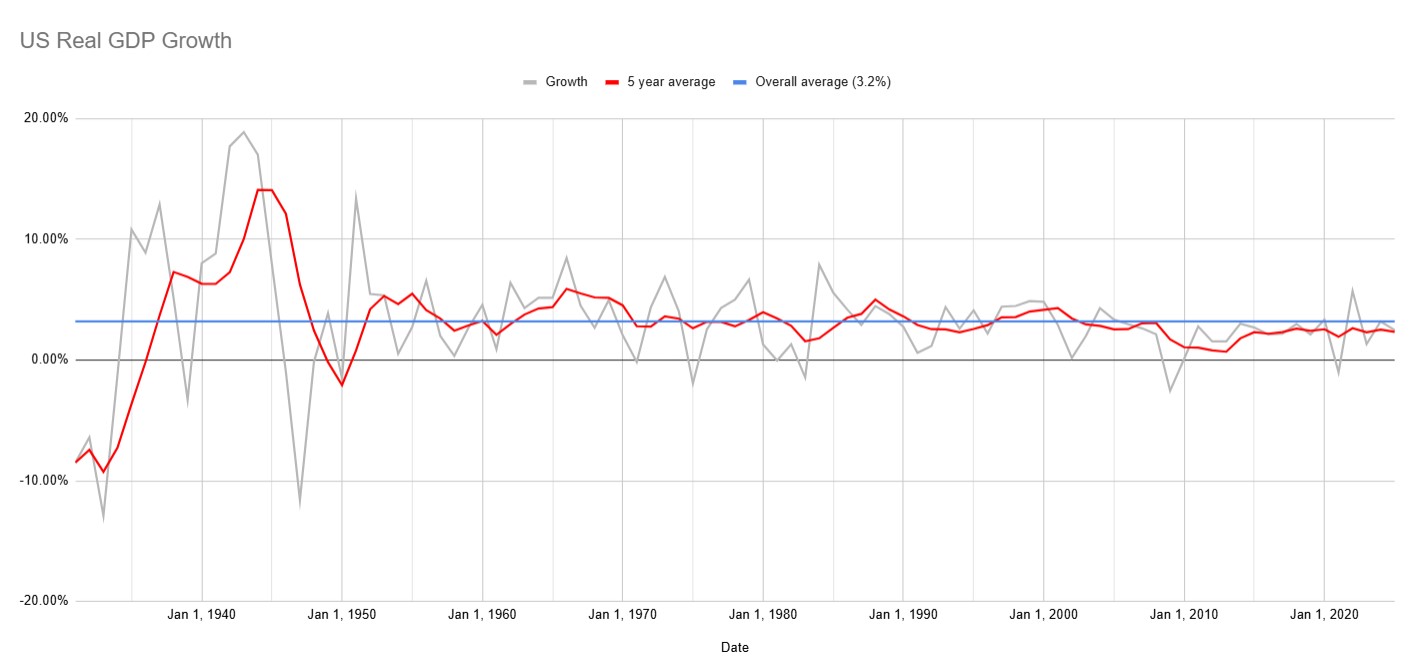
However, historical data suggests caution. While the S&P 500 has roared, overall U.S. GDP growth has remained remarkably steady, averaging roughly 3% after inflation for decades. In fact, recent growth has been slightly slower than the historical average, creating a logical tension between the skyrocketing stock prices and the more grounded pace of the actual economy.
Official Perspectives and Expert Caution
The investment community is currently divided between optimism regarding AI productivity and skepticism regarding valuations.

Vanguard’s Outlook
Vanguard’s ten-year return forecasts present a contrarian view. They suggest that international stocks and even bonds may outperform U.S. equities over the next decade. The reasoning is rooted in valuation: international markets, particularly in Europe, trade at significantly lower P/E ratios (often around 15.9), essentially offering investors a "discount" compared to the high-multiple U.S. tech sector. While Vanguard has held this view for several years—and been incorrect as the U.S. market continued to outperform—their long-term model relies on the eventual "reversion to the mean."
The "Oracle" of Omaha
Warren Buffett, the chairman of Berkshire Hathaway, has signaled a clear lack of enthusiasm for current valuations. Berkshire Hathaway is currently sitting on a record $334 billion in cash, having opted against aggressive stock buybacks or new major acquisitions. This hoard of liquid capital suggests that even the world’s most successful value investor sees few "bargains" in the current environment.
Implications for the Individual Investor
For the long-term, passive investor, the noise of the market can be deafening. The temptation to time the market—selling during peaks and waiting for a crash—is the most common cause of underperformance.
1. Diversification as a Hedge
While a U.S.-only portfolio has been the clear winner for over a decade, investors may consider broader allocations. Robo-advisors and diversified index funds that include international exposure and bonds offer a mechanism to capture global growth while mitigating the volatility of the concentrated U.S. tech sector.
2. The Debt Dilemma
The debate over paying down a mortgage versus investing in the market has shifted. With interest rates higher than they were in the 2010s, a 7% mortgage is no longer the "cheap money" it once was. For many, paying off a mortgage acts as a guaranteed, tax-free return on investment. It is a psychological and financial defensive maneuver that provides stability in an uncertain, high-valuation market.
3. The Human Factor
The most significant implication is the need to decouple one’s identity from the ticker tape. The market will experience "manias, panics, and crashes" regardless of the underlying technological innovations. If one is truly investing for the long term—decades, not months—the fluctuations of the S&P 500 are largely noise.

The ultimate strategy remains unchanged: maintain a consistent contribution schedule, keep costs low through index funds, and ignore the daily headlines. Reinvest the time saved from worrying about market cycles into physical activity, community, and personal growth. In the long run, the most reliable return on investment is not found in a brokerage account, but in the quality of one’s life.
As we stand at this junction of historical valuation and technological potential, the most prudent course of action is not to panic, but to remain grounded. Whether the AI revolution leads to a new era of human prosperity or a correction of inflated tech multiples, the fundamentals of patient, disciplined investing remain the surest path to financial independence.
