

Does your business feel like it’s drowning in a sea of browser tabs? If you are juggling four or more disparate tools just to shepherd a single document from inception to signature, you aren’t alone—but you are likely losing money, time, and sanity in the process.
This year, as Zoho Writer celebrates its 20th anniversary, the platform is marking the milestone by highlighting a critical shift in the modern workplace: the evolution of the "word processor" into the "work processor." By unifying document creation, collaborative editing, automated workflows, and digital signatures into one ecosystem, Zoho is challenging the status quo of fragmented business operations.
The Fragmented Reality: A Scavenger Hunt with Deadlines
To understand the friction in modern document management, consider a standard marketing analyst working in a five-person team. They need to secure a signed vendor agreement by Thursday.

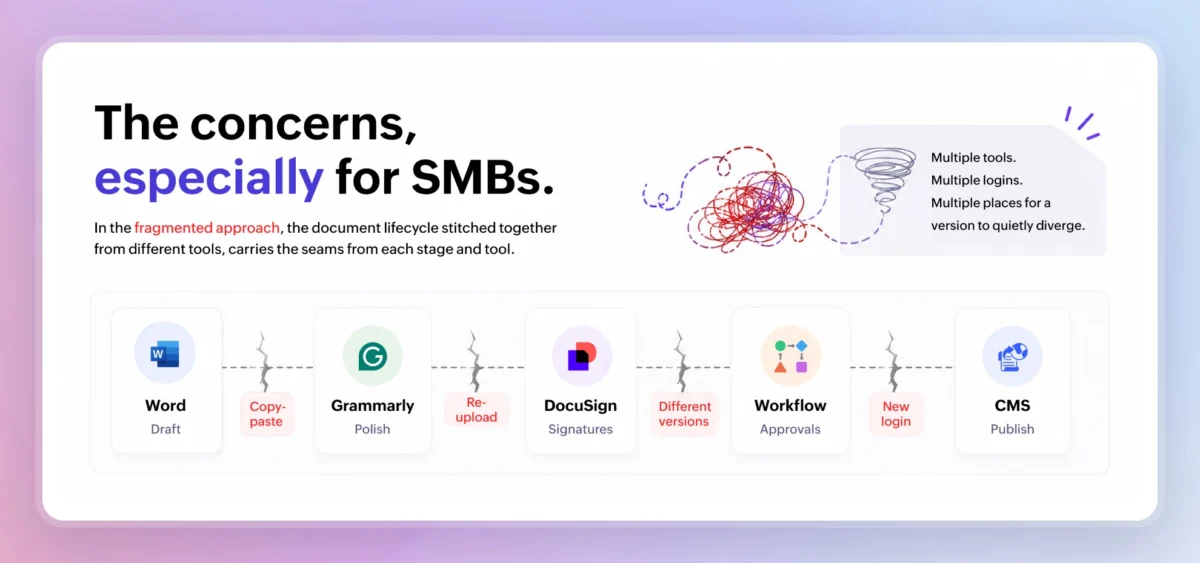
In a typical fragmented workflow, the process is a logistical nightmare. The analyst drafts the agreement in Microsoft Word, then runs it through a grammar-check tool like Grammarly to polish the prose. Next, they email the document to three colleagues for feedback, leading to a flurry of reply-all threads. Once the edits are synthesized, the document is exported and uploaded to a platform like DocuSign for a legal signature. Finally, the signed file is downloaded and manually filed into a shared cloud drive.
This "scavenger hunt" approach is more than just inconvenient; it is dangerous. Every time a document moves between these applications, a new version is created. "A client signs off on the wrong pricing, or legal reviews a clause that got fixed two versions ago," explains Balaji V., a product expert at Zoho. "By the time someone catches it, it’s not just a formatting problem anymore—it’s a business liability."
Chronology: Two Decades of Evolution
When Zoho Writer launched 20 years ago, it was a cloud-native alternative to traditional desktop software. However, the needs of small businesses have shifted dramatically over the last two decades.

- 2004–2010: The focus was on "The Cloud." Zoho pioneered the concept of writing, editing, and saving documents directly in a web browser, effectively removing the dependency on local installations.
- 2011–2018: The era of real-time collaboration. Zoho introduced granular permissions, enabling teams to co-author documents simultaneously, ending the era of version control conflicts.
- 2019–2024: The integration phase. Recognizing that a document is rarely an island, Zoho began embedding Zia (their AI writing assistant) and connecting Writer to CRM systems and digital signature modules.
- 2025–2026: The "Work Processor" era. Zoho has moved beyond simple text management, enabling documents to trigger automated workflows that update other business applications, creating a closed-loop system for document life cycles.
Supporting Data: The Hidden Costs of App Overload
The inefficiency of using multiple applications is not merely anecdotal; it impacts the bottom line through "hidden" overhead.
- Subscription Bloat: Paying for standalone word processors, AI editors, digital signature platforms, and document storage creates redundant costs. Consolidating these into a single platform like Zoho Writer—which integrates with Zoho WorkDrive—drastically lowers SaaS expenditure.
- Productivity Drain: Research into "context switching" suggests that employees lose significant time transitioning between apps. When the writing, the feedback, the data merging, and the signing all occur in one window, this transition time drops to zero.
- Security Risks: Each additional login is a new potential point of entry for a security breach. For firms handling sensitive client data, fewer integrations mean fewer "leaky" APIs and a smaller attack surface.
The Unified Approach: One Platform to Rule Them All
Zoho Writer eliminates the "copy-paste" cycle entirely. Consider the process of generating an offer letter for a new hire. Instead of creating a document from scratch, a manager can use Zoho’s pre-built templates or leverage Zia to draft the core content.
Collaboration happens natively. Instead of emailing versions, a manager can highlight a specific paragraph, tag a team member, and leave a comment. The document remains the "single source of truth." When the document is ready, merge fields pull candidate data directly from Zoho Sheets or a CRM. Once the candidate signs, the document is automatically routed to the company’s secure cloud storage. No one had to download, upload, or re-type a single piece of data.

Official Responses: Why the Workflow Must Change
"For small and medium-sized businesses (SMBs), the main challenge is people," says Sathish Kumar Giddi, Product Marketer for Zoho Writer. "The goal of our platform is to empower small business owners to do more with less. We’ve stopped looking at a document as a static file. Today, a document is a complete process."
Balaji V. echoes this sentiment: "It collects information, routes its own approvals, triggers workflows, updates other systems, and collects a legally valid signature. When you use four or five different apps, you are essentially breaking that process into pieces and forcing your team to glue it back together. We’re providing the glue."
Implications for Diverse Industries
The versatility of a unified "work processor" extends across various sectors:

- Hospitality: A hotel manager in Hawaii can automate vendor agreements for food suppliers while simultaneously generating onboarding documents for seasonal staff. By moving this all to one platform, they eliminate the risk of lost contracts.
- Digital Marketing: Agencies in places like Grand Rapids, Michigan, manage hundreds of client accounts. By keeping content creation, client feedback, and approval workflows in one place, they can turn around social media and blog content in minutes rather than days.
- Professional Services: Tax experts or consultants can publish e-books and white papers directly from their editor to WordPress or other platforms, collaborating with remote graphic designers and editors without ever leaving the Zoho ecosystem.
- Architecture & Engineering: Firms can share floor plans and material samples for feedback while simultaneously managing non-disclosure agreements (NDAs) and scope-of-work contracts, maintaining a professional, centralized record for every project.
Addressing the Migration Myth
One common objection to switching platforms is the "Library Problem"—the fear of losing years of accumulated documents. However, Zoho has prioritized migration tools that allow businesses to import their existing library of templates and files into the Zoho ecosystem. Once imported, these legacy files gain the new capabilities of the platform, including AI-driven insights and automated workflows.
Conclusion: The Future of Document Management
In the modern economy, the speed of your document flow is the speed of your business. If your documents are stuck in a cycle of manual routing, version confusion, and multi-platform sign-ins, you are operating with one hand tied behind your back.
Zoho Writer represents a shift toward a more streamlined, secure, and intelligent way of working. By consolidating the tools of the trade into a single, cohesive platform, businesses can stop focusing on the mechanics of document management and start focusing on the work that actually generates revenue.

As Zoho enters its third decade, the message to SMBs is clear: Your documents should work for you, not the other way around. For those ready to leave the scavenger hunt behind, the path forward is a unified one.
To see how your business can optimize its operations, visit Zoho Writer or request a demo to start your transition to a smarter, faster, and more secure document workflow.
