

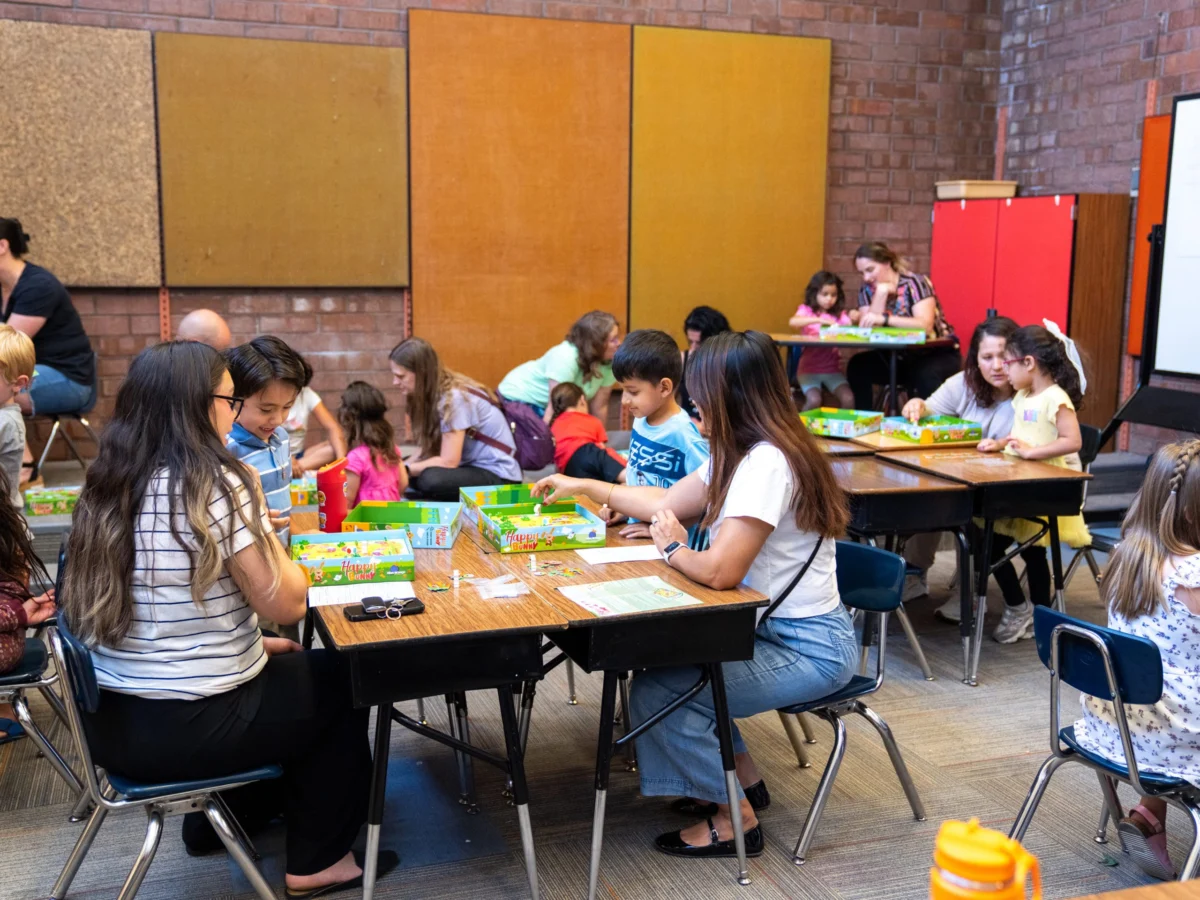
TAYLORSVILLE, Utah — In an elementary school classroom, the air hummed with a mix of nervous energy and curiosity. Fifteen parents sat in child-sized chairs, their young children fidgeting beside them, as Clarence Ames—a man who describes himself as an “early math evangelist”—posed a question that resonated with the collective experience of the room: “Has anybody here ever heard or said, ‘I’m not a math person?’”
Almost every hand in the room shot up.
Ames, who leads research and implementation for the Utah STEM Action Center, is intimately familiar with this reaction. In his outreach to parents of preschoolers across the state, he frequently encounters the "deer-in-the-headlights" look when he suggests that math, like reading, belongs in the home long before kindergarten begins. He views these moments not as obstacles, but as openings to heal "math trauma"—a pervasive cultural anxiety that convinces parents they are unqualified to guide their children’s early numerical development.
The Mission: Redefining Early Math
The initiative bringing these parents to Plymouth Elementary is known as MILO & Friends (Math Introduction and Learning Opportunities). It represents a critical, under-funded, and often overlooked frontier in American education: the bridge between the home and the classroom. While early literacy programs—like reading bedtime stories—are firmly entrenched in modern parenting culture, early math remains a "neglected sibling."
The premise of MILO & Friends is deceptively simple: empower parents to be their child’s first math teacher. By removing the stigma of mathematical inadequacy, the program aims to turn grocery store trips, laundry folding, and board games into laboratories for cognitive development.
A Chronology of a Grassroots Movement
The origins of the program date back five years, when Ames began researching ways to replicate the success of early literacy campaigns. Recognizing that Utah lacked the budget for a massive public relations blitz, he pivoted to an in-person, community-centric model.
- 2021: Ames partnered with the Utah Education Policy Center at the University of Utah to translate high-level academic research into actionable, low-pressure parental strategies.
- September 2022: MILO & Friends officially launched. The program focused on identifying tools—specifically board games—that could bridge the gap between complex mathematical concepts and preschool play.
- 2023–2025: Through a partnership with the Granite School District, the program scaled its engagement nights, moving into community centers and elementary schools to reach families directly.
- Present Day: The initiative is now looking toward empirical validation, planning a partnership with local pediatricians to track the kindergarten entry scores of children who have been exposed to MILO materials.
The Data: A National Crisis in Proficiency
The urgency behind these efforts is underscored by sobering national statistics. In September 2025, the board governing the National Assessment of Educational Progress (NAEP)—the "Nation’s Report Card"—released data showing a widening chasm in math achievement.
The gap between the highest- and lowest-performing students in 12th-grade math is currently at its widest point since at least 2005. More alarmingly, average scores across fourth, eighth, and 12th grades in 2024 fell below 2019 levels. Perhaps most concerning for the future workforce is that only 33 percent of 12th graders were deemed academically prepared for entry-level college math in 2024, a decline from 37 percent just five years prior.

Deborah Stipek, a professor emerita at Stanford University and a pioneer in early math research, argues that this decline is a systemic failure to intervene early enough. "For anyone who’s serious about trying to reduce the achievement gap, it’s very clear that you need to start before children enter school," Stipek explains. Research consistently shows that by the time children enter kindergarten, students from low-income families and minority backgrounds are disproportionately represented among those with lower math skills, creating a disadvantage that often persists for a lifetime.
The Mechanics of Play: How "Happy Bunny" Works
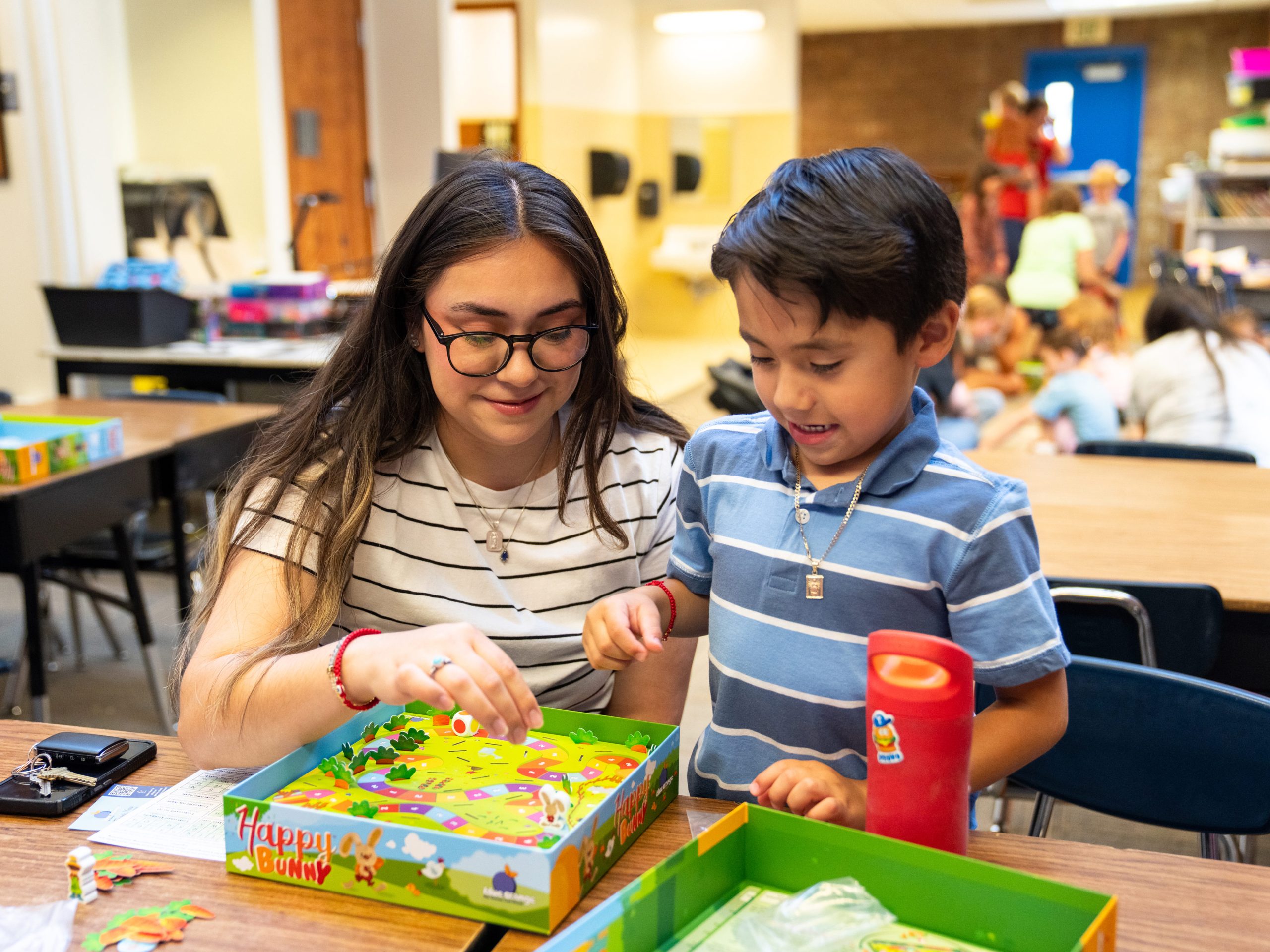
To combat these trends, MILO & Friends focuses on tools that turn abstract math into tangible fun. After reviewing hundreds of games, the team settled on Happy Bunny. On the surface, it is a simple game of bunnies and farmers. In practice, it is a masterclass in foundational mathematical pedagogy.
As parents and children played during the session at Plymouth Elementary, the math was happening in real-time:
- Abstraction: Matching the color on a die to a colored square on the board.
- Sequencing: Understanding the order of movement along the path.
- Symbolic Recognition: Identifying numbers on the squares and correlating them to the number of carrots pulled.
- Cardinality: The critical skill of connecting the act of counting to the total size of a set.
- Set Differentiation: Categorizing carrots by whether they have a "bite" out of them, teaching children to handle distinct subsets.
Katie Bearnson, who attended the event with her sons, Bentley (5) and Bradley (6), reflected on the experience. "We’ve definitely leaned more toward reading than math because reading is easy," she admitted. "Math, you have to put a little bit of thought into it to ask questions." After just one session, her perspective shifted, and she walked away with a set of laminated "math talk" cards designed to help her facilitate these conversations at home.

Official Responses and Participant Impact
The impact of the MILO program is already being felt on a personal level. Emilia Perez, once a parent participant, now serves as a family liaison for the school district. Three years ago, she felt exactly like the parents she now supports—someone who "wasn’t a math person."
After learning to incorporate math into daily life, her daughter Emily, now in first grade, is operating at an advanced level, having already mastered multiplication and division. "If I’d had this material for my older kids, just even known about it, it would have helped a lot," Perez said.
Formal studies support these anecdotal successes. A 2025 evaluation by the Utah Education Policy Center found that participants in MILO & Friends events reported a significant boost in confidence, particularly among Spanish-speaking families and those with lower levels of formal education. Similarly, the California-based PBS SoCal Family Math initiative—the largest of its kind in the nation—has seen its model replicated in 12 states, with evaluations confirming that workshops increase parental knowledge of foundational math skills.
The Broader Implications: Democracy and Critical Thought
While standardized test scores are the primary metric for school administrators, the proponents of early math outreach view the goal through a wider lens. For Madeleine Clark, the coordinator of services for the family engagement program, the work is about strengthening the emotional bond between parent and child.

"If a child’s bored and they’re not getting that connection, that eye contact, and that conversation from their parent, they usually melt down," Clark noted. "The math is the vehicle, but the connection is the result."
For Clarence Ames, the mission is even more existential. He views the development of mathematical reasoning not just as a career advantage for children, but as a pillar of a functional society. "I care about living in a free society," Ames said, reflecting on his "evangelical" approach to the subject. "Selfishly, I want everyone to have these skills because I want to live in a democracy where citizens can think critically."
As the event concluded, parents packed up their copies of Happy Bunny and their laminated math keys, stepping out into the late afternoon sun. They were leaving not just with a board game, but with a new toolkit for navigating the world with their children.
The strategy is a quiet one, devoid of the high-stakes testing pressures or the contentious debates that often dominate the educational landscape. Instead, it relies on a simple, ancient truth: that the most powerful classroom in the world is the one where a parent and a child sit down together, curious about the world, one carrot—or one count—at a time.
