

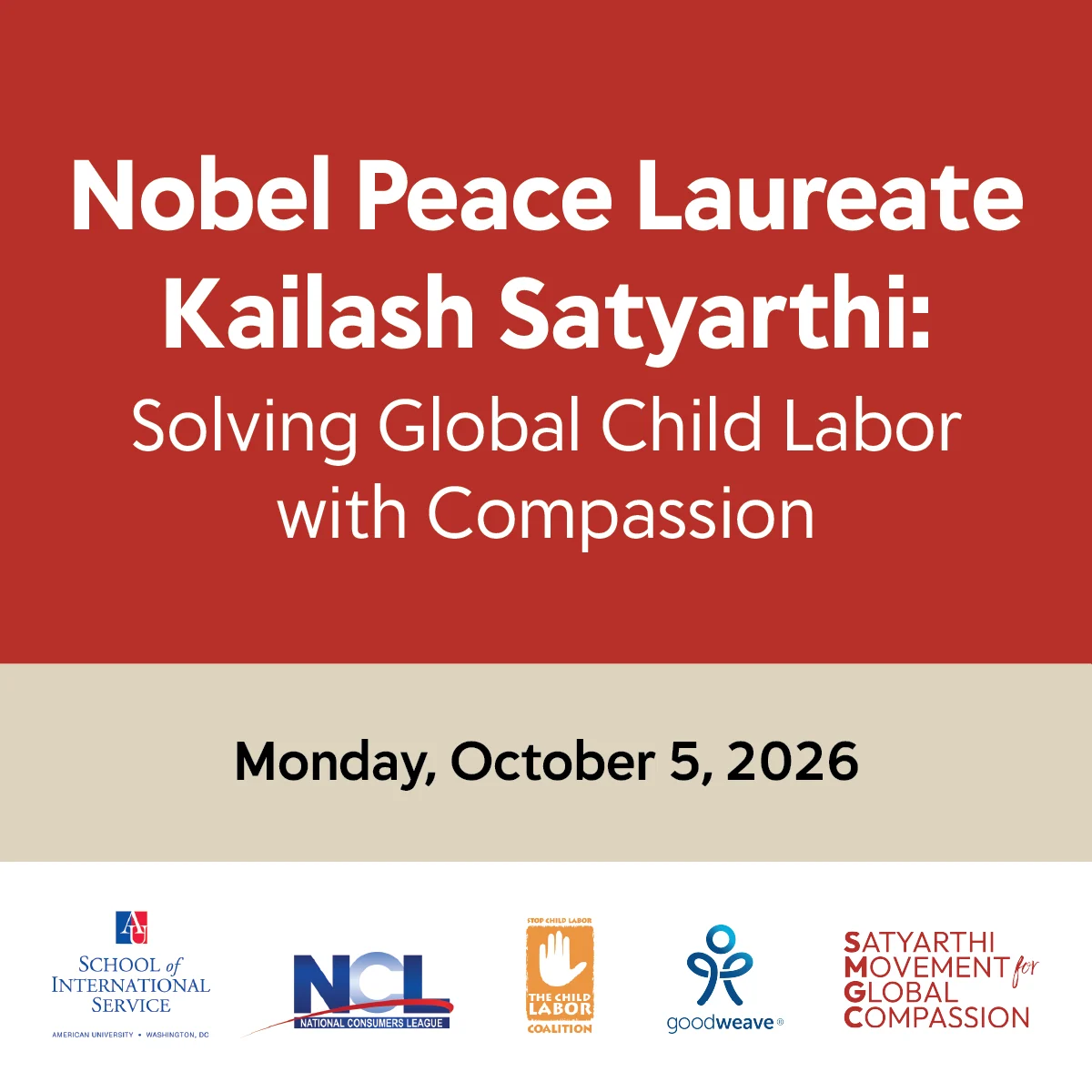
WASHINGTON, DC — As the international community grapples with the persistent and evolving nature of child exploitation, a high-profile assembly of activists, academics, and policymakers is set to take place at American University’s School of International Service (SIS). On Monday, October 5, 2026, the National Consumers League’s (NCL) Child Labor Coalition (CLC) will host "Solving Global Child Labor with Compassion," a public forum centered on the urgent need for systemic change and humanitarian intervention in the fight against child labor.
The keynote address will be delivered by Nobel Peace Laureate Kailash Satyarthi, a legendary figure in the global movement to end child slavery. His presence marks a significant moment for the CLC, which has spent decades coordinating a 38-organization network dedicated to protecting minors from hazardous labor conditions.
Main Facts: The Call to Action
The event, which runs from 2:30 p.m. to 4:00 p.m. at the Abramson Family Founders Room, is designed to move beyond traditional academic discourse and into the realm of actionable, compassion-driven policy. The primary objective is to evaluate how governments, the private sector, and individual consumers can harmonize their efforts to eradicate exploitative labor practices.
"The persistence of child labor is not merely an economic issue; it is a moral failure that demands a global response rooted in empathy and rigorous accountability," noted organizers ahead of the event.
The program will feature a robust agenda:
- Opening Remarks: Delivered by Rachel Sullivan Robinson, Interim Dean of the School of International Service, and Sally Greenberg, Co-Chair of the Child Labor Coalition.
- Keynote: A vision for global change from Kailash Satyarthi.
- Expert Panel: A moderated discussion led by Judy Gearhart, Research Professor at the Accountability Research Center at SIS, featuring Tim Ryan, Chairman of the Global March Against Child Labor, and Jon Jacoby, CEO of GoodWeave International.
Chronology: A History of Advocacy
To understand the significance of this gathering, one must look back at the trajectory of the movement. Kailash Satyarthi’s work began in the early 1980s with the founding of Bachpan Bachao Andolan (Save the Childhood Movement) in India. His lifelong dedication to rescuing children from sweatshops and brick kilns culminated in the 2014 Nobel Peace Prize, which he shared with Malala Yousafzai.
The National Consumers League has mirrored this trajectory. Founded in 1899, the NCL has been the tip of the spear in American labor rights, famously fighting for the abolition of child labor during the Industrial Revolution. By forming the Child Labor Coalition, the NCL institutionalized this fight, creating a collaborative platform that bridges the gap between labor unions, human rights NGOs, and consumer advocacy groups.
The upcoming October 5 summit is not an isolated event but a continuation of a decades-long partnership. Satyarthi has collaborated with the CLC on multiple legislative and awareness campaigns, and this event serves as a strategic checkpoint in an era where global supply chains are increasingly complex and difficult to police.
Supporting Data: The Scope of the Crisis
The challenge facing the panelists is immense. According to the latest estimates from the International Labour Organization (ILO) and UNICEF, hundreds of millions of children remain trapped in child labor. While progress was made in the early 2000s, recent global instability—including the lingering economic impacts of the pandemic, climate-driven migration, and regional conflicts—has threatened to reverse these gains.
Key Data Points to be Addressed:
- The Sectoral Breakdown: The majority of child labor occurs in the agricultural sector, followed by manufacturing and services. The panel is expected to address how "compassion" must translate into supply chain transparency in these specific industries.
- The Gender Gap: Studies consistently show that girls are more likely to be engaged in domestic work and unpaid household labor, which often goes uncounted in traditional labor statistics.
- The Role of Consumerism: Research from the Accountability Research Center (ARC) suggests that while consumer awareness is at an all-time high, the gap between "ethical intent" and "purchase behavior" remains a hurdle. The panel will examine how consumers can exert pressure on multinational corporations to go beyond voluntary corporate social responsibility (CSR) initiatives.
Official Responses and Strategic Perspectives
The diversity of the speaker lineup reflects the multidimensional approach required to solve this crisis.
Kailash Satyarthi has long argued that child labor is a symptom of a larger, broken system that prioritizes profit over human dignity. His "Global Compassion" framework suggests that we must stop viewing children as "assets" in a supply chain and start viewing them as subjects with inalienable rights.
Judy Gearhart, acting as moderator, brings the perspective of the Accountability Research Center. Her work focuses on how institutions—both public and private—can be held to account. "The challenge is no longer just about awareness; it is about the mechanics of enforcement," a spokesperson for the event stated. "We have the data; now we need the political and corporate will to implement change."
Jon Jacoby of GoodWeave International represents the practical, "boots-on-the-ground" approach. GoodWeave is famous for its certification process, which provides assurance to consumers that the carpets and textiles they purchase were not made by children. His insights will likely center on the scalability of these certification programs.
Tim Ryan of the Global March Against Child Labor brings the voice of the international movement. His organization operates in over 90 countries, focusing on the intersection of education and labor. He is expected to emphasize that removing a child from a workplace is only the first step; the second, and arguably more difficult, step is ensuring they have access to quality education.
Implications: The Path Forward
The symposium at American University serves a critical function: it bridges the gap between the classroom and the field. For students at the School of International Service, this is a masterclass in diplomacy and human rights advocacy. For the public, it is an opportunity to engage directly with the architects of international labor policy.
The "Compassion" Paradigm
The title "Solving Global Child Labor with Compassion" is intentional. In the context of the event, "compassion" is not an abstract emotion; it is defined as a proactive, policy-driven commitment to the most vulnerable. This implies:
- Legislative Advocacy: Strengthening laws like the U.S. Tariff Act of 1930, which prohibits the import of goods made with forced labor.
- Corporate Accountability: Requiring companies to perform rigorous due diligence on their global supply chains.
- Community Empowerment: Supporting the families of child laborers so that the economic incentive to send children to work is eliminated.
As the event approaches, the atmosphere in Washington is one of cautious optimism. The presence of a Nobel Laureate provides the necessary gravitas to command attention, while the inclusion of academic researchers ensures that the conversation remains grounded in empirical evidence.
How to Participate
The event is free and open to the public, though registration is mandatory due to expected high attendance. Organizers are encouraging students, policy analysts, NGO staff, and concerned citizens to register via the official Eventbrite portal.
The session will conclude with a Q&A period, offering a rare opportunity for attendees to pose questions to the panel regarding the future of the movement. For those unable to attend in person, the NCL and American University are expected to release key takeaways and potential video highlights following the event.
Conclusion
The upcoming forum at American University is a vital reminder that the fight against child labor is far from over. By bringing together the intellectual rigor of academia with the street-level experience of global activists, the Child Labor Coalition is setting the stage for a new era of advocacy. Whether this will lead to a tangible shift in global trade practices remains to be seen, but the event stands as a clear statement: the international community is not turning a blind eye to the millions of children currently denied their childhood.
For further information regarding the event, interested parties may reach out to Lisa McDonald, Vice President of Communications at the National Consumers League, at [email protected].
About the Child Labor Coalition:
Co-chaired by the National Consumers League and the American Federation of Teachers, the CLC serves as the primary national network of organizations dedicated to the abolition of child labor. Through education, advocacy, and collaborative action, the coalition strives to ensure that every child, regardless of geography, has the opportunity to pursue an education and live a life free from exploitation.
