

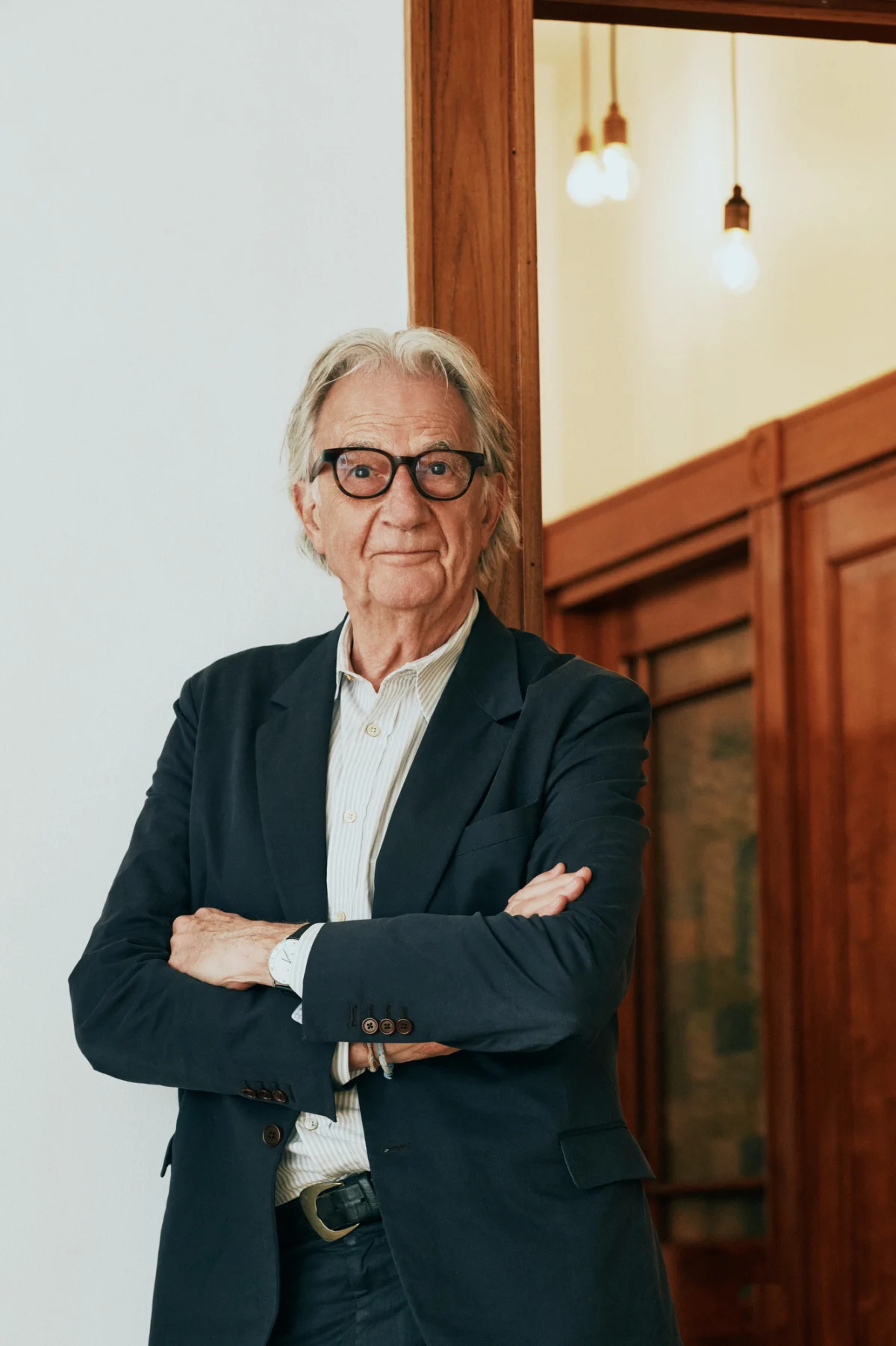
LONDON — On any given Saturday, if you wander into the Paul Smith flagship store on Albemarle Street in Mayfair, you might encounter an unassuming, lanky man with floppy hair and a quick wit helping customers find the perfect pair of socks. This is not a dedicated floor manager, but Sir Paul Smith himself. Despite being the head of a global fashion empire and a Knight of the Realm, Smith remains tethered to the retail floor, the very place where his journey began more than half a century ago.
It was during one of these Saturday shifts that Smith encountered a customer who perfectly encapsulated the eccentric charm of his brand. "A lady came to the store as a rabbit. She was as we are now, just chatting," Smith recalls. Rather than recoiling at the surreal sight, Smith leaned into the whimsy. "I said, ‘Can I help you? Do you need a new tail or anything?’"
This anecdote is more than just a charming story; it is a window into the soul of a man who has spent 56 years blending high fashion with a sense of childlike wonder. As he celebrates his 80th birthday and the release of his new memoir, Threads: My Life in Style, Smith remains a singular figure in an industry increasingly dominated by corporate conglomerates and data-driven trends.
Main Facts: The "Head of Happiness" and the Curiosity Shop
At 80 years old, Paul Smith defies the traditional image of an "old codger," a term he jokingly applies to himself. With a physique toned by regular Pilates and swimming, and a mind that remains as sharp as his tailoring, Smith continues to lead his company with a "tank of whimsy." Within the Japanese branch of his business—where he enjoys a cult-like following—he is affectionately known as the "Head of Happiness."
The center of his creative universe is his office in Covent Garden, a space that more closely resembles a museum of the bizarre than a corporate headquarters. Over the decades, anonymous admirers and friends have sent him a staggering array of gifts: a 20-foot-long yellow pencil, hand-carved fish, vintage bicycles, and even the crinkly wrappers used to pack fresh fruit. These objects are not merely clutter; they are the fuel for his "lateral thinking," a concept he credits for much of his success.
In September, this creative chaos was brought to the public in a grand scale. Smith recreated his overstuffed office at the Selfridges Corner Shop in London. The installation featured 400 cycling jerseys, a customized Paul Smith Mini, hundreds of rare books, vintage televisions, and cameras. The display served as a physical manifesto of his design philosophy: that inspiration can—and should—be found in everything.
A Chronology of Style: From a 12×12 Shop to Global Dominance
Paul Smith’s ascent to the pinnacle of British fashion was neither traditional nor guaranteed. His story is one of resilience, starting from a humble beginning in Nottingham.
The Formative Years (1960s – 1970s)
Smith left school at the age of 15 with no qualifications and undiagnosed dyslexia. His initial passion was not fashion, but competitive cycling. However, a serious accident at 17 ended his athletic dreams and landed him in the hospital for six months. It was during his recovery that he befriended students from the local art college, opening his eyes to the worlds of Warhol, Mondrian, and David Hockney.
In the late 1960s, Smith met Pauline Denyer, a Royal College of Art-trained designer. Denyer became his mentor, his moral support, and eventually his wife. In 1970, with £600 in savings, Smith opened his first shop in Nottingham. It was a windowless space measuring just 12 feet by 12 feet, open only on Fridays and Saturdays. The "manager" of the shop was the couple’s Afghan hound, Homer.
The Tailoring Revolution (1970s – 1980s)
By the mid-1970s, Smith began to challenge the rigidity of British menswear. Working in an era where the suit was a stiff, somber uniform, Smith sought to "loosen" the silhouette. In a parallel trajectory to Italy’s Giorgio Armani, Smith dropped the lapels, softened the shoulders, and introduced roomier cuts that allowed for movement.
His signature "classic with a twist" aesthetic was born during this period. He took traditional British checks and infused them with unexpected colors like lavender and lemon—shades previously reserved for womenswear. He added wacky polka-dot prints to boxer shorts and wonky stripes to socks, proving that men’s fashion could be both sophisticated and humorous.
Global Expansion and Recognition (1990s – Present)
The 1980s and 90s saw the brand explode internationally, particularly in Japan, where the Paul Smith aesthetic resonated deeply with the local appreciation for craftsmanship and subtle eccentricity. His partnership with Itochu Corp. solidified his presence in Asia, making him one of the most successful Western designers in the region.
In 2000, he was knighted by Queen Elizabeth II for his services to the British fashion industry. Two decades later, he was appointed a Companion of Honour, an elite distinction limited to only 65 living members, placing him alongside cultural titans like Judi Dench and Kazuo Ishiguro.
Supporting Data: The Independent Powerhouse
In an industry where most major labels have been swallowed by giants like LVMH or Kering, Paul Smith remains a rare breed: an independent designer who still owns the majority of his company.
- Financial Standing: According to The Sunday Times of London, Smith’s net worth is estimated to be in excess of £240 million.
- Retail Presence: Beyond the clothes, Smith has built a formidable retail property portfolio, owning several of the landmark buildings that house his shops.
- The Japan Factor: His longtime minority shareholder, Itochu Corp., has been instrumental in his global strategy, allowing him to maintain creative control while scaling massively in the East.
- The Memoir: His new book, Threads: My Life in Style, published by Macmillan, serves as both a biography and a business manual, detailing his interactions with figures ranging from King Charles III to David Bowie.
Official Philosophy: Hard Work and Lateral Thinking
Throughout his memoir and recent interviews, Smith is quick to dispel the myth of the "overnight success" or the "magic wand" of fashion. His philosophy is grounded in a quintessentially British work ethic.
"When people say I was ‘lucky’ in Japan, Pauline always responds that luck equals hard work and a lot of lateral thinking," Smith explains. He is vocal about the fact that his journey did not involve a fancy college degree or family wealth. Instead, it was built on stamina and an insatiable curiosity about the world.
He often speaks to young designers about the realities of the business. "You can do things in a humble way," he says, reflecting on his 12-foot shop. "So many of the young people and fashion students I meet think getting ahead is about networking, becoming well-known and starting your own company. But so many of them eventually close down."
His advice to the next generation is a blend of pragmatism and passion: "You have to get the balance right, make the attention-seeking pieces, do the special projects—and pay the rent."
Implications: The Legacy of the Paul Smith Foundation
As Smith enters his ninth decade, his focus has increasingly shifted toward legacy and the future of the creative industries. He still drives his electric, customized Paul Smith Mini Cooper to his Covent Garden headquarters every day, but he is also looking at how to support those who will follow in his footsteps.
The Paul Smith Foundation was established to provide studio space and business mentoring to emerging fashion creatives. Smith is acutely aware that the barriers to entry in the fashion world are higher now than they were in 1970. Through the foundation, he aims to teach young designers the "unconventional" path to success—one that prioritizes resilience over social media fame.
The implications of Smith’s career are profound for the British fashion landscape. He proved that a brand could remain independent, profitable, and relevant for over 50 years without losing its soul. He redefined the British "gentleman" not as a figure of stiff formality, but as someone who can appreciate a well-cut suit and a silly pun in equal measure.
Conclusion: A New Way to Look at the World
As the interview concludes, Sir Paul Smith demonstrates that his spirit remains as youthful as ever. He places his hands on top of his head, mimicking the ears of the "rabbit lady" who visited his store, and waves a cheerful goodbye.
His life, as chronicled in Threads, is a testament to the idea that success is not just about the destination, but the "friendship, camaraderie, love, and health" found along the way. In a world that often takes itself too seriously, Paul Smith remains the "Head of Happiness," reminding us all that there is always a new, more colorful way to look at the world.
For Smith, the journey continues. Whether he is designing a new collection, swimming his daily laps, or helping a customer in Mayfair find a new "tail," the architect of whimsy shows no signs of slowing down. As he puts it, "I adore coming to work." In the volatile world of fashion, that might be his greatest achievement of all.
