

In the rapidly evolving landscape of global fashion, a significant shift is occurring. Consumers are moving away from the "buy-and-discard" cycle of fast fashion toward a more circular, sustainable model: resale. However, for years, the primary barrier to entry for secondhand shopping was not a lack of interest, but a lack of convenience. While a new dress can be purchased from a retail giant with a single click, finding that same item secondhand often required hours of scouring disparate platforms, deciphering inconsistent seller descriptions, and navigating a fragmented digital landscape.
Enter Beni, a tech-driven resale search engine designed to bridge the gap between desire and discovery. Founded by CEO Kate Sanner, Beni is not merely another marketplace; it is an aggregator that sits atop the existing resale ecosystem. By leveraging artificial intelligence (AI), visual search technology, and a seamless browser integration, Beni is attempting to make "checking secondhand" a default reflex for the modern shopper.
Main Facts: A Unified Search for a Fragmented Market
Beni functions as a digital concierge for the circular economy. The core of its utility lies in its ability to scan over 40 major resale marketplaces—including giants like The RealReal, Poshmark, Vestiaire Collective, and eBay—within seconds. This solves the "multiple tab" problem that has long plagued the secondhand enthusiast.
The platform’s feature set is built around three primary modes of discovery:
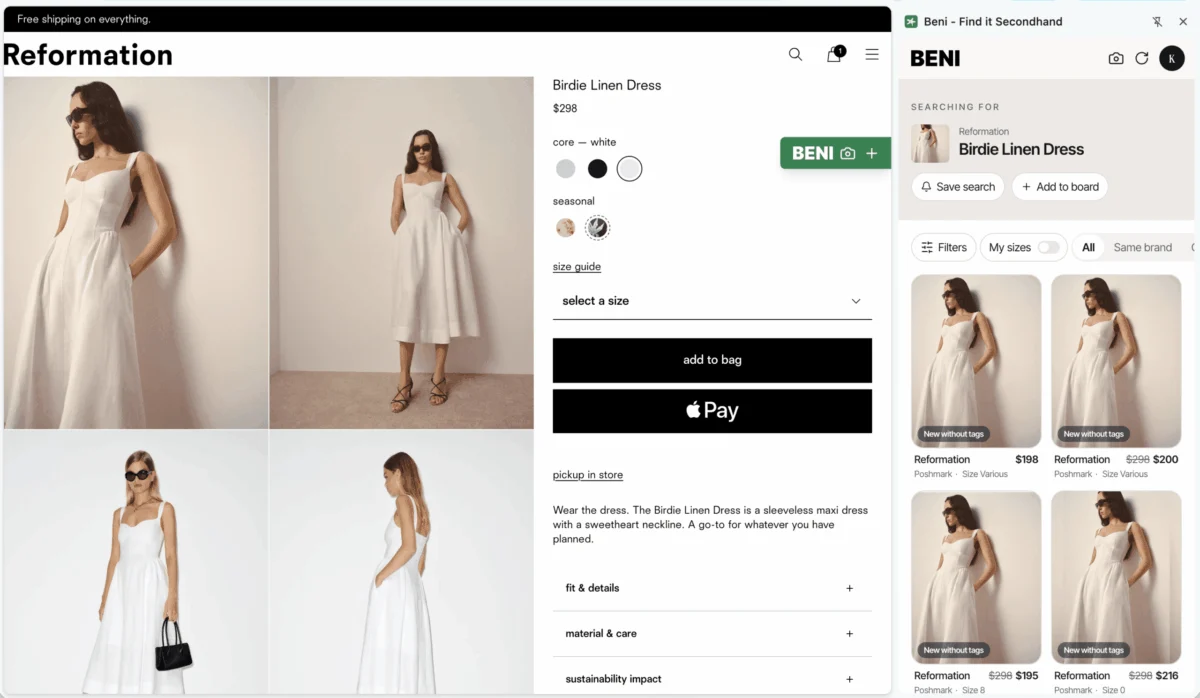
- The Browser Extension: When a user views a new item on a traditional retail site (such as Nordstrom or Patagonia), the Beni extension automatically pops up to show identical or similar items available for less on resale sites.
- Beni Lens: A visual search tool that allows users to upload a photo or a screenshot—perhaps of a celebrity outfit or a street-style look—and find the closest matches across the secondhand market.
- Social Discovery: The app allows users to curate "shops" of their favorite finds and follow other curators, turning the solitary act of searching into a social experience.
By focusing on the "discovery" phase of shopping rather than the "transaction" phase, Beni addresses the psychological friction of resale: the fear of the hunt being too difficult.
Chronology: From Thrift Stores to AI-Driven Aggregation
To understand Beni’s place in the market, one must look at the evolution of the resale industry.
- The Pre-Digital Era: Resale was localized in physical thrift stores and consignment shops. Discovery was limited by geography and the "luck of the draw."
- The eBay and Craigslist Era (Late 90s – 2000s): The first wave of digitization allowed for peer-to-peer selling, but the lack of curation and the prevalence of counterfeit goods made it a high-risk, high-effort endeavor.
- The Specialized Marketplace Era (2010s): Platforms like Poshmark, Depop, and The RealReal emerged, offering better user interfaces, authentication services, and niche communities. However, this led to extreme fragmentation. A shopper looking for a specific vintage Burberry trench coat might have to check five different apps to find the best price and condition.
- The Aggregation Era (Present): This is where Beni enters the timeline. As the number of resale platforms grew, the market became oversaturated for the average consumer. Beni represents the current stage of the industry: the consolidation of data to provide a "Google-like" experience for the circular economy.
Kate Sanner’s "aha" moment came from recognizing that while the inventory existed, the infrastructure to find it was antiquated. Her background in consumer marketing led her to realize that sustainability would only become mainstream if it became the path of least resistance.
Supporting Data: The Economic and Environmental Case for Resale
The rise of platforms like Beni is supported by staggering industry growth. According to the 2024 ThredUp Resale Report, the global secondhand apparel market is expected to reach $350 billion by 2028, growing three times faster than the overall apparel market.
Several factors drive this growth:
- The Value Gap: Consumers are increasingly price-sensitive. Beni’s data suggests that shoppers can often find high-end luxury goods or high-quality heritage brands at 40% to 80% off retail prices.
- Quality vs. Quantity: There is a growing "anti-fast-fashion" sentiment among Gen Z and Millennial shoppers. These demographics are prioritizing "cost-per-wear" and seeking out better-constructed vintage pieces that hold their value.
- The Search Burden: Market research indicates that "ease of use" is the number one factor that prevents occasional secondhand shoppers from becoming frequent ones. By indexing over 40 marketplaces, Beni effectively multiplies the search efficiency of a human user by forty-fold.
Furthermore, the environmental impact is profound. The fashion industry is responsible for approximately 10% of global carbon emissions. Extending the life of a garment by just nine months can reduce its carbon, waste, and water footprints by 20–30%. Beni facilitates this by ensuring that existing garments find new homes rather than ending up in landfills.
Official Responses: Insights from CEO Kate Sanner
In an exclusive dialogue with Sourcing Journal, Kate Sanner elaborated on the philosophy behind Beni’s technological architecture and the company’s long-term mission.

"The insight behind Beni was that people were being asked to work too hard to shop secondhand," Sanner explained. "You could find something you loved on a retail site in seconds, but finding it resale meant opening multiple tabs, trying different keywords, and sorting through hundreds of listings."
Sanner emphasized that Beni is designed to work "behind the scenes" to solve the inconsistency of human-generated data. "Resale listings aren’t consistent. Two sellers might describe the same jacket completely differently. Visual search helps bridge that gap—you can show us what you mean without knowing exactly what to call it."
When asked about the core value proposition, Sanner was clear: it’s about access and empowerment. "Often, that means being able to afford a better-made piece secondhand than you could ever buy new. We want people to use Beni because it’s useful and because they love what they find. Saving money, expressing your style, and shopping secondhand can all be part of the same decision."
Looking toward the future, Sanner sees Beni evolving from a search tool into a holistic style companion. "Shopping and buying are two different things," she noted. "Shopping is figuring out what you like: exploring, collecting inspiration, learning about quality. Buying is executing once you know what you want. We want to give people space for that first part, then make the second part easier."
Implications: The Future of Retail and Social Commerce
The success of Beni signals a broader shift in how the retail industry must operate. As aggregation tools become more sophisticated, traditional retailers may find themselves in direct competition with their own past collections.
1. The "Resale-First" Mentality
As Beni makes it easier to "check Beni before you check out," the primary retail market may see a shift in consumer behavior where "new" is no longer the default. This forces brands to focus on durability; if a brand’s clothes don’t have a high resale value, they may lose appeal to the savvy, Beni-using consumer who views clothing as an asset.
2. AI as the Great Equalizer
The use of visual search (Beni Lens) levels the playing field for consumers who lack fashion-industry vocabulary. You don’t need to know that a specific sleeve is a "mutton sleeve" or that a fabric is "bouclé"; the AI understands the visual data and finds the match. This democratizes high fashion and vintage discovery.
3. The Pinterest-ification of Shopping
Beni’s move into social curation and "shops" suggests that the future of commerce is increasingly social. By allowing users to follow curators, Beni is tapping into the "influencer" economy, but with a sustainable twist. Instead of influencers pushing new fast-fashion "hauls," they are now curating the best of what already exists in the world.
4. Integration with Traditional Retail
We are likely to see more "co-opetition" between tech platforms like Beni and traditional retailers. Some brands are already launching their own resale sites (e.g., Patagonia’s Worn Wear). Beni’s ability to pull this inventory into a central hub makes these individual brand efforts more viable by giving them much-needed visibility.
Conclusion
Beni is more than just an app; it is a vital piece of infrastructure for the circular economy. By removing the "work" from secondhand shopping, Kate Sanner and her team are proving that sustainability does not have to be a sacrifice. As AI continues to improve the accuracy of visual and cross-platform search, the barriers between "new" and "pre-loved" will continue to dissolve. In the world Beni is building, the best way to shop for the future is to look at what we have already created.
