

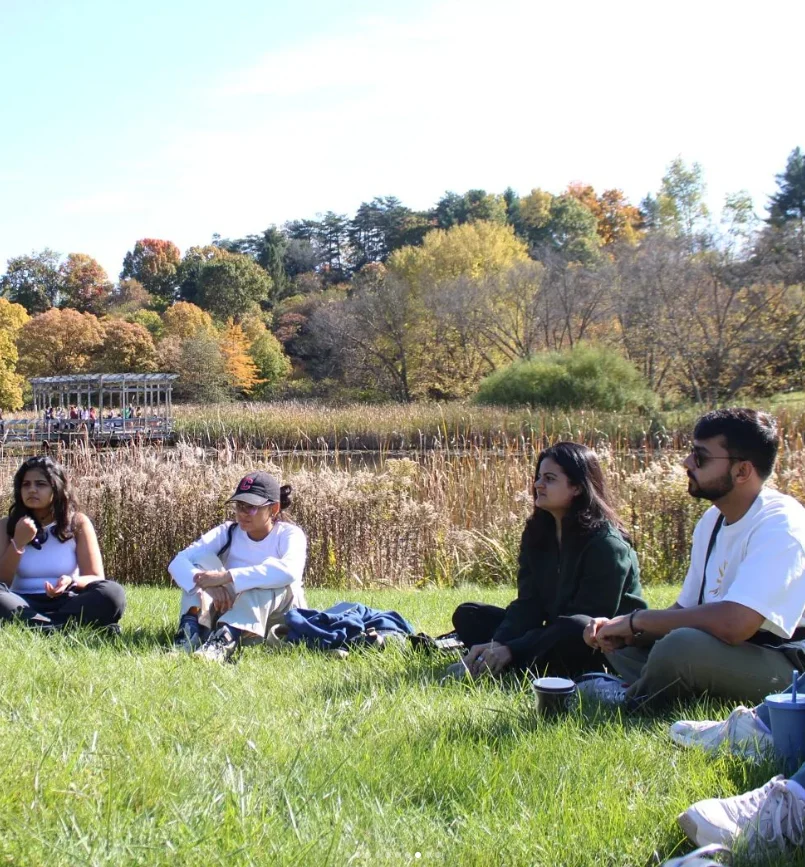
In 1984, Don Rakow was a graduate student at Cornell University, navigating the profound academic pressures and personal anxieties that often define the collegiate experience. During his most difficult moments, he found a recurring refuge: the campus gardens. “They were my sanctuaries—those gardens were essential for me to maintain balance and to survive,” he recalls.
Decades later, that personal discovery became a professional mission. As a plant science professor at Cornell, Rakow began witnessing the same struggle in his own students—a growing mental health crisis that traditional counseling services were increasingly unable to contain. He wondered: What if the campus itself could be a source of medicine?
That question birthed NatureRx, one of the nation’s first programs designed to formally integrate the natural environment into student health care. Today, the movement has expanded far beyond Cornell. From nature walks in New York to arts-based interventions at Stanford and basketball programs in urban centers, American higher education is undergoing a quiet revolution known as "social prescribing."
The Genesis of a Movement: From Personal Sanctuary to Campus Policy
The philosophy behind NatureRx is simple yet scientifically grounded: nature is not merely a leisure activity; it is a physiological intervention. By collaborating with Cornell Health, Rakow helped create a system where physicians and counselors can embed "referrals" for nature activities directly into a student’s electronic health record.
These are not vague suggestions to "get some fresh air." They are structured, measurable components of a student’s care plan. Dr. Jonathan Keffer, a physician at Cornell Health, often frames these prescriptions in clinical terms. “This is actually physiologically proven medical treatment,” Keffer explains. By referencing the vagal tone and the body’s parasympathetic nervous system, he helps students understand that spending time in nature is a biological mechanism to lower cortisol levels and combat the sympathetic nervous system’s "fight or flight" response.
The program at Cornell, now co-directed by Rakow and Professor Dorothy Ibes of the College of William & Mary through the Campus Nature Rx Network, has grown significantly. With support from the REI Cooperative Action Fund, the network now includes approximately 120 colleges and universities, all seeking to build their own bespoke models of nature-based support.
A Chronology of Crisis and Response
To understand why this shift is occurring, one must look at the historical trajectory of student mental health. For much of the 20th century, colleges viewed emotional support as a peripheral service. It was not until 1910 that Princeton University famously hired a psychiatrist after realizing that emotional distress was a leading cause of student attrition.
It took another four decades for campus counseling to become a standard institutional fixture, and another six decades for the demand for those services to reach a breaking point. Between 2009 and 2015, the utilization of counseling centers outpaced student enrollment growth by a significant margin. A massive study of 350,000 students across 373 campuses conducted between 2013 and 2021 revealed a staggering 135% increase in depression and a 110% increase in anxiety.

Faced with these statistics, universities found themselves in a bind: they could not simply hire enough counselors to meet the rising tide of demand. The expansion of programs like NatureRx in the early 2010s at Cornell was a direct response to a series of student tragedies and the subsequent realization that the "clinical-only" model of mental health was insufficient.
The Evidence Base: Why Social Prescribing Works
Social prescribing, which originated in the United Kingdom in the 1980s, posits that health is determined by more than just biology; it is influenced by social connection, environment, and movement. By referring patients to community-based activities—whether that be a nature walk, a pottery class, or a team sport—practitioners are addressing the root causes of isolation and stress.
The data supports this holistic approach. A Cornell-led study co-authored by Rakow found that mental health benefits can manifest after as little as 10 minutes outdoors. These benefits include reduced blood pressure, improved mood, and enhanced focus. For students, this is not just about feeling better; it is about functioning better.
Dr. Kent Bullis, another physician at Cornell Health, notes that he often sees students presenting with physical symptoms—insomnia, fatigue, and muscle tension—that are deeply rooted in mental strain. By offering a "prescription" for nature, he is able to bypass the stigma sometimes associated with seeking psychological counseling while addressing the physiological underpinnings of the student’s distress.
The "Paradox of Choice" and the Barrier of Time
One might ask: Why do students at large, activity-rich universities need a referral to have fun or go outside? Lindsey Mortenson, a clinical assistant professor of psychiatry and chief mental health officer at the University of Michigan, faced this exact question.
“We started from a place of concern and curiosity about students’ loneliness and disconnection,” Mortenson explains. "The problem that we have at Michigan is definitely not lack of opportunity—there’s no shortage of arts events almost every day on campus."
When the university surveyed 1,400 students to understand why they weren’t engaging, the results were revealing. The primary barrier was not a lack of interest, but a lack of time and a paralyzing sense of social anxiety. Many students felt they lacked the social confidence to show up to a club alone.
This realization led Michigan to launch Experience Rx and the Institute for Social Prescribing. The goal is to act as a bridge—a "social prescription" is essentially an invitation and an assist, helping the student take that intimidating first step into a new community or environment.

Institutional Innovations: From Stanford to New York University
The model is evolving differently depending on the campus culture. At Stanford University, the focus is on the arts. Through a partnership with the company SocialRx, students are connected with a "care navigator" who matches their interests with specific "doses" of cultural engagement, such as museum visits or dance workshops. Early data from Stanford is promising: 84% of referred students attended their prescribed activities, and 80% reported a subsequent improvement in their mental health.
Meanwhile, at New York University, the approach is academic and experiential. David Hollander’s course, "How Basketball Can Save the World," treats the sport as a vehicle for community building. Students in the course are tasked with promoting HoopsRx, a program that connects middle school students struggling with isolation to structured basketball programs.
For sophomore Ani Minic, who helped lead the campaign, the project was a bridge between her academic life and her personal history. As an athlete, she has always understood the field as her "happy place." Through these initiatives, universities are validating the idea that what we do outside the classroom is just as vital to our survival as what we do inside of it.
Implications for the Future of Higher Education
The rise of social prescribing signals a fundamental shift in how universities view their responsibility to the "whole student." As the 2024-25 Healthy Minds Study indicates, nearly 40% of college students are reporting moderate to severe depressive symptoms, and loneliness has reached endemic levels.
The implications of this trend are threefold:
- Economic Efficiency: By leveraging non-clinical, community-based resources, universities can alleviate the extreme pressure on overburdened counseling centers, allowing them to focus on students with the most acute clinical needs.
- Destigmatization: Integrating wellness activities into a standard "treatment plan" helps normalize the idea that self-care is a valid medical intervention, encouraging students to seek help earlier in their struggle.
- Holistic Success: As Dr. Keffer notes, these programs are also academic interventions. By reducing procrastination and increasing mental clarity, social prescribing helps students perform better academically, framing wellness as an investment in their success rather than a distraction from their work.
Ultimately, programs like NatureRx and Experience Rx are about reclaiming the campus environment. Whether it is a student like Sofia Mattson leading a walk to Beebe Lake to encourage her peers to "touch grass," or a student finding solace in a game of basketball, these initiatives serve as a reminder that health is not something that happens only in a doctor’s office.
As Don Rakow says, "There seems to be greater awareness that there need to be more tools for addressing student well-being." In a world increasingly defined by screens, stress, and isolation, the most effective medicine may have been in our own backyards all along.
This story was produced in partnership with MindSite News, a national news organization that reports on mental health. Julia Hotz is a 2025-2026 Carter Center Mental Health Fellow.
