

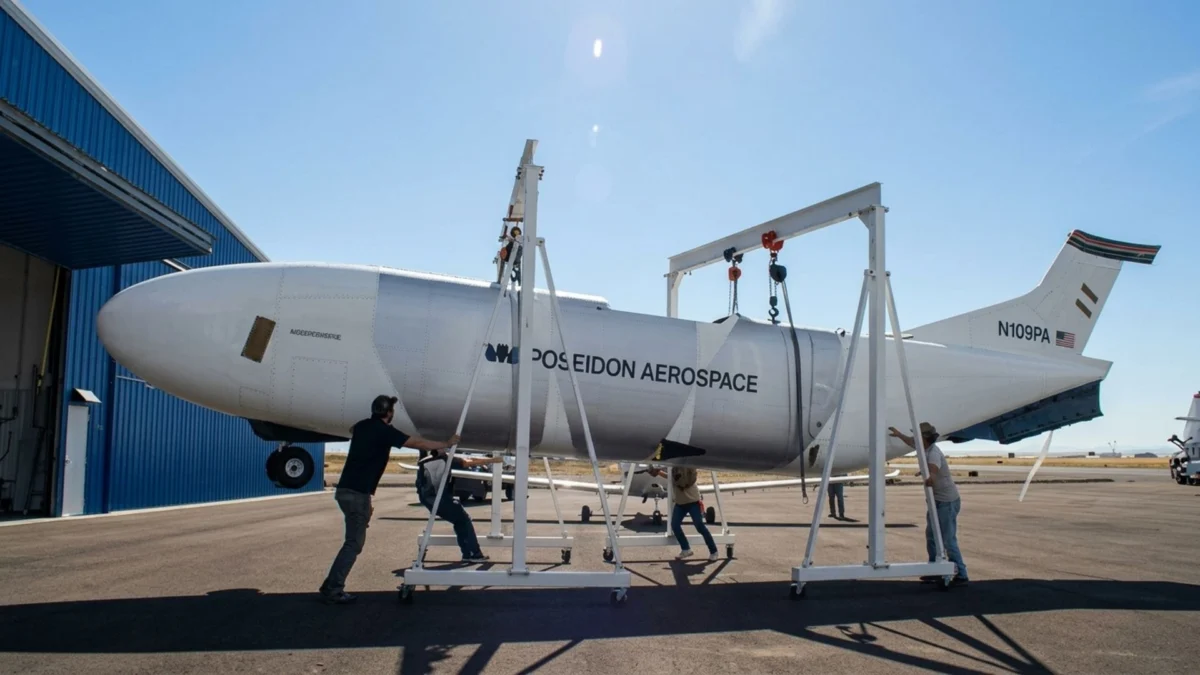
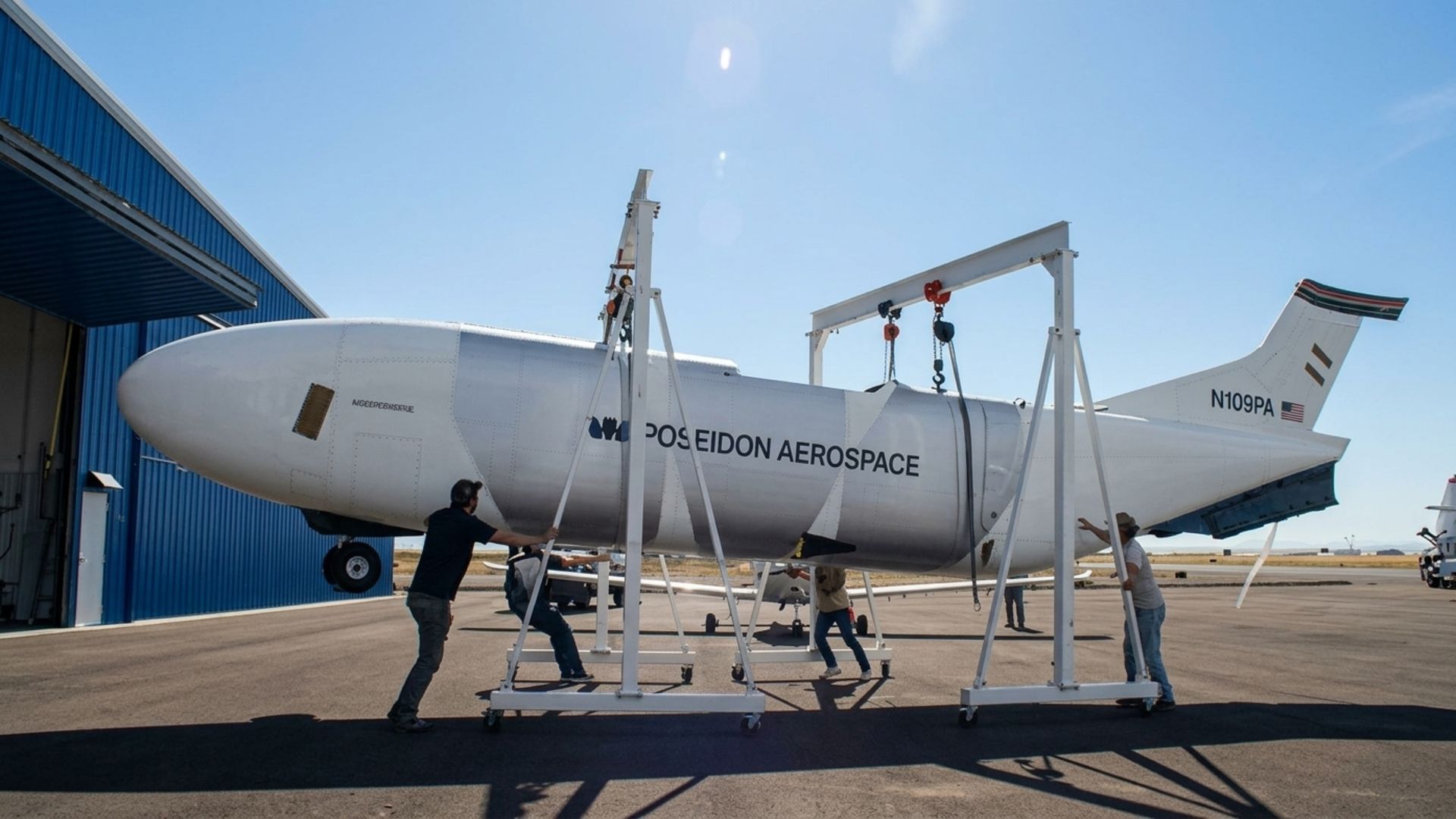
The landscape of global freight is undergoing a seismic, albeit quiet, transformation. While the roar of heavy-lift commercial jets remains a staple of international transit, a new breed of aircraft is preparing to take to the skies—one that entirely abandons the cockpit. Poseidon Aerospace, a rising force in the aviation technology sector, has unveiled its flagship project: Egret, an autonomous cargo drone with a 50-foot wingspan designed to rewrite the economics of logistics.
By stripping away the life-support systems, cockpit ergonomics, and structural reinforcements required for human occupants, Poseidon aims to turn the aircraft into a pure, high-efficiency cargo vessel. With the ability to ferry up to 4,000 pounds of freight, Egret is positioned to become a disruptive "truck of the sky," potentially rendering short-to-medium-range logistics significantly more cost-effective.
The Engineering Philosophy: Efficiency Through Subtraction
At the heart of the Egret project is a radical design philosophy: cargo capacity is paramount. Conventional cargo aircraft are often modifications of passenger airframes or designs that must accommodate a human crew. This introduces significant "dead weight"—flight controls, pressurized cabins, life support, and creature comforts for the pilot—all of which consume fuel and limit payload capacity.
Poseidon’s co-founders, former Amazon logistics engineer David Zagaynov and Lockheed Martin-trained mechanical engineer Parker Tenney, recognized that the most efficient way to move goods is to optimize the airframe exclusively for the payload. "We’re building the autonomous trucks of the sky to be able to move things as cheaply as possible from point A to point B," says Zagaynov.
By eliminating the cockpit, the company has reclaimed critical internal volume and shed hundreds of pounds of unnecessary structural weight. The result is a specialized aircraft that prioritizes volumetric efficiency, allowing operators to maximize the physical space dedicated to freight rather than the equipment required to keep a human pilot safe.
A Chronology of Innovation: From Prototype to Powerhouse
The journey to Egret has been defined by iterative testing and the rapid evolution of autonomous flight technology. Poseidon’s path to a full-scale heavy-lift drone was not a linear trajectory but a series of calculated risks and technological milestones.
The V0 Prototype: Learning Through Failure
The company’s earliest days were marked by the development of the V0 prototype. A testbed for flight control algorithms and structural integrity, V0 served as the "classroom" for Poseidon’s engineering team. The project underwent multiple major redesigns, teaching the team that the challenges of autonomous flight in a heavy-lift context are exponentially more complex than those faced by smaller, consumer-grade drones.
The Seagull and the Pivot to Maritime Utility
Following the lessons of the V0, the company moved into the marine-adjacent sector with the "Seagull." A quarter-scale prototype of their larger "Heron" concept, the Seagull was designed with a lightweight carbon-fiber chassis optimized for water-based takeoffs and landings. This phase of the company’s growth was instrumental in proving the viability of their flight systems to high-stakes stakeholders. The Seagull became a showcase piece, earning the attention of entities including the U.S. Department of the Navy and Special Operations Command. These demonstrations served as vital validation that Poseidon’s technology was not just a theoretical exercise but a robust tool capable of meeting the stringent demands of government and defense agencies.
Supporting Data and The Financial Landscape
The ambition behind Egret is backed by significant capital. Poseidon Aerospace recently secured $60 million in a Series A funding round led by TQ Ventures. This capital infusion is earmarked for the accelerated development and testing of Egret, covering everything from flight control software refinement to the scaling of their manufacturing processes.
While the financial backing is clear, the technical specifications remain a subject of keen industry interest. Currently, Poseidon has remained tight-lipped regarding:
- Operating Range: The maximum distance Egret can traverse on a single sortie.
- Cruising Speed: The efficiency-to-speed ratio of the aircraft.
- Fuel Consumption: The carbon footprint and operational cost-per-mile compared to traditional air-freight and ground trucking.
- Payload Density: The maximum volume versus weight capacity of the cargo bay.
Despite these unknowns, the industry sentiment is one of cautious optimism. The $60 million injection suggests that institutional investors have seen proprietary data confirming the economic viability of the Egret platform, particularly in how it might undercut the costs of traditional "last-mile" or "middle-mile" logistics.
Bridging the Gap: Remote Control vs. Full Autonomy
One of the most persistent misconceptions regarding Egret is that it operates as a "black box" system with zero human intervention. In reality, Poseidon has developed a sophisticated remote command-and-control infrastructure.
During the initial testing phases, which are slated to take place in the expansive, sparsely populated airspaces of Oregon, Egret will function as a "remotely piloted" vehicle. A ground-based operator will maintain a constant, high-latency link to the aircraft, monitoring live camera feeds and manipulating physical flight controls for throttle, flaps, and rudder surfaces.
This "human-in-the-loop" approach is a standard regulatory and safety precaution in the aerospace industry. By separating the pilot from the cockpit, Poseidon ensures that human oversight remains the final fail-safe during the critical validation period. This allows the company to gather massive datasets on flight dynamics and system reliability before transitioning to fully autonomous, AI-driven flight paths.
According to Zagaynov, this transition is the end goal: to create a system where human operators act as "mission managers" overseeing a fleet of drones, rather than "pilots" manually guiding individual aircraft.
Strategic Implications for the Future of Logistics
The deployment of Egret and similar heavy-lift drones carries profound implications for the global supply chain.
1. The Death of the "Middle Mile" Bottleneck
Currently, the "middle mile"—the movement of goods from a regional distribution center to a local hub—is often the most expensive and time-consuming part of the supply chain. By utilizing autonomous aircraft that do not require airports with long, paved runways or highly trained pilots, companies could bypass congested road networks and hub-and-spoke infrastructure.
2. Defense and Humanitarian Applications
The interest shown by the Navy and Special Operations Command suggests that Egret’s utility extends well beyond commercial freight. In conflict zones or disaster areas where ground infrastructure is destroyed or inaccessible, an autonomous, 4,000-pound payload capacity aircraft could provide a lifeline for food, medical supplies, and critical equipment without putting human pilots in harm’s way.
3. Regulatory Hurdles and Public Perception
The primary hurdle for Poseidon is not necessarily engineering, but the regulatory environment. The FAA and international aviation authorities are historically conservative regarding autonomous craft in non-segregated airspace. For Egret to succeed commercially, it must demonstrate a level of reliability that surpasses that of manned aircraft, especially concerning collision avoidance, weather resiliency, and cybersecurity.
Conclusion: A New Horizon for Aviation
Poseidon Aerospace is effectively attempting to solve the most difficult equation in aviation: how to increase payload capacity while minimizing the cost and complexity of the flight platform. By stripping away the human element from the cockpit, they are not merely removing a pilot; they are fundamentally rethinking the physics and economics of transport.
As the industry looks toward the upcoming flight tests in Oregon, the stakes are high. If Egret succeeds, it will likely serve as the blueprint for a new generation of unmanned heavy-lift cargo aircraft, potentially transforming the logistics industry into a leaner, faster, and more efficient global network. For now, the world waits to see if Poseidon can take these "autonomous trucks of the sky" from the testing grounds to the clouds, marking a definitive shift in how we move the goods that power our modern world.
