

Introduction: A Canvas of Contradictions
In the waning weeks of October 2026, the heart of Paris became the stage for a profound, albeit short-lived, collision between the ultra-high-net-worth art market and the raw, visceral reality of social upheaval. Inside the historic glass-vaulted canopy of the Grand Palais, the atmosphere was thick with the scent of expensive perfume and aged champagne. Outside, the streets of the French capital were pulsing with the rhythmic anger of thousands of citizens—students, laborers, and pensioners—demanding economic justice and educational reform.
Art Basel Paris, once the quintessential symbol of cultural prestige and financial might, found itself at a historic impasse. The fair, which brought together the world’s most influential gallerists, curators, and collectors, eventually shuttered its doors prematurely as the city’s social fabric strained under the weight of mounting unrest. This report explores the highlights of the exhibition, the juxtaposition of extreme wealth against systemic poverty, and the complex implications of hosting a high-end cultural spectacle during a period of national volatility.

The Chronology of the Fair: From Opulence to Exit
The Opening Days: Champagne and Cubism
The fair opened with the usual fervor. On October 26, 2026, the Grand Palais—a masterwork of 19th-century Beaux-Arts architecture—was flooded with natural light, intended to illuminate the works of masters like Giacometti, de Kooning, and Kusama. Attendees wandered through a maze of booths, where the transactional nature of the art world was masked by the conviviality of the cocktail hour.
One anecdote captured the spirit of the early days: a visitor, remarking on the "looting" of a local wine shop, stood before a cubist masterpiece priced at €950,000. Her companion’s retort—"Not the worst idea"—encapsulated the detached, almost surreal environment within the fair’s perimeter. By the third day, the mezzanine floor, dedicated to rising stars like Yann Stéphane Bisso and Théo Nguyên Phan, provided a glimpse into the future of the market, even as the "real world" outside began to press against the glass walls of the Palais.

The Turning Point: When the Streets Met the Fair
As the week progressed, the dichotomy became impossible to ignore. While collectors debated the merits of a stuffed toy whale by Cosima von Bonin or the "horrifying" cork sculptures of Jeff Koons, the sounds of protest—chants, sirens, and the distant rumble of marching crowds—began to infiltrate the sanctified space of the fair.
The security posture shifted from subtle observation to active containment. The realization that the "bubble" of the art world was permeable became a shared anxiety among the exhibitors. By the weekend, with transit lines paralyzed and the city’s major arteries occupied by demonstrators, the logistical and ethical feasibility of continuing the fair dissolved. Art Basel executives announced the cancellation of the remaining days of the fair on October 30, citing safety concerns and the evolving situation in the streets.

Highlights of the Exhibition: A Curatorial Perspective
Despite the early closure, the fair presented a rigorous survey of contemporary and modern art. The selection reflected a global preoccupation with identity, history, and the human condition.
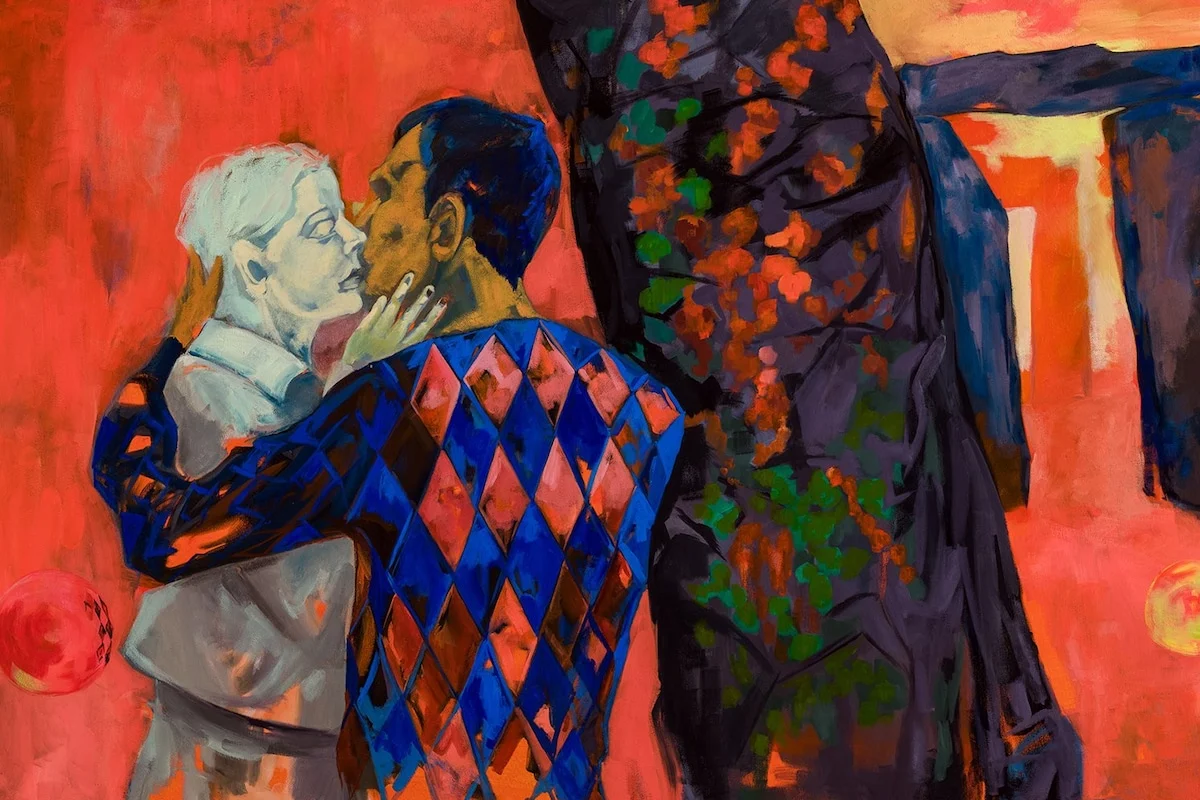
Georgia Gardner Gray: Kiss (2026)
One of the lead images of the fair, Georgia Gardner Gray’s Kiss, serves as a bridge between folklore and contemporary social constructs. Her work, characterized by surreal, dreamlike figures, feels almost ghostly. As part of her series showcased in Stones at the Museum der Moderne Salzburg, Kiss operates as a commentary on archetypal human connection, reminding viewers of the primal need for intimacy in an increasingly digitized and commercialized world.

Salman Toor: Living Room (2024)
At the Luhring Augustine booth, Salman Toor’s Living Room offered a starkly different scale—small, intimate, and profoundly voyeuristic. At only 27.9 x 35.6 cm, the work invites the viewer to peer into a private, queer immigrant space. The warm glow of side lamps illuminates a scene of domestic quietude—a bottle on the floor, a plate on the table—highlighting the resilience and vulnerability of marginalized identities within the high-pressure environment of urban life.
Chantal Joffe: Self-Portrait on the Beach in St Leonards (2026)
Chantal Joffe’s contribution was a masterful display of gestural painting. By focusing on the psychological depth of the subject rather than anatomical precision, Joffe captures the essence of the English seaside. Her work is a reminder that the "global" art market is often rooted in deeply personal, localized experiences.

Omar Ba: Au Commencement: La Pacte (2024)
Galerie Templon presented Omar Ba, whose work delves into the dark history of post-colonial relationships. Using a mix of acrylic, oil, pen, and correction fluid (Tipp-Ex), Ba creates layered textures that serve as metaphors for historical erasure and reconstruction. His work stands as a visceral interrogation of power, spirituality, and destiny.
Supporting Data: The Market in Numbers
While the fair was cancelled, the "pre-fair" activity and private sales reflected a market that remains largely insulated from local economic, but sensitive to broader geopolitical trends.

- Transaction Volume: Estimates suggest that even in the truncated timeframe, primary market sales remained robust, with several blue-chip works reaching the mid-seven-figure range.
- Diversity of Participation: The mezzanine floor saw a 15% increase in participation from galleries representing the Global South, indicating a shift in the traditional Euro-centric focus of the fair.
- Satellite Activity: The fair’s influence extended far beyond the Grand Palais, with installations at Dover Street Market Paris and Acne Paper Palais Royal, confirming that Paris remains the epicenter of the art-fashion nexus.
Official Responses and the "Complicated Matter"
The cancellation of Art Basel Paris 2026 has prompted a flurry of statements from the art world’s elite. An official statement from the fair’s organizers expressed "regret" but emphasized that the safety of the staff, visitors, and exhibitors was paramount.
However, beneath the corporate language, the tension is palpable. Many gallerists have expressed support for the protesters’ goals—education and economic stability—while simultaneously grappling with the reality of their own businesses. The art market is a "stratospheric" engine of wealth, and celebrating such a market while the city outside burns is an "undeniably complicated matter."

Critics argue that the art world’s performative engagement with sociopolitical themes rings hollow when the fair itself serves as a playground for the 0.1%. Others maintain that art fairs are vital cultural infrastructure that, by their very existence, fund the creation and preservation of human history.
Implications: A New Era for the Art Fair Model?
The events in Paris have forced a reckoning within the art industry. The traditional model—a high-capital, high-visibility event in a major city—is being challenged by two primary forces: the rising cost of living that makes these fairs appear increasingly tone-deaf, and the climate of political instability that makes physical gathering a logistical gamble.

1. The Sustainability of the "Grand Event"
Can the industry justify the carbon footprint and the economic insulation of events like Art Basel in a world that is becoming more politically polarized? The 2026 cancellation may serve as a template for future fair organizers, who might pivot toward more decentralized, localized models.
2. The Role of the Artist as Activist
The works showcased at the fair—particularly those by Arjan Martins and Omar Ba—demonstrate that the art itself is becoming more explicitly political. As artists continue to interrogate the history of colonialism and displacement, the fairs that host them will find it increasingly difficult to remain neutral "marketplaces."

3. Economic Disparity
The juxtaposition of a €950,000 painting and a protest against the cost of bread is a powerful, if uncomfortable, image. It suggests that the future of the art market must involve a more substantive engagement with the communities in which these fairs operate. The "convivial celebration" of the opening days is likely to be replaced by a more sober, introspective approach to public engagement.
Conclusion
The 2026 iteration of Art Basel Paris will be remembered not for the works that were sold, but for the moment the market was forced to stop. It was a rare instance where the art world could no longer look away from the city that hosted it. As the fair organizers, the city of Paris, and the international art community look ahead, the lessons of this year are clear: the ivory tower is no longer tall enough to ignore the streets below. The future of cultural exhibition depends on a renewed social contract—one that values the creation of meaning as much as, if not more than, the capture of value.
