

For many, the cemetery is a place to be avoided—a somber, uncomfortable reminder of our mortality. Yet, for the historian, the architect, and the nature lover, these sites represent something far more profound. They are, in essence, the "cities of the dead," mirrors held up to the societies that built them. From the sun-drenched hills of Andalusia to the tranquil, foliage-dense arboretums of New England, the world’s most breathtaking burial grounds are not merely resting places; they are living, breathing monuments to human artistry, cultural memory, and botanical brilliance.
The Architectural Legacy: Why We Visit the Departed
The practice of visiting cemeteries, or "taphophilia," has evolved significantly over the centuries. In the Victorian era, the "rural cemetery movement" transformed burial grounds into public parks, encouraging families to picnic among the headstones as a way of demystifying death. Today, this tradition persists in a more refined form. We visit these spaces to engage with the aesthetic heritage of our ancestors.

Whether through the intricate stone carvings of Gothic revival monuments or the stark, modernist lines of contemporary niches, cemeteries function as open-air museums. They provide an unvarnished timeline of design evolution, reflecting the shift from communal burial pits to the highly individualized, often opulent, funerary architecture that defines local identities.
Main Facts: The "Village of the Dead" in Casabermeja
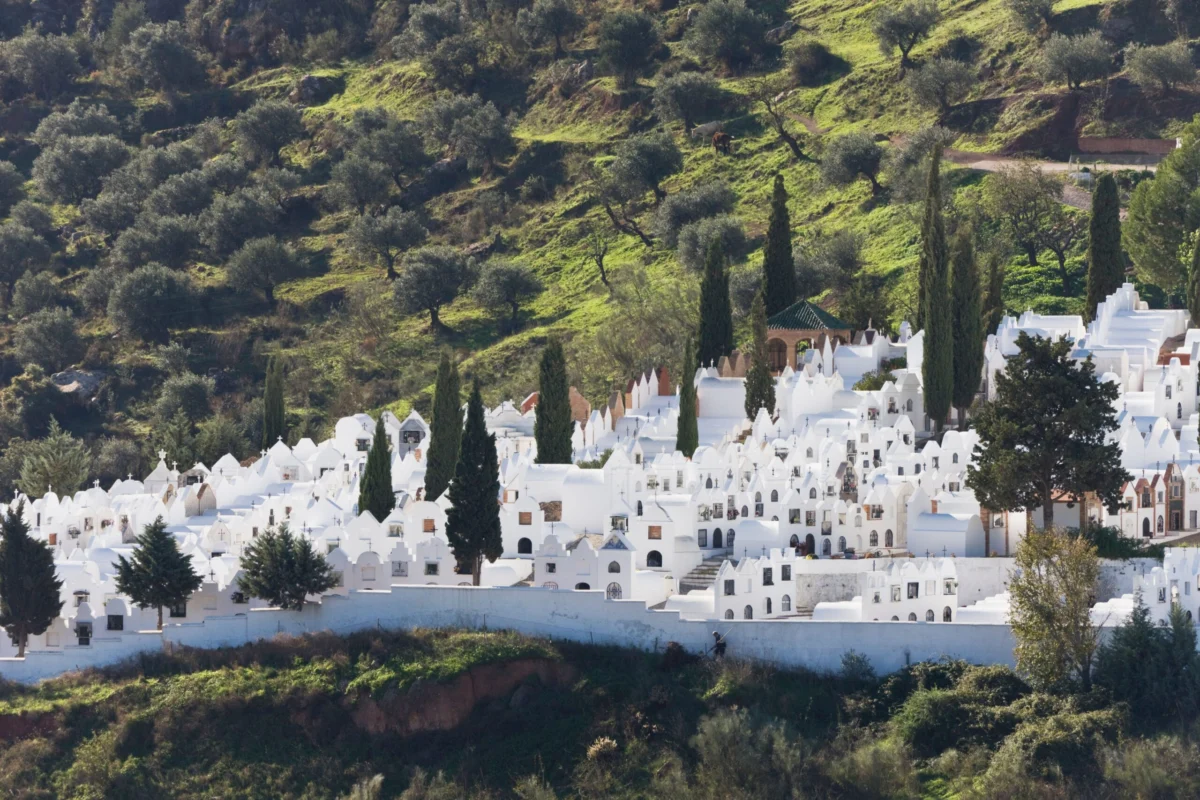
One of the most striking examples of this phenomenon is the Monumental Cemetery of San Sebastian in Casabermeja, Málaga, Spain. Unlike the sprawling, flat burial fields common in Northern Europe, the San Sebastian cemetery feels like a miniature, vertical city.

The site is defined by its iconic white-washed, above-ground niches—a structural necessity born from the rocky, challenging terrain of the region. This architectural choice gives the cemetery the appearance of a tiered village, with each "house" representing a final residence for the departed. Overlooking the sprawling, silver-green olive groves of the Andalusian countryside, the cemetery is a masterclass in vernacular architecture, blending seamlessly into the mountainous topography. It serves not just as a site for mourning, but as a visual extension of the town itself, reinforcing the Spanish cultural ethos that the dead remain an active, visible part of the community.
Chronology: The Evolution of Funerary Design
The history of the cemetery as a designed space is a long and storied one:

- Antiquity: Burial was primarily religious and utilitarian. In ancient civilizations, the focus was on the preservation of the body, leading to the construction of grand tombs like the Pyramids of Giza or the necropolises of the Etruscans.
- The Middle Ages: The churchyard was the center of community life. Death was public and communal, with burials occurring in the shadow of the cathedral to ensure the soul’s proximity to God.
- The 18th & 19th Century "Rural Cemetery Movement": As urban populations boomed in Europe and North America, churchyards became overcrowded and unsanitary. This birthed the garden cemetery—large, park-like spaces located on the outskirts of cities, designed with winding paths, exotic flora, and elaborate statues.
- The 20th Century to Present: A push toward minimalism and efficiency has seen the rise of modern memorial parks and high-density columbaria, while simultaneously, a movement toward "green burials"—where the body is returned to the earth in a biodegradable fashion—has gained traction as a reaction against the excessive materials of the past.
Supporting Data: Nature’s Role in the Afterlife
Cemeteries are often the largest, most undisturbed green spaces in major urban centers. This provides unique environmental benefits.
Take, for example, the Mount Auburn Cemetery in Watertown, Massachusetts. Founded in 1831, it is considered the first garden cemetery in the United States. Today, it serves as a critical stopover on the Atlantic Flyway. During the peak of spring and fall migrations, bird-watchers flock to its 175 acres of arboretum, which boasts thousands of trees and shrubs.

Research indicates that older, established cemeteries often contain higher biodiversity than city parks because they lack the constant human activity of a playground or sports field. They are, in effect, accidental nature preserves, protecting indigenous plant species and providing essential habitats for pollinators and migratory wildlife.
Official Responses and Preservation Efforts
The preservation of these sites has become a matter of international concern. Organizations like the Association of Significant Cemeteries in Europe (ASCE) work to promote cemeteries as vital components of cultural heritage.

"We are not just preserving stone and marble," notes one preservationist involved with the restoration of Mediterranean necropolises. "We are preserving the stories of the people who built the infrastructure of our modern world. When a cemetery is left to crumble, the history of the families buried there begins to fade from the collective memory."
Local governments in regions like Málaga have increasingly recognized the tourism potential of these sites. By investing in the structural stability of the white-washed niches in Casabermeja, local officials have ensured that the cemetery remains not just a place for the deceased, but a landmark that draws visitors to appreciate the regional architecture and history, effectively funding its own maintenance through cultural tourism.

The Implications: Why We Must Look Closer
The trend of "dark tourism"—or visiting sites associated with death—often gets a bad reputation, but it is fundamentally an exercise in empathy. When we walk through a cemetery, we are forced to confront the universality of the human experience.
1. Architectural Preservation
The decline of traditional funerary art is a significant loss to global culture. As society moves toward more anonymous forms of disposal, we risk losing the craftsmanship of master stonemasons and architects. Promoting cemeteries as cultural sites encourages the continued funding of traditional repair techniques.

2. Environmental Stewardship
As urban density increases, the "green lungs" provided by cemeteries become increasingly valuable. Policies that encourage the protection of these sites as public, non-commercial green spaces are vital for urban climate resilience.
3. Mindfulness and Mental Health
In an era of hyper-connectivity and constant digital distraction, the silence of a cemetery offers a rare commodity: perspective. These spaces are designed for introspection. Whether one is an atheist, agnostic, or religious, the quietude of a well-maintained garden cemetery provides a sanctuary for mindfulness that is difficult to find in the modern, bustling city center.

Conclusion: A Living Legacy
As we approach the autumn season, and with it, the cultural focus on Halloween, it is the perfect time to shift our perception of the graveyard. These are not merely places of "death." They are the most quiet, beautiful, and architecturally significant archives we possess.
Whether you are drawn to the rugged, white-washed beauty of the Spanish hillside in Casabermeja, the lush, bird-filled groves of Massachusetts, or the intricate statuary of Paris’s Père Lachaise, these sites offer a profound connection to our past. They invite us to slow down, look closely, and appreciate the art of a life well-lived—and the beauty of a memory well-kept. Next time you pass a cemetery, do not look away. Step inside. You might find that, in the presence of those who came before us, you discover something essential about yourself.
