

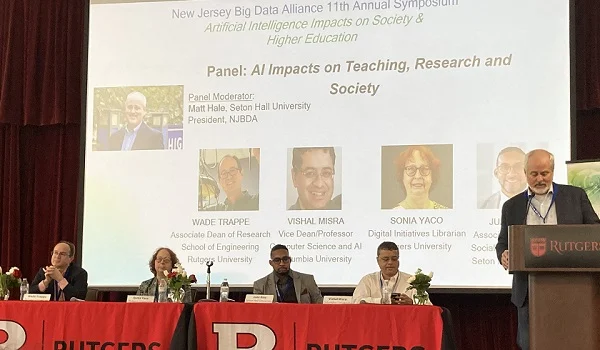
The rapid integration of Artificial Intelligence (AI) into the fabric of higher education is no longer a distant forecast; it is a present-day reality. At the 2024 New Jersey Big Data Alliance (NJBDA) Annual Symposium, held last spring at Rutgers University–New Brunswick, leading academics and technology experts gathered to dissect the transformative power of AI. The consensus was clear: from the intricacies of administrative enrollment to the nuance of classroom pedagogy, the influence of AI is poised to touch every facet of the collegiate experience.
The Scope of the Shift: A Comprehensive Transformation
The symposium’s session, titled “AI Impacts on Teaching and Research,” served as a focal point for the conference. The premise was ambitious yet inevitable: AI is not merely a tool for efficiency, but a structural catalyst. According to the panel, every element of university life—ranging from grading rubrics and lecture formats to complex data management and research analysis—is undergoing a fundamental redesign.
The panel featured a diverse group of experts:
- Matthew Hale (Moderator): Associate professor and chair of the Master of Public Administration program at Seton Hall University.
- Vishal Misra: Professor of computer science and vice dean of computing and AI at Columbia University.
- Juan Rios: Associate professor in the Master of Social Work program at Seton Hall University.
- Wade Trappe: Associate dean for research and development at the Rutgers School of Engineering.
- Sonia Yaco: Digital initiatives librarian at Rutgers University.
Administrative Efficiency: Optimizing the University Machine
The discussion opened with an examination of how AI can streamline university operations, which are often characterized by legacy systems and bureaucratic friction.
Wade Trappe of Rutgers highlighted two primary areas where AI could revolutionize administration. First, in admissions, AI could assist administrators in cultivating balanced, diverse cohorts. “You could really accelerate your cohort of students coming into the university,” Trappe noted, explaining that if an admissions team identifies an abundance of one type of applicant, AI can help balance the intake by highlighting gaps in representation, such as artists or specific academic backgrounds.
Second, Trappe addressed the perennial challenge of faculty research output. He noted that AI-driven analytics could identify faculty members who have not submitted grant applications in recent years. By providing this visibility, the software allows department deans to proactively engage with researchers, offering support to remove hurdles in the grant-writing process. Trappe pointed to tools like Tableau as examples of existing software that, when integrated with AI, will soon provide Rutgers faculty with unprecedented data-driven insights.
Institutional Strategy: Columbia’s Proactive Approach
Vishal Misra, who holds the distinction of being Columbia University’s first dean of AI, provided a look at how large-scale institutions are governing this transition. Having entered academia after launching a company built on ChatGPT-3, Misra brings a pragmatic, industry-informed perspective to the university.
At Columbia, a presidential task force has been mobilized to map out the university’s AI landscape. The initiative has already identified 70 distinct use cases, ranging from the mundane—such as dining services—to the critical, including research teaming and technology licensing. “We are prioritizing which ones to take on first,” Misra explained. The institution is specifically focusing on automating the labor-intensive pre-grant and post-grant processing phases, which often occupy a significant portion of a researcher’s time.
Archival Renaissance: Making History Accessible
Perhaps the most compelling use case presented at the symposium came from digital librarian Sonia Yaco, who specializes in special collections. Yaco identified a generational gap in literacy: many modern students are unable to read cursive handwriting, effectively locking them out of vast swathes of historical archives.
AI is bridging this divide. Yaco explained that AI can now transcribe handwritten manuscripts into legible text, making the content searchable and accessible. Beyond text, AI is transforming image archives. In collections containing tens of thousands of unlabeled photographs, AI can analyze visual content to generate descriptive metadata.
“The AI can be phenomenally accurate,” Yaco stated. “You can link that text to a document that previously had no illustrations, or to photographs that previously had no text.” By creating these “MARC” (Machine-Readable Cataloging) records, universities can transform static, inaccessible archives into dynamic, multimedia databases that cater to diverse learning styles.
The Acceleration of Research
Matthew Hale, reflecting on his own career, illustrated how AI has fundamentally altered the temporal cost of research. He recounted a study he conducted on local television news coverage of the 2000 election. The process involved mailing VHS tapes to 50 television markets, having staff record coverage, shipping the tapes to the University of Southern California, and hiring personnel to manually code the content.
“It took us almost a year to do every election,” Hale recalled. “I think it would be done in 37 seconds today.” While the estimate is a hyperbolic illustration of the shift, the point remains: AI has collapsed the timeline for data collection and analysis, allowing scholars to move from data ingestion to hypothesis testing at a speed previously considered impossible.
The Pedagogical Imperative: Guardrails and Ethics
As the discussion turned to the classroom, the tone shifted from excitement to caution. Wade Trappe noted that while students are often “digital natives” who already possess high fluency in tools like ChatGPT, they lack the critical “guardrails” necessary to use these tools effectively.
The central challenge for educators, Trappe argued, is teaching students to recognize the phenomenon of “hallucination”—when an AI confidently presents false information as fact. “We should teach them that just because some wonderful new tool tells you an answer doesn’t mean you should believe it,” he emphasized. The goal is to move students from passive consumption of AI-generated content to active, skeptical interrogation of it.
Social Work and Future-Building
Juan Rios, from the perspective of social work, proposed a novel use for generative AI: the creation of “future scenarios.” In his social policy courses, Rios uses AI to help students move beyond the constraints of current systems.
“We allow our students to localize how this possible future could look,” Rios said, describing a process where students use AI to visualize the outcomes of solving systemic issues like homelessness or substance misuse in specific urban environments, such as Newark. By prompting the AI to visualize a post-crisis future, students are forced to engage with the structural changes required to achieve those outcomes.
Rios posed a vital question for the audience: “What is the distinction that we’re giving to our community? How is the community benefiting from this knowledge now?” For Rios, the value of AI in the classroom is not found in the output itself, but in how it empowers students to envision and articulate better futures for the communities they serve.
Implications for the Future
The 2024 NJBDA Symposium underscored that higher education is at a crossroads. The implications of AI adoption are profound:
- Democratization of Knowledge: Through transcription and digital archiving, historical records are becoming accessible to a wider audience than ever before.
- Shift in Faculty Roles: With AI handling data analysis and administrative burdens, the role of the professor will likely shift further toward mentorship, critical thinking instruction, and complex synthesis.
- Institutional Resiliency: As institutions like Columbia and Rutgers integrate AI into their operational backbones, the focus will increasingly turn to data privacy, ethical usage, and the mitigation of algorithmic bias.
As the symposium concluded, the overriding sentiment was one of cautious optimism. The tools are here, and the potential for increased efficiency and pedagogical innovation is immense. However, the successful integration of these tools will depend not on the software itself, but on the ability of universities to teach the next generation how to navigate a world where information is no longer scarce, but where truth must be more rigorously verified than ever before.
The path forward, as mapped out by the panelists, requires a balanced approach—one that embraces the technological acceleration of AI while maintaining the rigorous ethical standards that define the academic mission. As the academic year progresses, the initiatives discussed at Rutgers will serve as a bellwether for the rest of the higher education sector, providing a roadmap for how to survive, and thrive, in the age of intelligence.
