

At the recent Advertising Week presentation in New York, Meta unveiled a transformative suite of AI-driven tools designed to redefine how businesses interact with the platform’s advertising ecosystem. As the digital landscape becomes increasingly saturated, Meta is shifting its strategy from simple ad-placement services to comprehensive, agentic AI partners.
For brands and marketers, these updates—ranging from sophisticated business assistants to seamless in-stream checkout experiences—represent a significant pivot toward automation, efficiency, and hyper-personalized consumer journeys.
The Core Transformation: Meta’s AI-Powered Business Assistant
The most significant announcement from the event concerns the evolution of Meta’s AI-powered business assistant. Previously a tool for basic guidance, the assistant is being upgraded into a comprehensive operational partner.
Enhanced Context and Memory
Meta is moving away from generic AI responses. By granting the assistant "memory" and context-awareness, the tool can now look back at a brand’s performance history. It can analyze what strategies were deployed last quarter, account for seasonal fluctuations, and recall specific campaign goals. By understanding the unique DNA of a business, the assistant is now capable of providing highly tailored, actionable recommendations rather than one-size-fits-all advice.
Brand Voice Integration
One of the most requested features by enterprise-level clients has been the ability to maintain brand consistency. Meta is introducing new importing tools that allow brands to upload their strategic guidelines, brand voice, and tone documents directly into the assistant. This ensures that any generated content or suggested copy aligns perfectly with the brand’s established identity, significantly reducing the time spent on manual revisions.
Agentic Capabilities: Beyond Suggestions
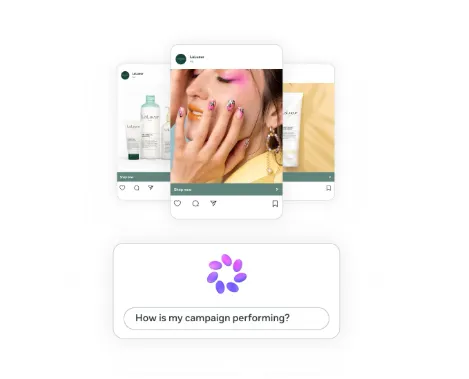
Perhaps the most ambitious leap is the introduction of "agentic" capabilities. In this new iteration, the assistant no longer just recommends changes; it can execute them. Users can provide conversational prompts to:
- Generate new creative assets from scratch.
- Update audience targeting parameters in real-time.
- Adjust daily and lifetime budgets based on performance data.
This transition marks a shift where the AI functions as a junior media buyer, allowing human marketers to focus on high-level strategy rather than the granular management of campaign dials.
Empowering Performance: Ads Creative Studio and Strategy
As creative becomes the primary driver of ad performance in a post-cookie world, Meta is doubling down on tools that help brands iterate and optimize.
Democratizing Ads Creative Studio
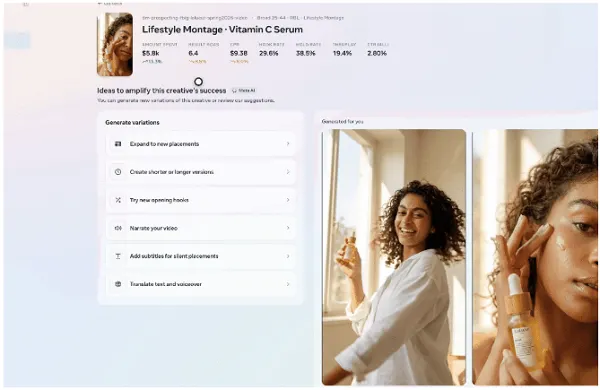
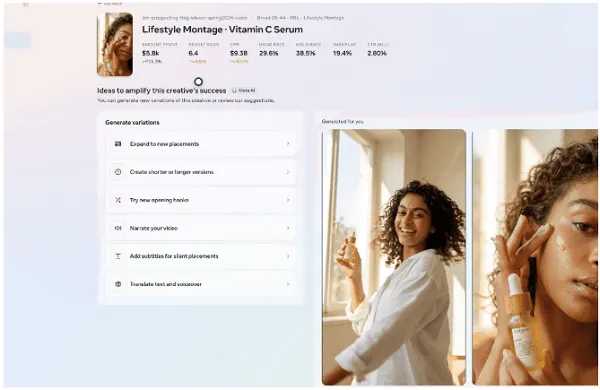
Meta is expanding access to its Ads Creative Studio. By leveraging deep performance data and audience insights, the platform can highlight exactly why certain assets are resonating while others are failing. With AI guidance, the studio provides concrete suggestions on how to improve hooks, shorten clips, or adjust audio to maximize ROI. Expanding this to a broader range of advertisers levels the playing field, giving smaller brands access to enterprise-grade analytics.
Customer Lifecycle Strategy
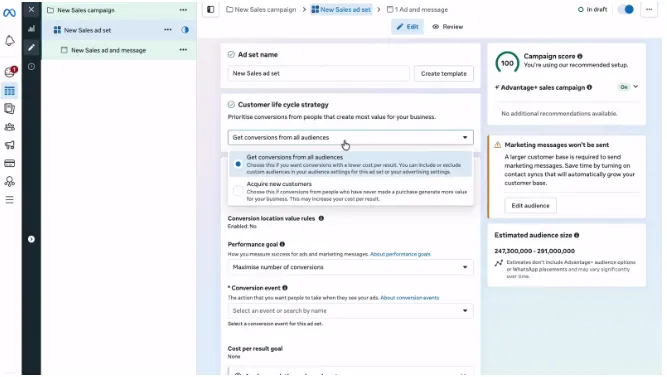
Meta is also rolling out its Customer Lifecycle Strategy to all advertisers. This feature allows marketers to categorize their audience segments by lifecycle stage (e.g., new prospect, repeat customer, lapsed user). By defining these segments, the platform’s algorithm can align its recommendations and bidding strategies to ensure that specific campaigns achieve top-level business objectives, such as maximizing customer lifetime value (CLV) rather than just driving immediate clicks.
The Video Generation Frontier
In an era dominated by short-form video, Meta is lowering the barrier to entry for video production.
- Advantage+ Creative: This feature is now generally available, enabling advertisers to generate video variations from existing static assets. This is a game-changer for brands with large image catalogs that lack the resources for high-end video production.
- Dynamic Editing: Within Ads Creative Studio, marketers can now edit video concepts on the fly. This includes adjusting clip lengths, adding text overlays, modifying captions, and changing end scenes to facilitate A/B testing at scale.
- Catalog-to-Video: Meta is simplifying video generation directly from product catalogs, complete with related product recommendations for upselling. This feature is designed to move customers through the funnel by suggesting complementary items, effectively automating the merchandising process.
Chronology: The Road to the "Agentic" Ad Platform
To understand the magnitude of these updates, it is helpful to look at the timeline of Meta’s rapid AI integration:
- Early 2024: Meta launches the initial version of its Business Assistant and introduces Ads Creative Studio to a limited partner set, focusing on basic performance insights.
- Mid-2024: Meta begins integrating Generative AI into its Advantage+ suite, allowing for automated image expansion and text variation.
- Late 2024 (Advertising Week NYC): Meta announces the "Agentic" pivot, moving from insight-generation to execution and cross-platform checkout integration.
- Future Roadmap: Integration of third-party AI tools through the Meta Ads MCP server, allowing for a fully interoperable ecosystem where external AI agents can manage Meta ad spends.
Supporting Data: Why This Matters
Industry experts have long argued that the "Attention Economy" is shifting toward "Intent-Based Commerce." According to recent data from Meta, users are increasingly turning to AI-integrated interfaces—such as Meta AI, Muse, and the Business Agent—not just to browse, but to compare products and make decisions.
- The "Muse" Effect: Meta’s Muse AI has seen rapid adoption, crossing 5 million downloads and 3 million weekly active users.
- Conversion Efficiency: By shortening the path from discovery to purchase—specifically through in-stream checkouts—Meta is addressing the "friction" that causes drop-offs in mobile commerce.
- Third-Party Interoperability: By expanding the Meta Ads MCP server, Meta is acknowledging that brands use a variety of tools. Enabling these tools to communicate directly with Meta’s backend reduces data fragmentation.
Official Responses and Strategic Vision
During the presentation, Meta leadership emphasized that the future of commerce is "conversational."
"People discover brands and products through creators they trust, communities they belong to, and AI that understands what they are looking for," a Meta spokesperson noted. "Increasingly, this is happening in Meta AI, Muse, and Meta Business Agent, where people ask, compare, and decide what to buy. So we’re building partnerships with retailers to offer new ways to directly complete a purchase without leaving the conversation."
This reflects a clear strategic intent: Meta wants to own the entire commerce loop. By keeping the user within the Meta ecosystem from the moment of inspiration (an AI conversation) to the moment of transaction (a direct Shopify/PayPal checkout), they are insulating themselves from the volatility of the broader web.
Implications for the Industry
The introduction of these tools carries profound implications for the digital marketing landscape:
1. The Rise of the "Prompt Engineer" Marketer
As the Business Assistant takes over manual tasks, the value of a media buyer will shift. Success will no longer be defined by the ability to manage complex campaign structures, but by the ability to communicate strategic intent to an AI. "Prompt engineering"—the art of guiding AI to produce the best output—will become a core competency for modern marketers.
2. Death of the "Static" Ad
With the democratization of AI video generation, the standard for ad quality will rise. Static ads will likely be relegated to low-intent retargeting, while high-intent acquisition will be dominated by dynamic, AI-generated video that adapts to the viewer’s preferences.
3. Frictionless Commerce
The partnership with Shopify, Adyen, PayPal, and Stripe to enable direct checkout within Messenger and Meta AI is the most significant development for conversion rates. By removing the need to navigate to a landing page, brands can expect to see a drastic reduction in bounce rates and a corresponding increase in conversion velocity.
4. A Shift in Agency Models
Agencies will need to pivot. Services centered on manual campaign optimization or basic asset creation will be commoditized by Meta’s native tools. High-value agencies will instead focus on "strategic architecture"—designing the brand voice, the lifecycle stages, and the high-level business goals that feed into Meta’s AI engine.
Conclusion
Meta’s latest updates represent more than just a software refresh; they signal a fundamental shift in how businesses interact with the platform. By moving toward a model where AI acts as an autonomous extension of the marketing team, Meta is attempting to solve the dual problems of complexity and inefficiency.
For the modern marketer, the message is clear: The future of growth is not found in fighting the algorithm, but in mastering the AI agents that power it. As these tools become more accessible, those who lean into these automated workflows will likely find themselves at a distinct competitive advantage, capturing consumer intent in real-time within the very conversations that drive discovery.
