

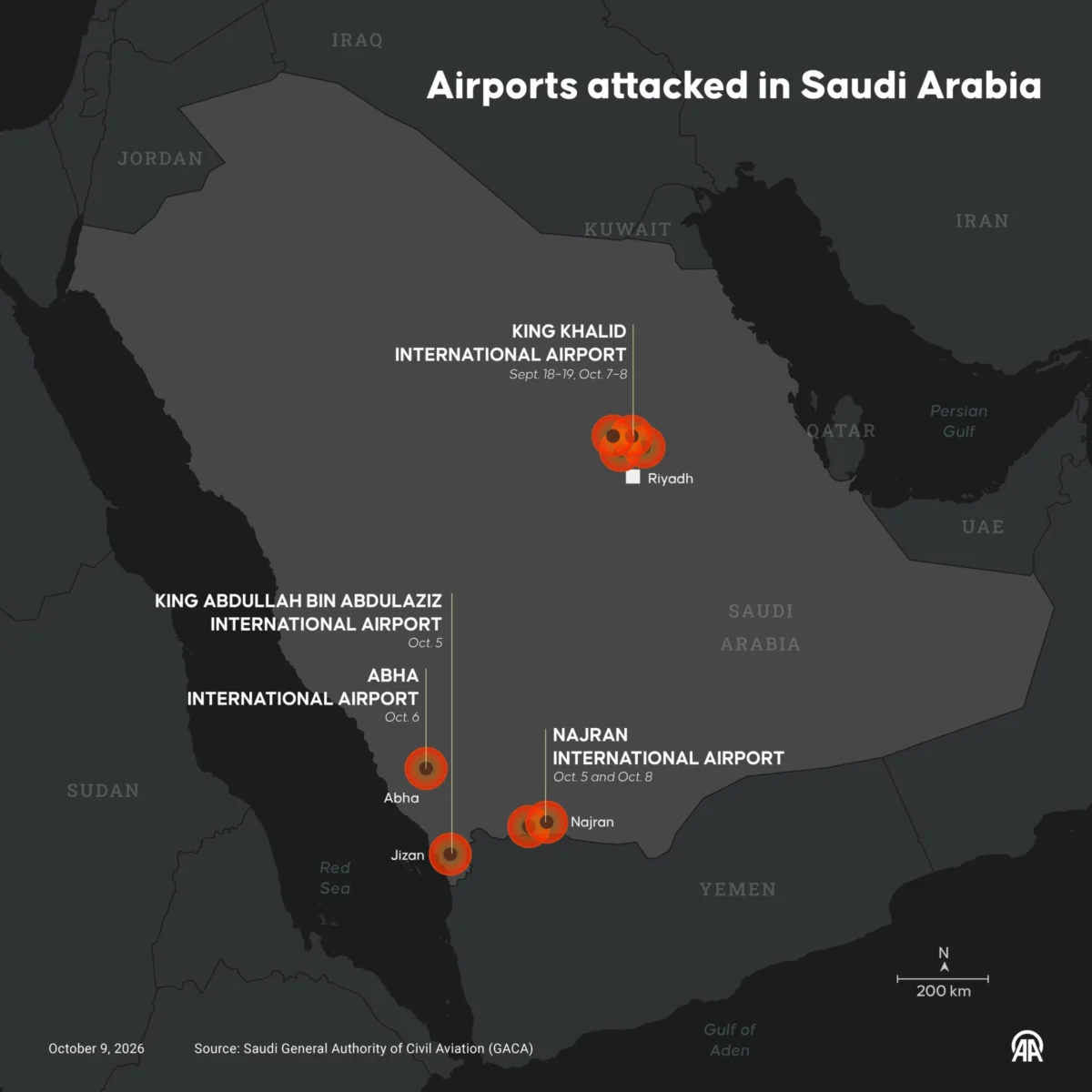
RIYADH — A devastating missile strike on the King Khalid International Airport in the Saudi capital has left 12 people dead and over 300 injured, marking the most lethal incident in the Gulf region since the onset of the ongoing conflict involving Iran-backed factions. The attack, which struck terminals housing domestic flights, has paralyzed international travel and forced a desperate scramble for military assistance from Western allies.
The victims of the Saturday afternoon assault represented a cross-section of the international community, underscoring the global impact of the escalating violence. Among the deceased were four Saudi citizens, two Bangladeshi nationals, a Palestinian, a U.S. citizen, an Egyptian, a Jordanian, a Syrian, and a Sudanese national. Scores of the injured remain in critical condition, overwhelming local hospitals as emergency services continue to operate under a state of high alert.
The Chronology of Chaos: A Week of Sustained Aggression
The catastrophe at King Khalid International Airport did not occur in a vacuum; it serves as the bloody culmination of a week of intense military friction. The volatility began shortly after a Saudi-led coalition launched a significant military offensive against Houthi rebels in Yemen, aimed at curbing their territorial gains along the Red Sea coast.
- Mid-week: Tensions spiked as reports emerged of three aircraft being damaged at Riyadh’s airport during previous, smaller-scale strikes. The Saudi national carrier confirmed that one of its planes sustained damage while grounded.
- Thursday: Houthi rebels issued a stark, final warning to international carriers, characterizing Saudi airspace as an active "theater for military operations" and threatening dire consequences for those who continued to operate within it.
- Saturday Morning: Rebels alleged that Saudi forces had launched strikes against Sanaa International Airport in the Houthi-held Yemeni capital.
- Saturday Afternoon: The fatal missile strike hit the complex housing Terminals 3 and 4 at Riyadh’s airport. Simultaneously, the Saudi-led coalition reported that a projectile landed near King Fahd International Airport in Dammam, while a ballistic missile was intercepted over the Al-Kharj governorate.
- Saturday Evening: Saudi civil aviation authorities suspended all operations at King Khalid International Airport, blocking entrances and dimming lights as security forces cordoned off the facility.
Supporting Data and Strategic Implications
The intensity of the current offensive has exposed critical vulnerabilities in the kingdom’s defense infrastructure. Regional officials, speaking on condition of anonymity, have revealed that Saudi Arabia is facing a severe shortage of missile interceptors. This deficit has prompted Riyadh to reach out to international partners—including France, Britain, Pakistan, and Egypt—to request emergency air defense deployments.
The situation is further complicated by the fact that the United States, which has provided intelligence sharing, target identification, and strategic planning for the Saudi-led coalition, is also reporting a depletion of its own interceptor stockpiles due to the sustained nature of the regional conflict.
The economic ramifications are equally profound. As the world’s leading oil exporter, Saudi Arabia’s stability is a cornerstone of the global economy. The persistent targeting of airports, military facilities, and energy infrastructure has rattled international markets. Despite the chaos, the Saudi energy ministry initially signaled intent to proceed with a major international energy conference scheduled for Sunday in Riyadh, a move interpreted by analysts as a symbolic attempt to project stability amidst mounting insecurity.
Official Responses and Diplomatic Maneuvering
The international community’s reaction has been one of swift condemnation and growing anxiety. Major Western nations, including the United States, Britain, Germany, Australia, and Canada, issued urgent travel advisories, warning their citizens to avoid the airport entirely.
In Washington, the response has been cautious but suggests potential escalation. President Donald Trump, addressing the press shortly after the attack, indicated that the U.S. is currently evaluating its level of involvement. "We may. We’re going to look at it," the President stated when asked if the U.S. would join Saudi-led strikes against the Houthis. "We just found out about the recent attack. So we’ll make a decision. We move very quickly."
Conversely, diplomatic channels remain open, albeit strained. Saudi Arabia’s foreign minister engaged in high-level discussions with his Omani counterpart on Saturday. Oman, which has historically served as a critical mediator in the region, is seen as a key player in any potential de-escalation efforts. The focus of these discussions, according to official statements, remains on "supporting diplomatic solutions to de-escalate tensions."
Aviation Security and the "Theater of War"
The European Union Aviation Safety Agency (EASA) has significantly expanded its guidance regarding Saudi airspace. The agency cited the Houthis’ demonstrated ability to strike deep into the kingdom and their explicit targeting of aviation infrastructure as a "greater focus."
EASA warned that the high frequency of missile and drone launches—coupled with the subsequent interception efforts—creates a perilous environment for commercial aviation. "These activities create an increased risk of misidentification of civil aircraft," the agency stated, a chilling reminder of the tragic potential for catastrophic error in an active combat zone.
Before the Saturday strike, the ripple effect on global travel was already evident. Airlines including Air India, FlyDubai, the Lufthansa Group, and Pakistan International Airlines had already suspended or altered schedules for flights to and from Riyadh. The indefinite suspension of operations at King Khalid International Airport, with flights being diverted to alternate locations, has left thousands of passengers stranded and created a logistical bottleneck that experts warn could take weeks to resolve.
A Nation Under Siege: The Domestic Response
Inside Saudi Arabia, the government is struggling to control the narrative as fear spreads. In a move to clamp down on the circulation of sensitive imagery, authorities issued a stern warning this week: any individual found "filming, publishing or sharing information related to countering missiles and drones and their impact sites" will face severe legal liability.
This censorship reflects a government attempting to balance the need for public order with the reality of an existential threat. The civilian death toll—spanning multiple nationalities—has transformed what was once a proxy war in Yemen into a direct, localized tragedy for the residents of Riyadh.
Looking Forward: The Path to Escalation or Resolution?
As the kingdom mourns the 12 victims and assesses the physical damage to its infrastructure, the geopolitical outlook remains grim. The Houthi rebels, who have previously framed their actions as a blockade in response to the Saudi-led coalition, have yet to issue a formal statement regarding the Riyadh airport attack. Their silence, however, is rarely indicative of inactivity; historically, the group has taken days to claim responsibility for major operations.
The expansion of the conflict into the heart of the Saudi capital creates a pressure cooker scenario for the U.S. administration and its allies. The decision to either provide further military support or push for an immediate diplomatic ceasefire will define the next chapter of this regional crisis. With oil prices sensitive to the volatility in the Strait of Hormuz and the Red Sea, the stakes extend far beyond the borders of Yemen and Saudi Arabia.
For now, the runways at King Khalid International Airport remain dark. The silence at the facility serves as a stark reminder of the fragile state of regional security, where a single missile strike can disrupt the lives of thousands and force world powers into the difficult calculus of war. As the Saudi government prepares to bury its dead, the international community watches closely, waiting to see if the region will descend further into a wider, more unpredictable conflict.
