

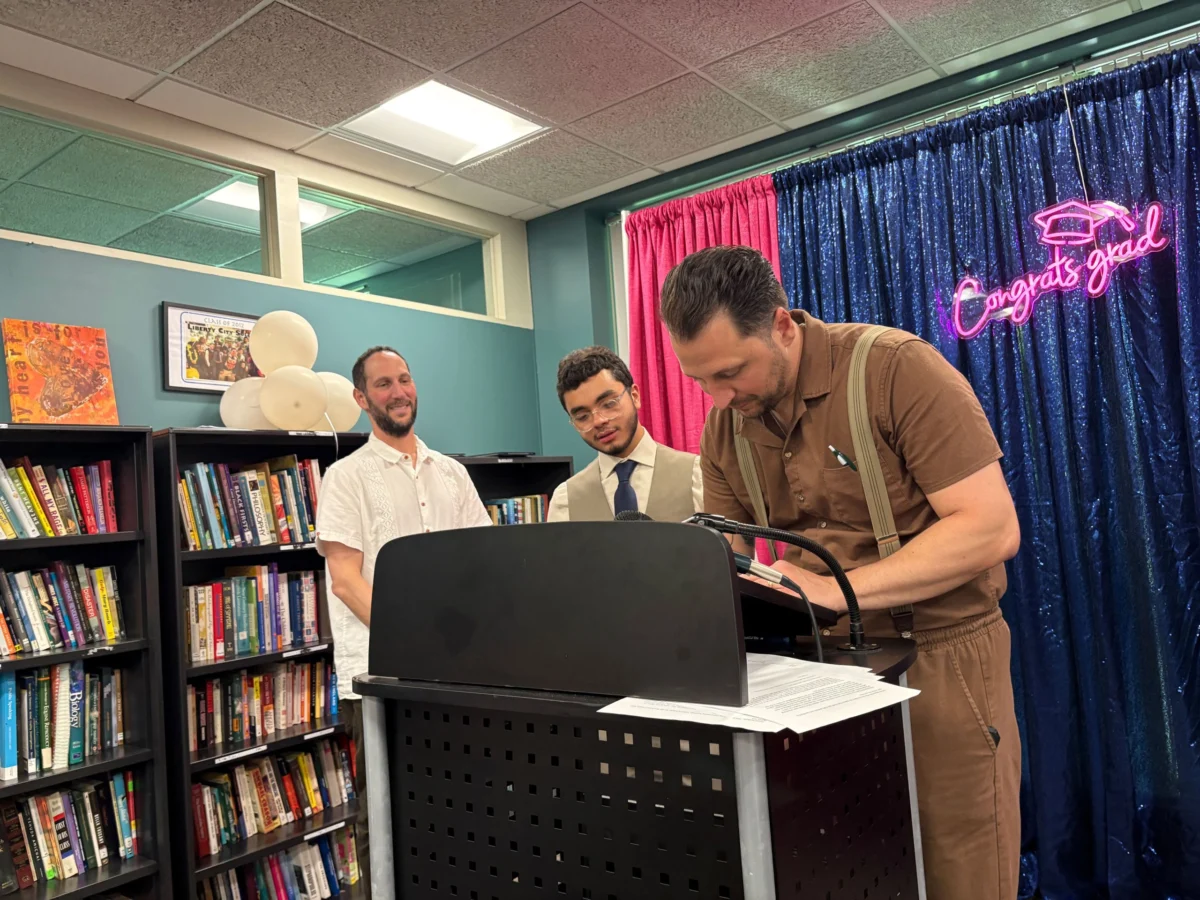
Evan Perez is, in many ways, the prototype of the modern student. A first-year business student at Babson College attending on a full scholarship, Perez spent his formative years at The Met High School in Providence, Rhode Island—a campus that prioritizes "real-world learning" over traditional rows of desks and standardized testing. During his time there, he wasn’t just memorizing facts; he was building an AI-focused business and securing internships that allowed him to shadow professionals in the field.
Yet, despite his success, Perez admits to a lingering tension. While his high school education taught him how to advocate for himself, pitch ideas, and collaborate—skills essential for his current entrepreneurial path—he also found himself playing catch-up on traditional academic rigor. "The Met taught me to advocate for myself, and really prepared me for a college where you are pitching yourself and your ideas," he reflects. However, the trade-off between immersive project-based learning and foundational academic preparation remains a point of friction that he continues to navigate.
Perez’s experience sits at the epicenter of a national reckoning: How can U.S. high schools effectively balance career-connected learning with the rigorous academic preparation required for a future where artificial intelligence and automation are rapidly reshaping the professional landscape?
The Disconnect: A System in Need of Evolution
The current model of the American high school is increasingly being viewed as a relic of the industrial age. As the global economy pivots toward agility, technical literacy, and creative problem-solving, the traditional "one-size-fits-all" diploma is failing to keep pace.
According to a recent report by the National Association of State Boards of Education (NASBE), the dissatisfaction is palpable. Nearly 75% of high school graduates report feeling unprepared for the realities of life after graduation. This sentiment is echoed by educators, with one-third of teachers expressing doubt that their students possess the skills necessary for the modern workforce.
This, combined with a rising skepticism toward the traditional four-year college path, has forced a re-evaluation of the purpose of secondary education. With only 38% of Americans expressing "a great deal" of confidence in higher education—a significant drop from previous years—the pressure is on high schools to act as more than just a conduit to university. They must now function as launchpads for diverse professional trajectories, including trade certifications, apprenticeships, and entrepreneurial ventures.
Mapping the Evolution: A Chronology of Change
The shift toward career-integrated learning is not a sudden trend but the culmination of years of experimentation across the U.S. education landscape:
- The Early Innovation Era: Over the last decade, models like P-TECH (Pathways in Technology Early College High School) began integrating paid internships, intensive mentorship, and the opportunity to earn an associate degree by high school graduation. These programs proved that underserved populations could thrive when given a direct line of sight to a career.
- The State-Level Policy Wave: States like Indiana have begun to revamp the high school diploma itself, offering "seals" that designate a student’s readiness for college, the military, or the workforce. This modular approach signals a departure from the singular, college-prep-only philosophy.
- The AI and Automation Inflection Point (2024–Present): With the meteoric rise of generative AI, the conversation has shifted from "college vs. career" to "what skills are future-proof?" Schools like those in Niagara Falls, New York, have implemented nine-grade career exploration programs, allowing students to choose from specific pathways—such as engineering, finance, or design—long before they reach their senior year.
Supporting Data and The Reality on the Ground
The effectiveness of these programs remains a subject of intense scrutiny. While the enthusiasm for "career pathways" is high, the data on long-term outcomes is mixed. In Delaware, early studies on career pathways offer clues: while students in these programs often report higher engagement and satisfaction, determining the long-term "payoff"—in terms of wage growth and job stability—requires longitudinal tracking that many school districts are only just beginning to implement.
The challenge, as reported by districts in Massachusetts and Connecticut, is one of capacity and scale. In Connecticut, technical high schools have become so popular that the state was forced to move from competitive admissions to a lottery system, highlighting a massive, unmet demand for hands-on, career-oriented education.
However, critics of this shift point to a potential "tracking" danger. If students are encouraged to specialize too early, they risk being funneled into narrow career paths, potentially limiting their long-term flexibility in an economy where the average worker may change careers five to seven times.
Official Responses and Strategic Shifts
Policymakers and educational leaders are currently caught between two competing pressures: the need to provide immediate, tangible career skills and the obligation to ensure students maintain a broad intellectual foundation.
A new state policy framework is currently circulating that calls for "career-connected learning" to be embedded into every high school day, rather than relegated to elective vocational blocks. Proponents of this shift, such as those behind the recent "Beyond Silos" report, argue that AI literacy and service-based learning should be as standard as algebra or English.
Furthermore, a growing coalition of higher education institutions and industry leaders is pushing for "stackable credentials." This model allows students to earn industry-recognized certifications while in high school, which can then be "stacked" toward a degree later in life. This modular approach aims to bridge the gap between the "college-or-bust" mentality and the urgent need for workforce readiness.
Implications for the Future: What Comes Next?
The implications of this transition are profound. If the goal of high school is to prepare students for a world where AI automates routine tasks, the curriculum must move away from rote memorization toward what Evan Perez calls "authentic, performance-based assessment."
For students, the future will likely require a hybrid identity: the ability to think critically (the hallmark of a traditional liberal arts education) while possessing the technical agility to adapt to new software, tools, and industry requirements.
For schools, the hurdle is systemic. Rebuilding a curriculum around projects, internships, and AI integration requires massive professional development for teachers and a fundamental restructuring of school schedules. It also requires a new relationship with local businesses, which must move from being passive recipients of graduates to active partners in the design of the learning experience.
A Call to Action
As the national conversation continues, the voices of students remain the most critical. Evan Perez, looking back at his own path, remains optimistic but cautious. "I honestly think we need to really take a step back and think more about how education works," he says. "Schools have to think: are tests useful? Are classes useful when AI is automating so much? How can we use AI in ways that help us with our careers?"
The Hechinger Report is committed to answering these questions by going directly to the source. By speaking with students, parents, and educators across the country, we aim to document what works, what fails, and how we can best support the next generation.
The era of the "standardized" high school is ending. In its place, a more experimental, fluid, and career-connected model is beginning to emerge. Whether this new model will truly democratize opportunity or merely create new barriers remains to be seen. But one thing is clear: the status quo is no longer an option. The future of the American high school will not be defined by the grades on a transcript, but by the readiness of its graduates to navigate an increasingly complex and automated world.
