

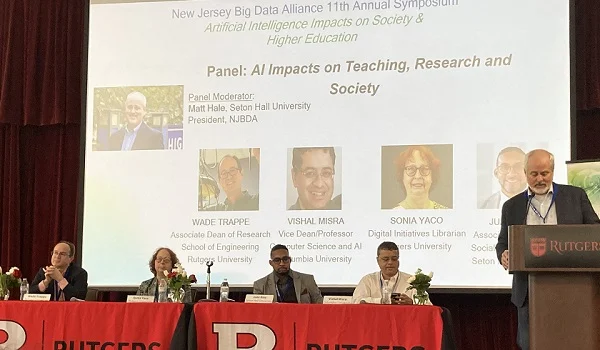
The integration of Artificial Intelligence (AI) into the ivory towers of academia is no longer a futuristic speculation—it is a present-day reality. At the 2024 New Jersey Big Data Alliance Symposium, held last spring at Rutgers University–New Brunswick, leading academics and technology experts gathered to dissect the profound implications of AI on the fundamental pillars of society and higher education. The consensus was clear: from the way universities manage student cohorts to how they preserve historical archives, the digital transformation is comprehensive and irreversible.
The Symposium: A Hub for Innovation
The 2024 New Jersey Big Data Alliance Symposium served as a critical forum for addressing the rapid evolution of machine learning and generative models. Among the highlights was a high-level panel titled "AI Impacts on Teaching and Research." Moderated by Matthew Hale, chair of the Master of Public Administration program at Seton Hall University, the discussion featured a cross-section of experts, including Vishal Misra (Columbia University), Juan Rios (Seton Hall University), Wade Trappe (Rutgers School of Engineering), and Sonia Yaco (Rutgers University).
The overarching theme of the symposium was that AI is not merely an auxiliary tool; it is a catalyst for a total paradigm shift. As the panel introduction noted, "Everything from grading to lecture formats to data collection, management, and analysis will be changed because of AI."
Chronology of the Shift: From Early Adoption to Systemic Integration
The integration of AI in higher education has moved through distinct phases over the past decade. Initial academic interest focused on data analytics for enrollment management and basic research efficiency. However, the release of advanced generative models—such as ChatGPT—has compressed the timeline for adoption from years to mere months.
At the symposium, panelists traced this progression, noting that universities have moved from the "experimental phase" into a "strategic implementation phase." Institutions are now establishing dedicated task forces to map out hundreds of use cases, ranging from administrative back-office efficiency to highly specialized research and archival restoration.
Supporting Data: Operational Efficiencies and Research Velocity
The panel provided concrete examples of how AI is already optimizing university operations. Wade Trappe of the Rutgers School of Engineering emphasized the logistical power of AI in admissions. "You could really accelerate your cohort of students coming into the university admissions," Trappe noted, explaining that AI can help administrators balance incoming demographics, ensuring a healthy mix of athletes, artists, and scholars.
Furthermore, the operational reach of AI extends to faculty management. Trappe highlighted the use of data visualization tools like Tableau to identify faculty productivity trends, such as tracking grant submission rates. By pinpointing researchers who have not applied for funding in extended periods, deans can provide targeted support to accelerate the research pipeline.
The speed of research is perhaps the most immediate beneficiary of this technology. Moderator Matthew Hale shared a personal anecdote from his early career, describing the labor-intensive process of analyzing television coverage of the 2000 U.S. election. "We hired people in 50 television markets to insert VHS tapes into machines, pull the tapes out, and send them to the University of Southern California, where we hired people to sit down and watch them and code them," he recounted. "It took us almost a year. I think it would be done in 37 seconds today."
Official Perspectives: Navigating the New Frontier
The symposium featured insights from those leading the charge within their respective institutions.
Columbia’s Strategic Approach
Vishal Misra, Columbia University’s first dean of AI, described a top-down, university-wide strategy. Under the guidance of the President’s office, Columbia has identified over 70 distinct use cases for generative AI. "We are prioritizing which ones to take on first, from dining services to technology ventures, the licensing office to research teaming," Misra explained. By streamlining pre-grant and post-grant processing, the university aims to reduce the bureaucratic burden on researchers, allowing them to focus on scientific innovation rather than administrative paperwork.
Digital Humanities and Archival Restoration
One of the most compelling use cases came from Sonia Yaco, a digital initiatives librarian at Rutgers. Yaco highlighted how AI is rescuing history that would otherwise remain inaccessible. Noting that many modern students lack the ability to read cursive handwriting, Yaco described how AI can transcribe handwritten manuscripts into typed text, making them instantly searchable and readable.
Beyond text, AI is revolutionizing image cataloging. "We have collections with tens of thousands of photographs with no labels on them," Yaco said. Using AI to generate descriptive metadata—creating "MARC" cataloging records—allows librarians to link text to previously unidentified photographs. "The AI can be phenomenally accurate, and you can link that text to a document that previously had no illustrations… you can make truly multimedia collections," she added.
Implications for Teaching and Ethics
Perhaps the most contentious area of the symposium was the classroom. With 18-year-olds already proficient in using generative AI tools, the role of the professor has shifted from being a gatekeeper of information to being a guide for critical thinking.
Teaching the "Guardrails"
Wade Trappe emphasized that the priority is no longer preventing students from using AI, but teaching them to manage the risks. "We need to teach them the guardrails," he stated. "How do you know that what you asked and what it’s giving you is not a hallucination? Do you know whether or not it’s fake, whether or not it’s built on data that was fake?" The lesson for the next generation is clear: technological output is not an objective truth, and academic rigor now requires the ability to audit AI-generated content.
Social Work and Future-Building
Juan Rios, an associate professor of social work at Seton Hall, provided a unique perspective on the pedagogical use of AI. Rather than viewing AI as a threat to creativity, he uses it to help students conceptualize complex social change.
"One of the tools that I’ve been integrating into the classroom is the use of generative AI to have students create scenarios of a future if this social problem is addressed," Rios said. By tasking students with creating images of a world without homelessness or substance abuse, he allows them to "stretch their minds" and then "localize" those solutions to the communities they serve, such as the city of Newark. This method bridges the gap between abstract academic theory and practical, community-based action.
Conclusion: A Transforming Institution
The 2024 New Jersey Big Data Alliance Symposium underscored that the university of the future is fundamentally data-driven. While concerns regarding accuracy, ethics, and the potential for "hallucinations" remain, the prevailing sentiment among the experts is one of cautious optimism.
As higher education continues to integrate these technologies, the focus remains on a symbiotic relationship between human expertise and machine speed. Whether it is through the preservation of handwritten archives, the acceleration of multi-million dollar grant processes, or the simulation of complex social policies, AI is not replacing the academic experience—it is expanding its boundaries. The challenge for the coming years will be to ensure that these tools are used not only to improve efficiency but to deepen the human capacity for inquiry and community service.
