

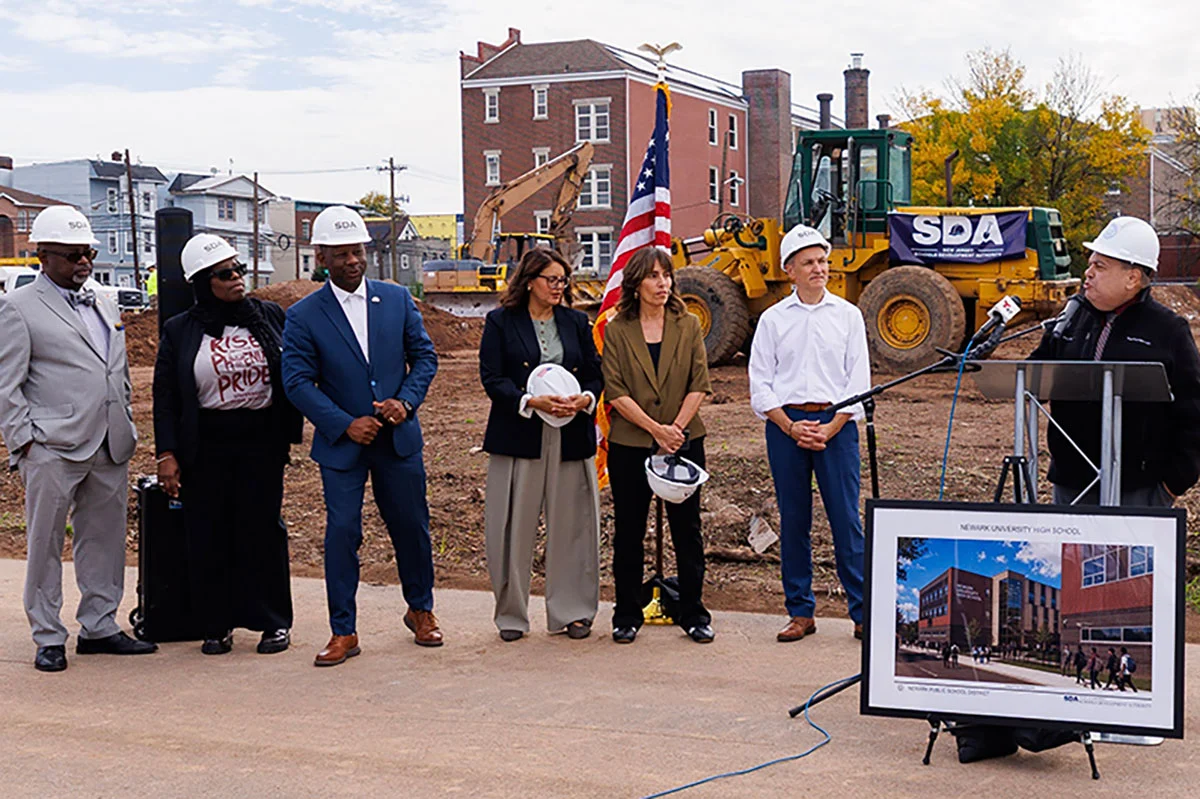
NEWARK, N.J. — For the students, alumni, and educators of Newark’s University High School, the intersection of Hawthorne Avenue and Dewey Street has long been a symbol of promise deferred. For over twenty years, the site sat as a quiet reminder of bureaucratic gridlock, shifting political tides, and the global disruptions of a pandemic. However, on a crisp Wednesday afternoon, the low rumble of earth-moving equipment replaced the silence, marking the official commencement of a project that represents more than just steel and mortar—it represents the fulfillment of a long-standing promise to one of New Jersey’s most storied academic institutions.
Newark Public Schools Superintendent Roger León, who served as principal of University High School when the project was first conceptualized in 2006, stood alongside state and local leaders to break ground on what will become a 198,000-square-foot, state-of-the-art educational facility. Designed to accommodate up to 1,080 students in grades nine through twelve, the new school is poised to redefine the learning experience for the "Phoenix"—the mascot and moniker of the school’s resilient student body.
A Legacy of Resilience: The Chronology of a Project
The journey to this groundbreaking ceremony is a study in perseverance. When the original plan for a new University High building was unveiled in 2006, the landscape of Newark education looked vastly different. Over the ensuing two decades, the project faced a litany of obstacles that would have stifled lesser initiatives.
- 2006: The initial announcement of a new school building for University High School is made, with Superintendent León serving as the school’s principal.
- 2007–2019: The project enters a period of dormancy characterized by changing state administrations, shifting priorities within the New Jersey Schools Development Authority (SDA), and evolving fiscal constraints.
- 2020–2022: The COVID-19 pandemic brings global construction to a standstill, further complicating supply chains and project timelines.
- 2022–2024: A renewed, aggressive push by the Newark Board of Education, in collaboration with the SDA, moves the project from conceptual stagnation to active planning.
- 2024 (Present): Site preparation begins, with the removal of old foundations and underground infrastructure, setting the stage for full-scale construction.
The project is now firmly in its final stages of development. According to the SDA, the current phase—which includes clearing the site of former roadway remnants and underground storage tanks—is slated to continue through the first quarter of 2027. Following this, the SDA will finalize the selection of a design-build contractor, with vertical construction of the new facility expected to commence in the fall of 2027.
Supporting Data and Institutional Scope
The scope of the project reflects the magnitude of the need. The new University High School is not merely a replacement; it is an expansion of capacity and capability. By providing 198,000 square feet of space, the facility will be equipped to support modern pedagogical requirements, including specialized laboratories, high-tech media centers, and collaborative spaces that the current, aging infrastructure cannot support.
For the SDA, this project represents a significant milestone. "The new University High School will be the first project that the SDA has completed in this ward in their promise of building new schools in Newark," Superintendent León noted during his remarks. Upon its completion, it will stand as the ninth school facility delivered by the SDA in the city, marking a pivot toward revitalizing the South Ward’s educational infrastructure.
SDA Chief Executive Officer Manuel Da Silva, who shares a personal connection to Newark’s school system as an alumnus of Oliver Street School and Science High School, emphasized the technical rigor of the undertaking. "Together we will deliver a modern, innovative learning environment that will support student success in generations to come," Da Silva stated. The project is a testament to two years of intensive collaboration between the district and the state, designed to bypass the historical bottlenecks that plagued the project’s early years.
The Voices of Advocacy: Official Responses
The groundbreaking ceremony was not merely a construction update; it was a gathering of leaders who have personally felt the weight of this school’s history.
The Legislative Perspective
N.J. Senate Majority Leader M. Teresa Ruiz took a moment to celebrate the academic pedigree of the school, which has produced luminaries including Newark Mayor Ras J. Baraka and Board of Education President Hasani K. Council. "We celebrate today because University High School has been soaring academically, despite whatever its brick and mortar had indicated," Senator Ruiz remarked. However, she was quick to pivot to the broader issue of equity, calling for sustained state investment in school facilities across New Jersey. "Our students need facilities capable of supporting modern instruction," she asserted, emphasizing that the physical environment is an extension of the curriculum.
Assemblywoman Eliana Pintor Marin, drawing from her background as a former Newark school board member, highlighted the logistical importance of the new space. "We need to make sure that they’re equipped with schools that have enough learning capability and space," she said, noting that the physical capacity of a school directly correlates with the opportunities available to its students.
The Community and Leadership Perspective
For South Ward Councilman Patrick Council, the event was deeply personal. Having served on the school board when the project was first introduced decades ago, his involvement spans the entire history of the initiative. "When we move from this groundbreaking to the ribbon cutting, we will all rejoice," he said. He credited the families of the South Ward for their unwavering advocacy, noting that the project survived only because the community refused to let the dream of a new school die.
Board of Education President Hasani K. Council, an alumnus of University High, spoke with visible emotion. "Our students deserve a building that matches their potential," he stated. "Seeing this project move forward is deeply meaningful to me."
Implications: A New Era for Newark Education
The implications of the new University High School extend far beyond the South Ward. By investing in a high-performing institution that has historically operated within the confines of outdated facilities, the city is signaling a commitment to "infrastructure as an equalizer."
Addressing the Digital and Pedagogical Divide
The modern school design will prioritize flexibility. In an era where the traditional "rows of desks" model is increasingly obsolete, the new facility is expected to include:
- STEM-Integrated Classrooms: Labs designed for advanced engineering, robotics, and biotechnology.
- Flexible Learning Commons: Spaces that allow for small-group collaboration and project-based learning.
- Environmental Sustainability: The new structure will adhere to modern energy-efficiency standards, reducing the district’s long-term operational costs.
A Catalyst for Urban Revitalization
The construction project is also a local economic driver. Beyond the immediate jobs created by the design-build contracts, the presence of a flagship high school acts as an anchor for the surrounding neighborhood. It encourages residential stability, signals to families that the city is committed to their long-term growth, and provides a centralized hub for community engagement.
The Symbolic Power of Completion
Perhaps the most significant implication is the message sent to the students of Newark. For two decades, the "new building" was a ghost—a story told by teachers and parents about a project that was "always coming but never arriving." By breaking ground, the current administration has replaced cynicism with tangible progress. The Phoenix is rising, and the message to the student body is clear: their education, their potential, and their future are worth the wait.
As the earth movers continue their work through the end of 2027, the site at Hawthorne and Dewey will be watched closely. It is no longer just a plot of land; it is a promise being kept. When the doors finally open, the new University High School will stand as a monument to the endurance of its students and the collective will of the leaders who finally brought the project to life.
