

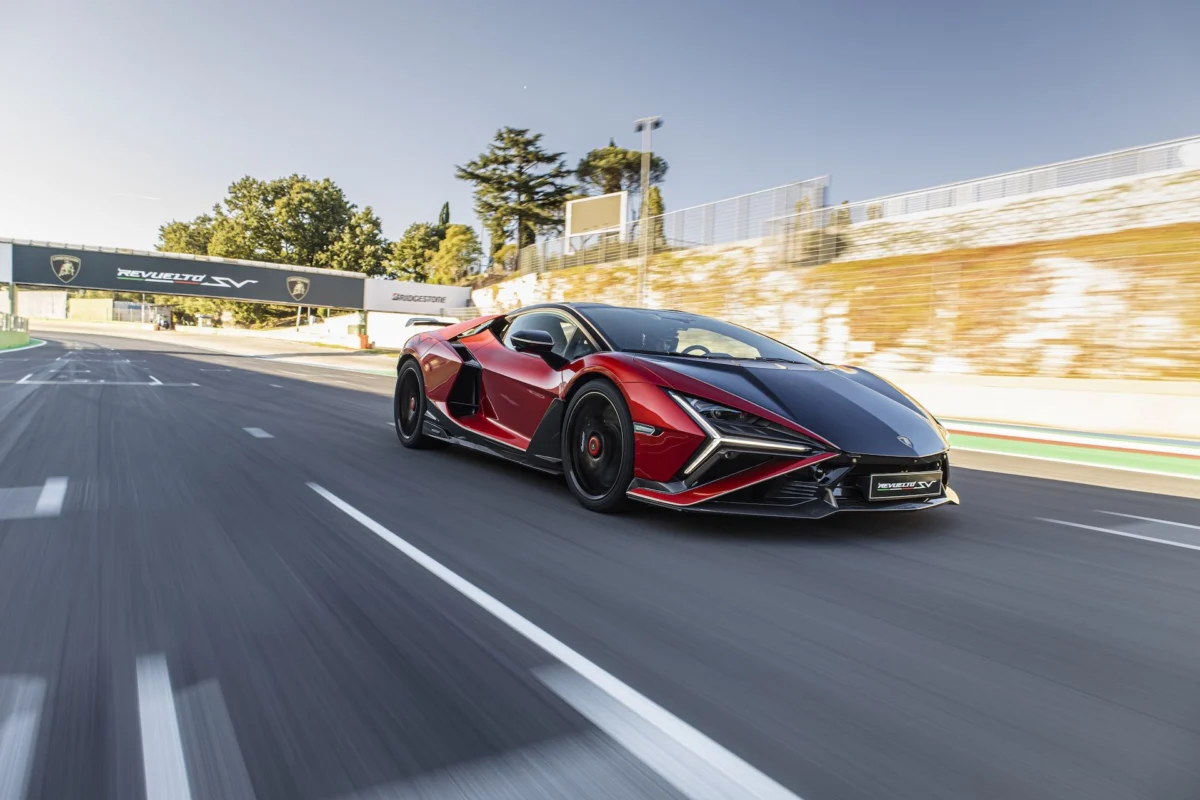
Long before I held a driver’s license, my life was defined by a singular, all-consuming obsession with anything on wheels. I recall my earliest days not in a crib, but in a pedal-less toy car, “Fred Flintstoning” my way across the pavement. I lived for rides in my father’s aging Beetle, a machine that belched black smoke and rattled with a mechanical ferocity that—to my young ears—sounded like pure power. If that young, car-obsessed version of myself were to encounter the 2027 Lamborghini Revuelto SV in a dark room, I am certain I would have run in terror.
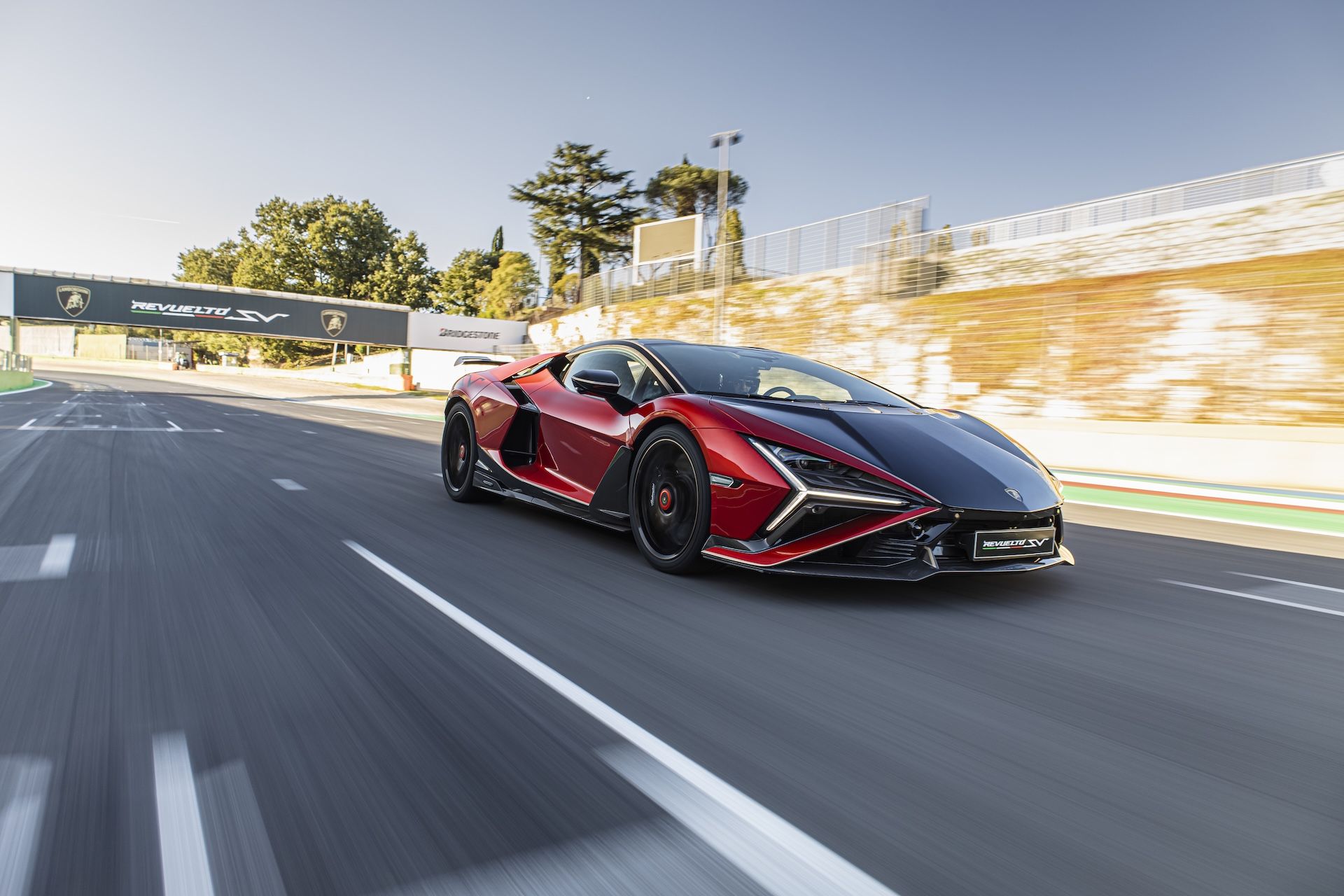
The Revuelto SV is not a machine of subtlety. With its predatory, nose-down stance and piercing, slit-like LED eyes, it possesses a menacing aesthetic that feels truly diabolical. It is a machine that seems to exist solely to pounce. However, after spending a punishing, exhilarating day pushing it to its absolute limits at Italy’s legendary Autodromo di Vallelunga, I discovered that this “sinister” reputation is, in fact, the car’s greatest strength.
The Evolution of the "Super Veloce"
The 2027 Lamborghini Revuelto SV is the latest iteration of the storied Super Veloce (Super Fast) badge—a designation that has carried the weight of automotive legend for 55 years. From the iconic Miura and the sharp-edged Diablo to the brute-force Murciélago LP 640-4 and the V12-powered Aventador, the SV moniker has always signaled the pinnacle of Sant’Agata Bolognese’s performance capabilities.
This new model is a track-oriented evolution of the standard Revuelto plug-in hybrid. But do not let the “plug-in hybrid” label deceive you into thinking this is a fuel-sipping commuter. This is an electrified masterpiece of engineering designed to make your toes curl the moment the V12 ignites, and your vision blur when you demand its full, combined 1,050 horsepower. Production will be strictly limited to 1,963 units, a nod to the year Ferruccio Lamborghini founded the company.

Engineering the Beast: Monofuselage and Propulsion
At its core, the Revuelto SV utilizes a state-of-the-art carbon-fibre monofuselage. In a departure from previous V12 Lamborghinis, the gearbox is mounted transversely behind the engine. The powertrain setup is a masterpiece of complexity: a naturally aspirated 6.5-liter V12 engine works in concert with three axial-flux electric motors. Two are mounted at the front axle, providing sophisticated torque vectoring and all-wheel-drive capability, while a third sits above the gearbox to bolster the rear wheels.
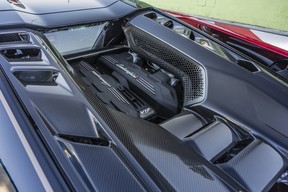
The V12 itself produces 813 horsepower and 535 lb-ft of torque. When the electric motors are factored in, the total output swells to a staggering 1,050 hp. For short, high-demand bursts, the system can summon up to 1,025 lb-ft of torque. The engine remains exposed—no glass or carbon covers here—a design choice by Lamborghini’s director, Mitja Borkert, who draws direct inspiration from the raw, mechanical aesthetic of high-end motorcycles like his own Ducati Panigale V4.
Aerodynamics and Weight Management
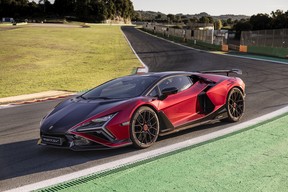
The SV treatment isn’t just about engine tuning; it is a masterclass in downforce. The engineers have achieved an 80% increase in downforce compared to the base Revuelto. This is immediately visible in the larger front splitter and the prominent fixed rear wing. While some might argue that an active wing is more “advanced,” the fixed wing on the SV is lighter, less complex, and arguably more effective for a pure track weapon.
These aerodynamic changes necessitate a slight sacrifice in top speed—dropping from the standard car’s velocity to a still-terrifying 345 km/h (214 mph)—but the gain in cornering stability is, frankly, priceless. The use of carbon-fibre components throughout the chassis saves roughly 28 kilograms, though this is offset by the larger 7.3-kWh lithium-ion battery pack required to sustain the car’s performance, leaving the dry weight at a substantial 1,772 kg (3,907 lb).

Suspension and Handling: The GT3 Philosophy
The suspension geometry has been entirely overhauled. By relocating the outer mounts for the upper control arms, the engineers have achieved a near 1:1 wheel-travel to damper-travel ratio. This configuration reduces camber loss by 12% during high-G compression, resulting in significantly improved grip.
The dampers are provided by KW and, unlike the semi-active units on the standard Revuelto, these are manually adjustable, passive units derived from GT3 racing technology. This system alone accounts for a 2.3-kilogram weight reduction. The setup is finished with center-lock wheels wrapped in bespoke Bridgestone Potenza Race R semi-slick tires, featuring a stylized “L” on the sidewall, confirming their specialized development for this chassis.

Stopping Power: The Brembo CCM-R Plus
If the power is otherworldly, the braking system is perhaps the most impressive element of the entire car. The Revuelto SV introduces the Brembo CCM-R Plus system, featuring composite front rotors with silicon-carbide plating.
Lamborghini has integrated a 6D sensor into the chassis that measures acceleration and angular velocity across three axes. This data is fed into an Integrated Vehicle Estimator (IVE), which predicts exactly how the brakes should respond in real-time. The result is a 10% improvement in braking distance and a pedal feel that remains linear, firm, and absolutely immune to fade, even after multiple 15-minute high-intensity lapping sessions at Vallelunga.

Interior: A Cockpit for the Elite
Inside, the cabin is a focused, driver-centric environment. You don’t just sit in the carbon-fibre-backed seats; you are cradled by them. Customization options are nearly limitless, though carbon-fibre trim remains the signature aesthetic. In a surprising collaboration, Lamborghini has partnered with Sonus Faber for the audio system—a brand known for home speakers that command six-figure price tags.
The steering wheel is a control center unto itself, featuring four distinct dials. One of these allows the driver to select the SV-exclusive “Pilota” mode. Derived from Lamborghini’s GT race program, this mode offers five levels of traction control intervention, allowing drivers to dial back the electronic safety net to nearly zero while simultaneously adjusting the suspension to absorb the shock of harsh track curbing.

Track Performance: The Data Doesn’t Lie
During our testing at Vallelunga, the Revuelto SV proved its worth. The car rockets from 0 to 100 km/h in a mere 2.4 seconds. While a high-performance SUV might achieve a similar sprint time, the Revuelto does it with an visceral, bone-chilling 9,400 rpm wail that no electric vehicle can replicate.
The integration of the electric motors effectively eliminates any perceived lag, providing an immediate, brutal rush of torque. Despite its weight, the car handles with the precision of a much smaller machine. The steering is sharp, and the grip provided by the Bridgestones is tenacious. Even when I pushed the car into corners at speeds that suggested I was headed for disaster, the SV simply turned harder, clawing its way through the apex with unflappable composure.

Testing at Germany’s Hockenheimring confirmed this dominance: the SV proved to be five seconds faster than the standard Revuelto, marking the quickest official lap time ever recorded by a street-legal car at that circuit.
The Implications for the Supercar Segment
The 2027 Lamborghini Revuelto SV is, at its heart, a race-track-bred machine for the elite enthusiast. With a price tag sitting at roughly US$741,000, it is not a car for the masses. Yet, it serves as a fascinating proof-of-concept for the future of the internal combustion engine in an electrified world.

By combining the raw emotion of a high-revving, naturally aspirated V12 with the precision of advanced electronic torque vectoring and hybrid assistance, Lamborghini has created something that is simultaneously more powerful and more forgiving than its predecessors. It is not “mentally taxing” to drive at the limit, which is perhaps the greatest compliment one can pay a track special.
The only minor gripe encountered during our time on track was the button layout on the steering wheel; under the intense physical strain of heavy cornering, it was easy to accidentally trigger the wipers or other auxiliary functions. However, this is a small price to pay for the level of control afforded by the wheel’s design.
Conclusion
The Revuelto SV is a triumph of engineering that balances the “demonic” nature of the Lamborghini brand with a refined, track-focused accessibility. It doesn’t snap at the driver; it encourages them. It is an intoxicating partner that masks its own mass with a display of mechanical and electronic mastery. For those fortunate enough to secure one of the 1,963 units, the experience will be nothing short of transcendent. It is, quite simply, the pinnacle of the Italian marque’s commitment to the art of the Super Veloce.
