

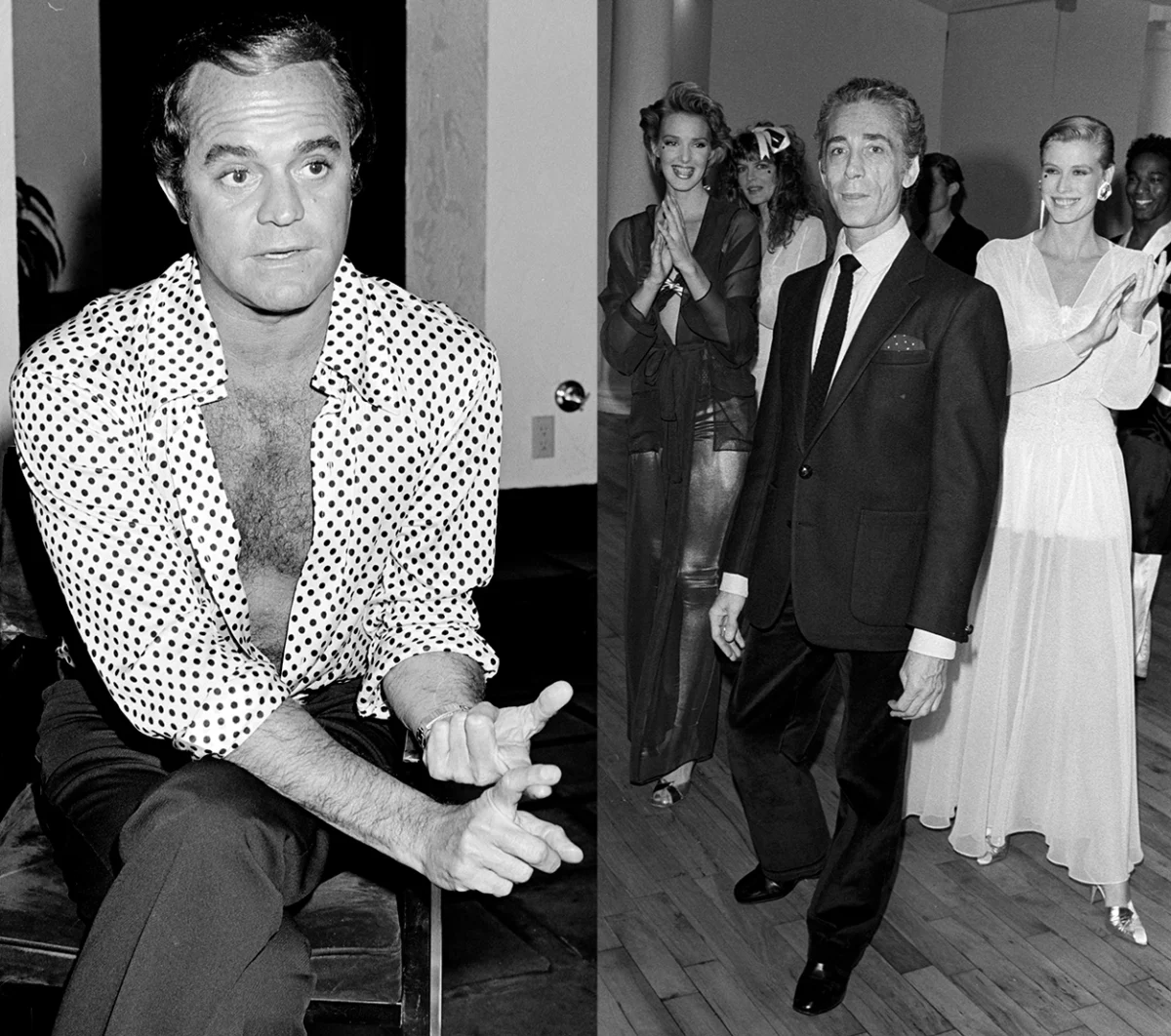
On a mid-September evening in 1990, the Grand Hyatt Hotel in Washington, D.C., became the epicenter of a cultural shift in the American fashion landscape. The Hispanic Designers Inc. organization was hosting its sixth annual gala and fashion show—an event that served not merely as a social gathering, but as a definitive coronation of two men who had spent decades weaving their heritage into the fabric of global style.
That night, Luis Estévez was honored with the Lifetime Achievement Award, while Fernando Sánchez received the prestigious MODA award. Both men, couture-trained and immigrant-born, had successfully navigated the transition from European ateliers to the competitive markets of New York and Los Angeles. In doing so, they did more than design clothes; they built legacies that challenged the traditional boundaries of ready-to-wear, eveningwear, and intimate apparel.
I. Main Facts: A Dual Legacy of Innovation and Heritage
The careers of Luis Estévez and Fernando Sánchez represent a pivotal chapter in the history of American fashion, one where Latin American and European sensibilities merged with the pragmatic demands of the American consumer.
Luis Estévez, a Havana-born visionary, is often remembered as the designer who brought a sense of architectural rigor and Caribbean warmth to the Hollywood elite. His work was characterized by a sharp understanding of silhouette, a skill he honed during his early studies in architecture. By the time he received his Lifetime Achievement Award in 1990, he had already dressed several of the most influential women of the 20th century, including First Lady Betty Ford and Princess Grace of Monaco.

Fernando Sánchez, a Spaniard by birth, achieved something perhaps even more revolutionary: he erased the line between the boudoir and the ballroom. While his peers focused on structured suits and evening gowns, Sánchez looked at lingerie and loungewear as untapped frontiers for high fashion. His "lounge-to-rtw" (ready-to-wear) concept was decades ahead of its time, predicting the contemporary obsession with slip dresses and pajama dressing that dominates runways today.
Together, these two designers represented the "Hispanic Influence" that the 1990 gala sought to celebrate—a blend of high-culture training, unapologetic glamour, and a relentless drive to modernize how women dressed for both public and private life.
II. Chronology: From European Ateliers to American Iconography
The Rise of Luis Estévez (1930–2014)
The journey of Luis Estévez began in the vibrant, high-society circles of pre-revolutionary Havana. As the grandson of sugar tycoon Santiago Estévez, he was born into a world of luxury that would later inform his aesthetic.
- Late 1950s: After arriving in New York to study architecture, Estévez took a summer job in the display department at Lord & Taylor. This exposure to retail sparked a pivot toward fashion.
- The Paris Years: Utilizing his social connections, he moved to Paris to apprentice under Jean Patou. It was here that he mastered the technical aspects of French couture, learning how to balance luxury with the emerging demand for high-end ready-to-wear.
- 1960s – The New York Era: Returning to Manhattan, Estévez founded Grenelle-Estévez. He secured a showroom at 550 Seventh Avenue, a legendary address in the Garment District that also housed contemporaries like Oscar de la Renta.
- 1967 – The Westward Shift: Seeking to recreate the "sun and sparkle" of his youth in Havana, Estévez moved his base to Los Angeles. This move allowed him to become the premier designer for Hollywood’s Golden Age stars and the socialites of Montecito.
The Evolution of Fernando Sánchez (1935–2006)
While Estévez was conquering Hollywood, Fernando Sánchez was revolutionizing the very concept of "home" dressing.

- Early Career: Born in Spain, Sánchez moved to Paris at a young age. His talent caught the eye of Yves Saint Laurent, who recommended him to the House of Dior. He further refined his craft at Maggy Rouff and Nina Ricci.
- Late 1960s – The American Transition: Sánchez moved to New York and took an unconventional path for a couture-trained designer: he became the designer for Warners bras and at-homewear.
- 1973 – Brand Independence: He launched his namesake label, focusing on what he called "glamorous and frivolous" lingerie that doubled as eveningwear.
- 1980s – Expansion: Sánchez signed major licensing deals with Lily of France and Vanity Fair, bringing his sophisticated vision to a broader market while maintaining his high-fashion status in the New York nightlife scene.
III. Supporting Data: The Architecture of the Aesthetic
The impact of Estévez and Sánchez can be measured through their distinct approaches to construction and their high-profile clientele.
The Estévez Silhouette
Estévez’s background in architecture was evident in his "clean-lined" approach. He was known for his "V-back" dresses and his ability to create drama without over-embellishment.
- The First Lady Connection: His most significant "data point" in terms of visibility was First Lady Betty Ford. Unlike many who wore custom one-offs, Ford frequently wore looks straight from his seasonal collections, providing a massive boost to his brand’s commercial viability.
- The Celebrity Roster: His client list included Lana Turner, Zsa Zsa Gabor, Natalie Wood, and Merle Oberon. This "Hollywood-Monaco" pipeline solidified his reputation as a designer of international stature.
The Sánchez Revolution
Sánchez’s genius lay in his material choices—lace, silk, and satin—and his ability to give them structural integrity.
- The Lounge-to-RTW Concept: In his 1975 collection for Warner, which featured 40 pieces of loungewear, he proved that "at-home" clothes could be as sophisticated as a cocktail dress.
- Signature Pieces: His most famous contributions included the tricolor "puff coat" and the lacy slip dress. These pieces were staples of the 1970s and 80s social scene, frequently seen at venues like Studio 54.
IV. Official Responses and Design Philosophy
To understand the weight of their contributions, one must look at how the designers and their contemporaries viewed their work.

Estévez was famously unapologetic about his focus on a specific, sophisticated demographic. In a 1976 interview with WWD, he stated:
“I associate fashion with the reality of the people I know who wear fashion, and where and how they wear it. I know that it’s not ‘in’ with the very hip crowd of people, but I don’t give a damn.”
This commitment to "his" woman—the socialite, the actress, the diplomat’s wife—allowed him to maintain a consistent brand identity for over four decades.
For Fernando Sánchez, the work was about emotion and liberation. His former assistant publicist, Tanya Wetenhall, recently recalled the eclectic mix of influences that drove his vision:

“Fernando brought fashion, sophistication, and construction to loungewear at a time when the category was still largely seen as something separate. It was a combination of his mother’s style, his love of Morocco, iconic films like ‘West Side Story,’ and the New York nightlife that inspired his artistic vision.”
Sánchez himself often downplayed his technical mastery of the lingerie category, preferring to see himself as a "dress designer" who happened to work in intimate fabrics. He famously noted that lingerie "must be, first of all, flattering."
V. Implications: The Enduring Mark on American Fashion
The recognition of Luis Estévez and Fernando Sánchez at the 1990 Hispanic Designers Inc. gala was a watershed moment. It signaled the industry’s acknowledgment that the "American Look" was not a monolith, but a tapestry woven by immigrant hands.
The Democratization of Glamour
Sánchez’s work with moderate-priced labels like Lily of France and Vanity Fair was a precursor to the modern "high-low" collaborations we see today. He proved that a designer could maintain a high-fashion reputation while selling to the mass market, provided the "intentional glamour" of the product remained intact.

The Hollywood-Fashion Nexus
Estévez’s move to Los Angeles in 1967 was a strategic masterstroke that anticipated the modern reliance of fashion houses on the red carpet. By positioning himself in the "Havana of his youth"—California—he created a lifestyle brand before the term was commonplace, encompassing couture, furs, and even home design at his estate, La Vista.
Contemporary Influence
The legacies of both men are visible on today’s runways. The "slip dress" trend, which has seen a massive resurgence in the 2020s, owes a direct debt to Sánchez’s refusal to keep lingerie in the boudoir. Similarly, the minimalist, architectural eveningwear of modern designers mirrors the discipline Estévez brought to the craft in the 1950s and 60s.
While their namesake labels may no longer be active, the honors bestowed upon them in 1990—the Coty Awards, the CFDA recognitions, and the Hispanic Designers Inc. awards—ensure their names remain synonymous with a period of American fashion that was as elegant as it was transformative. They did not just design for their time; they designed for the future of how we perceive beauty, comfort, and identity.
