

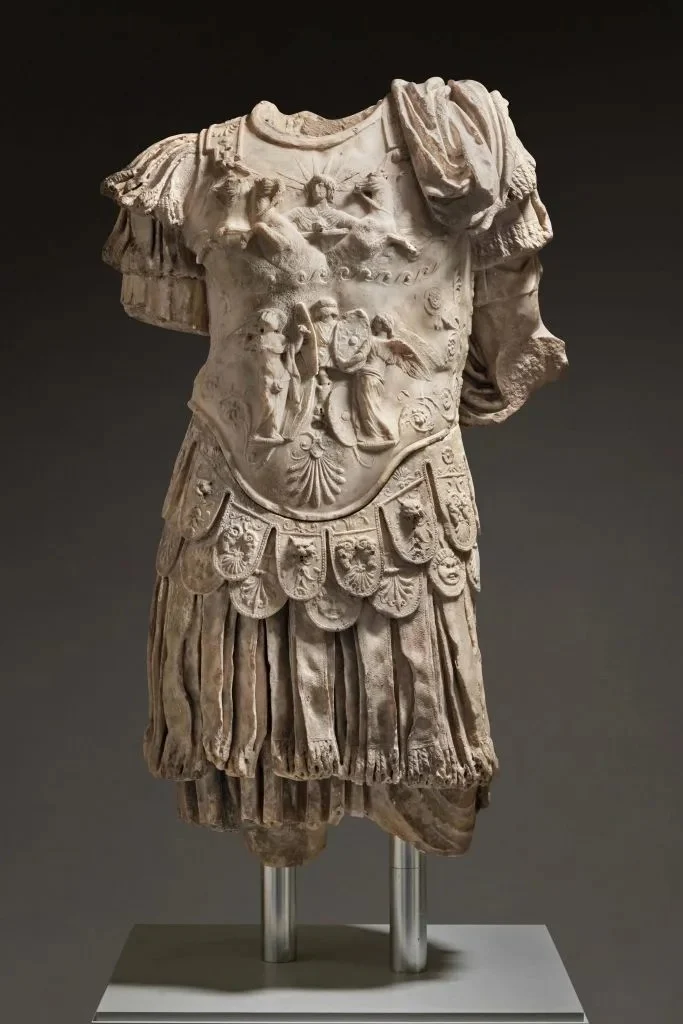
In a staggering display of the enduring allure of antiquity, a marble torso of a Roman emperor—dating back to the Julio-Claudian dynasty of the first century CE—has redefined the market for ancient art. On the evening of October 21, the masterfully carved sculpture hammered for $34.3 million at Sotheby’s, obliterating its high-end estimate of $12 million. This extraordinary result does more than just fill the coffers of the consignor; it establishes a new global auction record for a Roman antiquity, signaling a renewed, aggressive interest in the remnants of the classical world among the ultra-wealthy collecting class.
The price tag eclipses previous benchmarks, including the $28.6 million fetched by a bronze Artemis and stag in 2007 and the $24.5 million commanded by a marble Aphrodite in 2021. By clearing these hurdles, the Julio-Claudian torso has cemented its status as one of the most significant pieces of classical sculpture to ever cross the block in the modern era.
A Masterpiece of the Julio-Claudian Era
The torso is a testament to the sophisticated craftsmanship of the early Roman Empire. Larger than life-size, the work depicts a male figure clad in a highly ornate cuirass—the breastplate armor that was a symbol of military authority and imperial divinity. The stylistic nuances of the carving suggest it was produced during the first half of the first century CE, a period that saw the consolidation of Roman power following the transition from Republic to Empire.
Art historians and provenance researchers have traced the marble to the Aegean island of Paros, a site legendary in the ancient world for its superior, translucent white stone. It is widely believed that while the commission was Roman, the hand behind the chisel was Greek—an common occurrence in the era, where Roman patrons relied on the technical mastery of Hellenistic sculptors to project the majesty of the imperial family. The armor’s specific iconography suggests a direct lineage to the aesthetic established by Augustus, the first Roman emperor, who utilized such sculpture to project an image of a leader who was both a military conqueror and a guarantor of the Pax Romana.
Chronology of a Displaced Treasure
The journey of this sculpture from the civic heart of an ancient Roman city to the high-stakes environment of a Manhattan auction room is as complex as the history it represents.

From Salona to the Modern Market
Historians believe the piece originated in Salona, a major city in the Roman province of Dalmatia (modern-day Croatia). In its original context, the torso likely stood as a focal point in a temple within the city’s civic forum, serving as a constant reminder of the Emperor’s watchful presence over the provinces.
The Mid-Century Turmoil
For centuries, the work remained lost to the annals of history, only to reappear in the private collection of Wilhelm Aloys Maximilian Neumann, a nineteenth-century industrialist based in Graz, Austria. As World War II reached its crescendo and the Red Army advanced across Central Europe, the Neumann heirs recognized the potential for the destruction or looting of their cultural assets. In an act of desperate preservation, the family secreted the massive, heavy marble torso within the walls of their home.
The statue remained hidden for decades, effectively erased from the public record until the house underwent major renovations in the post-war era. Its subsequent rediscovery became a sensation in the art world, providing a rare "fresh-to-market" provenance that is the holy grail for high-end collectors.
The Rise in Value
In 2010, the torso appeared at a Sotheby’s auction, where it was acquired for $7.4 million. The buyer, a collector who has maintained a veil of anonymity, held the piece for over a decade. It was eventually consigned as part of an elite collection titled “Magnum Opus,” a series of sales designed to offer the world’s most significant works of art to a new generation of investors. The jump from $7.4 million in 2010 to $34.3 million in 2026 reflects not only the inflation of the art market but a massive shift in the perception of Roman sculpture as a blue-chip asset class.
The Economics of Antiquity: Why Now?
The $34.3 million price point is not merely a result of bidding momentum; it represents a fundamental change in the market for antiquities. Margaret Schwartz, global head of European and ancient sculpture at Sotheby’s, noted that the rarity of the work was the primary driver of the bidding war.

“Opportunities to acquire a Roman Imperial marble of this quality are exceptionally rare,” Schwartz remarked. “Bidders recognized that this was a museum-caliber sculpture with outstanding provenance, remarkable preservation, and profound historical importance.”
Experts suggest that the market for antiquities is currently benefiting from a "flight to quality." As the contemporary art market faces increased volatility and shifting trends, ultra-high-net-worth individuals are increasingly turning to classical antiquities as a store of value. These objects possess a "historical permanence" that modern works lack; they have survived empires, world wars, and the passage of two millennia. Consequently, they are increasingly viewed as foundational assets that transcend the ephemeral nature of the current art cycle.
Implications for the Global Art Trade
The record-breaking sale of the Julio-Claudian torso carries significant implications for the future of the antiquities trade.
Impact on Provenance Standards
With the increase in prices comes an increased scrutiny on the legality and ethical history of ancient objects. While this specific torso boasts a documented history stretching back to the nineteenth century, the high prices now commanded by such works will undoubtedly put pressure on auction houses to provide even more rigorous provenance documentation. The “Magnum Opus” sale highlights a new era of transparency, where the history of an object—from its excavation to its current ownership—is as valuable as the marble itself.
The Museum-Private Sector Divide
The sale also underscores a growing tension between private collectors and public institutions. While curators worldwide likely coveted the torso for their permanent collections, the sheer scale of the winning bid puts such works out of reach for many public museums, which often rely on restricted endowments. This shift suggests that the world’s most important cultural treasures are increasingly circulating within a closed loop of private wealth, only surfacing for public view at rare, high-profile auctions.

A New Benchmark for Roman Art
Finally, this sale resets the bar for the category of Roman Imperial art. For years, Greek and Egyptian antiquities have dominated the headlines in terms of valuation. By vaulting over the $30 million mark, this torso proves that Roman portraiture and statuary—previously undervalued relative to their aesthetic and historical weight—are now among the most sought-after categories in the art world.
Conclusion
The sale of the Roman Imperial torso is a defining moment for the art market in 2026. It serves as a reminder that the echoes of the Roman Empire continue to resonate, not just in our political and legal institutions, but in the physical objects that continue to captivate the human imagination. As the hammer fell at $34.3 million, it signaled more than a transaction; it marked the transition of a piece of history from a private residence to a new, perhaps even more exclusive, future. For the collector who secured the piece, the investment is a piece of eternity. For the art world, it is a new chapter in the ongoing history of how we value—and define—the past.
