

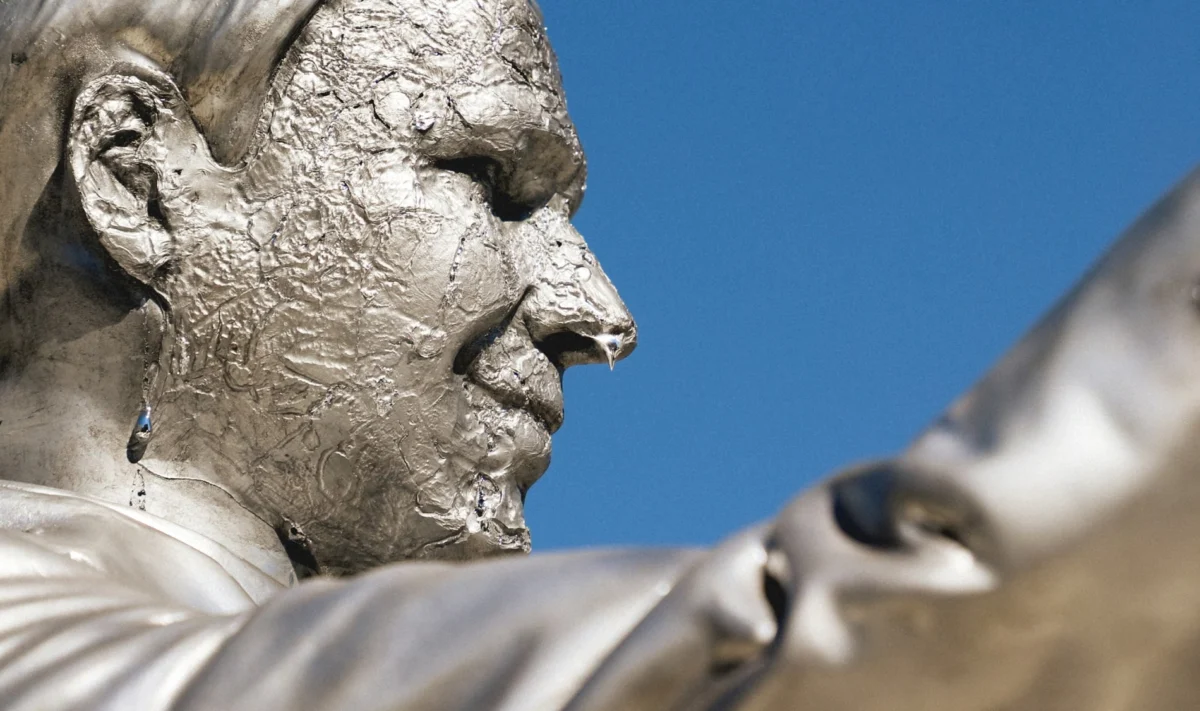
In a striking act of protest art that blurs the lines between political satire and environmental critique, a life-size statue of outgoing Florida Governor Ron DeSantis was unveiled in the state capital of Tallahassee last week. The sculpture, however, was never intended to stand the test of time. Crafted entirely from solid gallium—a rare metal with a remarkably low melting point—the statue began to liquefy almost immediately upon being placed in the Florida heat. As the visage of the Republican governor succumbed to the ambient temperature, a macabre feature was revealed: a stark, metallic skull hidden beneath the politician’s waxen-like exterior.
This ephemeral installation, organized by environmental advocacy group 350 Action in collaboration with the creative agency Uncommon, serves as a visceral metaphor for the state’s current climate trajectory. By utilizing a material that melts at 85.6 degrees Fahrenheit, the artists sought to confront the public with the reality of a warming planet, framing the governor’s legislative record as a "melting" of the very protections intended to safeguard Florida’s future.
A Chronology of Policy Reversal: The DeSantis Tenure
To understand the weight of this artistic protest, one must look at the legislative history of the past eight years. Ron DeSantis’s tenure, which is set to conclude this coming January, has been characterized by a systematic dismantling of environmental regulations and a concerted effort to decouple state governance from climate science.
The Early Years: Positioning and Rhetoric
When DeSantis first ascended to the governorship, he initially struck a more moderate tone regarding Florida’s environmental vulnerabilities, specifically concerning the Everglades and water quality. However, as his political ambitions grew and his ideological alignment with the hard-right wing of the Republican Party solidified, his approach to climate change shifted from peripheral neglect to active hostility.
The Legislative Assault
By the midpoint of his second term, the governor’s office launched a full-scale offensive against climate-conscious governance. Key milestones in this timeline include:
- 2023–2024: The state government initiated a series of sweeping bans on "net-zero" mandates, effectively prohibiting municipalities from setting local emissions targets. This move stripped power from cities like Miami and Orlando, which had been attempting to build localized climate resilience.
- The Educational Gag Rule: Perhaps most controversial was the legislative push to restrict the mention of "climate change" in public school curricula. By framing the topic as ideologically charged, the administration successfully limited the ability of educators to discuss the scientific consensus regarding human-induced warming.
- The "Scrubbing" Legislation: In a move that garnered national headlines, the state legislature passed a bill—signed by DeSantis—that officially removed the term "climate change" from various sections of Florida state law, replacing it with softer language that prioritized economic development and infrastructure maintenance without acknowledging the root cause of the environmental hazards.
- Energy Policy Shifts: The administration oversaw a legislative prohibition on offshore wind power development and consistently weakened oversight for natural gas pipelines, arguing that these measures were necessary to protect the state’s economic competitiveness.
Supporting Data: The Cost of Climate Denial
While the political discourse in Tallahassee has increasingly moved toward denialism, the physical reality of Florida’s geography tells a different, more expensive story. Florida serves as the "canary in the coal mine" for the United States, facing an existential threat from rising sea levels, intensifying hurricane seasons, and extreme heat events.

The Insurance Crisis
The most tangible impact of the state’s environmental volatility is the collapse of the insurance market. Florida homeowners currently face the highest insurance premiums in the nation. The math is simple: as the state experiences more frequent and severe weather events, the risk profile for insurers becomes unsustainable.
Over the last several years, more than a dozen major insurance carriers have either exited the Florida market entirely or filed for insolvency. This has left hundreds of thousands of residents dependent on "Citizens Property Insurance Corporation," the state-backed insurer of last resort, which has seen its enrollment balloon as private options vanish. Critics argue that by ignoring the climate-driven nature of these disasters, the state has failed to address the systemic cause of the market collapse, opting instead to bandage the symptoms while ignoring the cause.
Scientific Consensus vs. Political Reality
Despite the overwhelming consensus from organizations such as the National Oceanic and Atmospheric Administration (NOAA) and the Intergovernmental Panel on Climate Change (IPCC) regarding the dangers of unchecked emissions, the DeSantis administration maintained that such policies were "radical" and "anti-business." The irony, according to climate economists, is that the cost of inaction is rapidly outpacing the cost of mitigation. Projections suggest that if current trends continue, the economic loss to Florida’s coastal real estate and tourism industry will reach into the hundreds of billions by 2050.
Official Responses and Political Fallout
The unveiling of the melting statue was met with a predictably polarized response. Supporters of the governor’s environmental policies have characterized the stunt as "performative," "childish," and "misleading."
"This is not science; this is a circus," a spokesperson for the governor’s office commented in a brief statement following the statue’s collapse. "The Governor’s policies have been focused on economic stability and protecting the rights of Floridians to affordable energy, not bowing to the demands of environmental alarmists."
Conversely, the activists behind the project stand by the efficacy of their message. Candice Fortin, campaign manager at 350 Action, articulated the motivation behind the installation: "The climate crisis is one of the top issues facing our planet today. And yet, some candidates running for office still deny it’s happening, and deny the bold climate action that the people want. We wanted to show them, in the most literal way possible, what happens when you treat the environment as an afterthought."

Implications for the Future: A State at a Crossroads
As the clock runs down on the current administration, the focus of the state has shifted toward the upcoming election. In what is widely considered a Republican stronghold, the political temperature remains high. The GOP candidate favored to succeed DeSantis, Byron Reynolds, has signaled that he intends to continue the current trajectory. Reynolds has openly rejected the scientific consensus linking human activity to climate change, branding such concerns as "political theater" aimed at dismantling the American way of life.
The Changing Landscape of Florida Politics
The implications of this continuity are profound. For environmentalists, the next four years represent a critical window to shift public opinion. However, the state’s recent history of gerrymandering and the successful consolidation of power by the executive branch make a legislative reversal unlikely in the near term.
The melting statue in Tallahassee may be a fleeting image, destined to be swept away as debris once the metal has fully liquefied, but it represents a growing frustration among a segment of the population that feels the state is ignoring a slow-moving catastrophe. Whether this sentiment can translate into a meaningful shift in policy remains to be seen.
As Florida continues to experience record-breaking summer temperatures—many of which easily exceed the 85.6-degree threshold of the gallium statue—the gap between the state’s official legislative stance and its physical reality is widening. The statue is a mirror: it reflects a government that has chosen to look away while the ground—and the economy—beneath its feet begins to soften.
In the final analysis, the "Melting DeSantis" is not just a piece of art; it is a timestamp. It captures a specific moment in American history where the friction between political ideology and environmental reality reached a breaking point. Regardless of the outcome of the next election, the physical consequences of the state’s environmental policy will continue to manifest in the form of higher insurance bills, flooded streets, and a climate that is, in every sense, becoming increasingly volatile. The question for the next administration will not be whether they can stop the melting, but how they intend to help the state survive it.
