

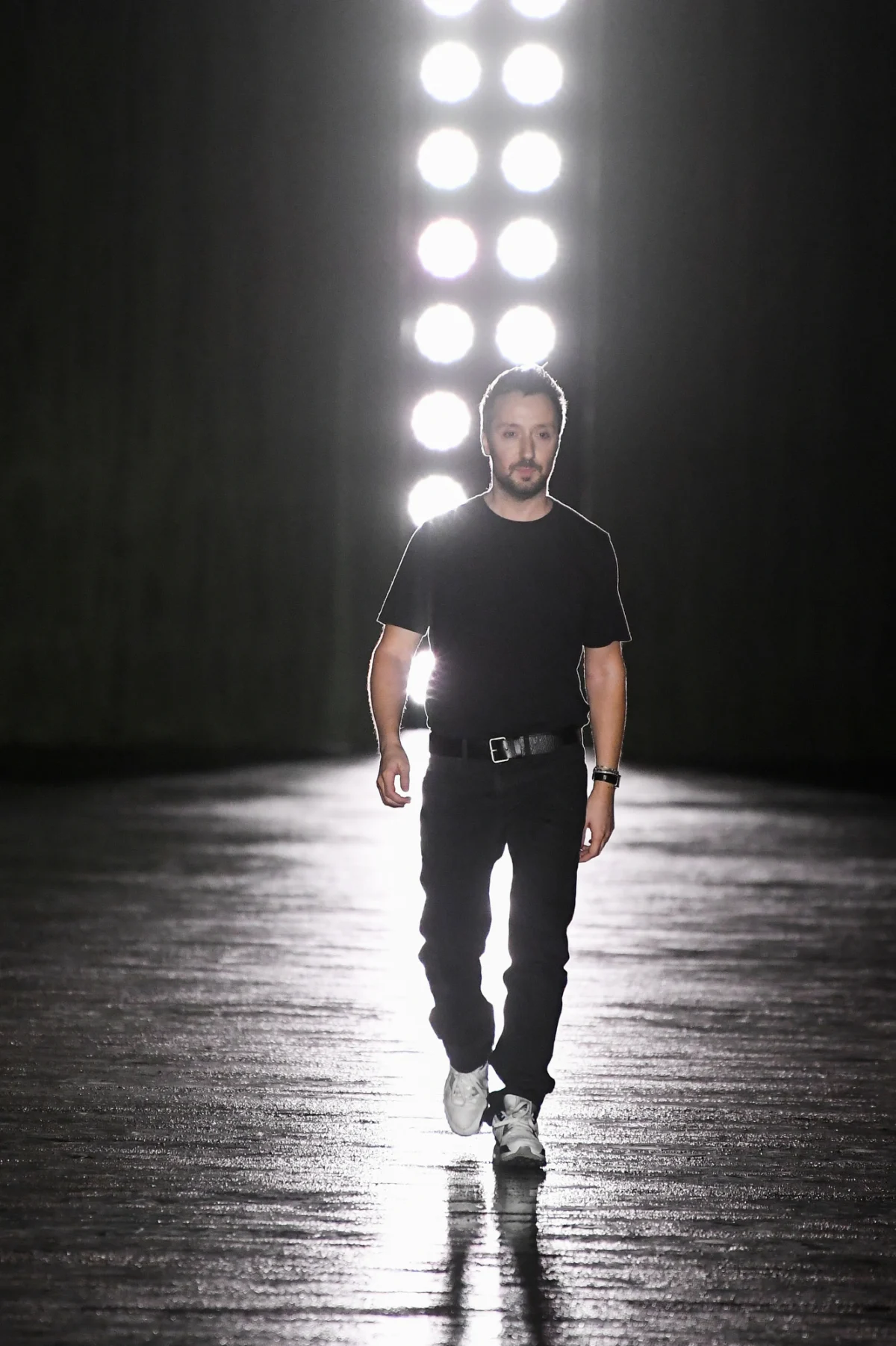
In a move that has sent tremors through the global fashion industry, Saint Laurent and its visionary creative director, Anthony Vaccarello, have officially announced the conclusion of their ten-year partnership. The departure, which brings to an end one of the most successful and culturally resonant tenures in contemporary design, marks a pivotal inflection point for the Kering-owned house as it prepares for a strategic transition.
The announcement, released by the Paris-based maison on Friday morning, was brief but underscored the weight of the moment. The house acknowledged that the 44-year-old Belgian designer “played a key role in Saint Laurent’s development, helping to strengthen its identity and influence across the worlds of fashion and culture.” While the official statement remains guarded regarding the specifics of his exit, the fashion world has spent the last week in a state of high-intensity speculation, following a Spring 2027 runway show that many industry observers have now retroactively dubbed a definitive “swan song.”
The Final Curtain: A Speculative Finale
The speculation surrounding Vaccarello’s exit reached a fever pitch during the most recent Paris Fashion Week. His all-gold Spring 2027 collection, presented under three monumental chandeliers in the shadow of a shimmering Eiffel Tower, possessed a gravity and a retrospective quality that felt, in hindsight, like a formal farewell. The grandeur of the set, combined with the collection’s focus on the essential codes of the house, provided a cinematic climax to a decade that saw Vaccarello transform Saint Laurent into a powerhouse of sharp, provocative, and highly desirable luxury.
The departure is being framed not as a failure, but as the completion of a mission. According to sources familiar with the internal workings of the Kering group, the decision was made with a view toward the long-term future of the brand. In a call with sell-side analysts shortly after the announcement, representatives from the parent company emphasized that the transition is entirely independent of the brand’s recent financial performance, focusing instead on a broader, multi-year strategic roadmap for the label.

A Legacy of Aesthetic Precision
To understand the significance of this departure, one must look back at the state of Saint Laurent in 2016, when Vaccarello first took the helm. Following the tenure of Hedi Slimane—who had radically redefined the brand through a rock-and-roll, “reform-heavy” aesthetic—Vaccarello arrived with a mandate to preserve the house’s rebellious spirit while simultaneously elevating its sophistication.
Over the course of his ten-year tenure, Vaccarello established himself as one of the most formidable showmen in Paris. His runway presentations were legendary, ranging from a monumental, man-made waterfall at the foot of the Trocadéro to a surrealist hedge of hydrangeas shaped into the brand’s iconic “Cassandra” logo. He was a designer who favored the hot-blooded, daring side of fashion, drawing heavily on the archives of Yves Saint Laurent—the safari jackets, the strong-shouldered tailoring, and the provocative evening wear—and filtering them through a lens of modern, aggressive sensuality.
Beyond the runway, Vaccarello’s contribution was structural. He maintained an iron grip on the house’s visual identity, most notably in the brand’s strict adherence to black-and-white photography for all social media and campaign imagery. This aesthetic discipline created a cohesive, recognizable world that resonated deeply with a new generation of luxury consumers.
Cultivating Culture: Beyond the Garment
Perhaps the most lasting legacy of the Vaccarello era will be his expansion of the Saint Laurent brand into the realm of high-level cultural production. In 2023, he established Saint Laurent Productions, a move that allowed the house to finance and produce films by globally acclaimed directors, including Jim Jarmusch, Pedro Almodóvar, and Jacques Audiard.

This venture proved remarkably successful, with films like Emilia Pérez and Father Mother Sister Brother garnering significant international accolades. By embedding the brand within the cinematic arts, Vaccarello elevated Saint Laurent from a fashion label into a multi-disciplinary cultural entity. This was further bolstered by the creation of Saint Laurent Editions and the launch of the Saint Laurent Babylone gallery in Paris, which served as a hub for art, literature, and intellectual exchange.
The Succession Question: Chemena Kamali’s Return?
As the industry turns its eyes toward the future, all signs point to a familiar face. Chemena Kamali, currently serving as the creative director at Chloé, is widely rumored to be the frontrunner to succeed Vaccarello. Kamali is far from a stranger to the Saint Laurent ecosystem; she previously served as the women’s ready-to-wear design director under Vaccarello from 2016 to 2023. Her deep institutional knowledge, combined with the success she has found in her own right, makes her a logical choice to lead the brand into its next chapter.
The transition, however, will be carefully managed. Kering’s leadership, including CEO Luca de Meo, has been clear about their intent to pivot toward under-represented product categories. According to notes from Barclays following the analyst call, the focus for the incoming creative leadership will be on scaling high-end leather goods, expanding the brand’s presence in men’s ready-to-wear, and deepening its penetration in key growth markets like China and the broader Asian region.
Official Responses and Corporate Strategy
The transition has been met with a chorus of praise from Kering’s upper echelons. Luca de Meo, who took the role of CEO at Kering in late 2025, issued a statement of profound gratitude: “I would like to express my sincere gratitude to Anthony for his contribution to Saint Laurent over the past 10 years. Through his creative vision and exacting standards, he has contributed to strengthening the enduring influence of one of France’s greatest couture houses.”

Cédric Charbit, the president and CEO of Saint Laurent, echoed these sentiments, noting that Vaccarello’s work was instrumental in elevating the house to the "forefront of desirability."
The business side of the transition appears stable. Despite the creative shift, Kering does not expect any disruption to the product pipeline. Because the brand’s revenue has been heavily skewed toward "carry-over" leather goods—the perennial bestsellers that drive consistent profit—the company believes the core business is well-insulated from the volatility that often accompanies a change in creative direction.
Financial Context and Future Outlook
The timing of the departure comes as Saint Laurent positions itself for a period of aggressive expansion. While the wider luxury market has faced headwinds, Saint Laurent has remained a beacon of stability within the Kering portfolio. In the first half of 2026, the brand saw a return to growth, outperforming several of its sister labels.
The strategy for the next five years is ambitious. During the company’s Capital Markets Day in Florence last year, leadership emphasized the need to "reawaken and reinvigorate icons," transforming them into products that transcend seasonal fashion cycles. The goal is twofold: to double sales to Very Important Clients (VICs) by 2030 and to simultaneously double the brand’s footprint in Asia.

A Legacy Set in Stone
As Anthony Vaccarello prepares to receive his International Designer of the Year award at the CFDA Fashion Awards in New York this November, he leaves behind a house that is vastly different from the one he inherited. He took a historic label and gave it a modern, razor-sharp edge that captured the zeitgeist of the 2020s.
Whether it was through the recruitment of master handbag designer Johnny Coca—a quiet but critical move to bolster the brand’s accessories business—or the cultivation of an inner circle that included icons from Kate Moss and Charlotte Gainsbourg to the legacy muses of Yves himself, such as Catherine Deneuve, Vaccarello understood that the business of luxury is built on more than just the cut of a blazer. It is built on the construction of a myth.
As Saint Laurent prepares to announce its new creative leadership, the industry watches with bated breath. The bar set by the Belgian designer is incredibly high, and the challenge for his successor will be to maintain that same sense of "desirability" while navigating the complex demands of a modern global luxury giant. For now, however, the fashion world pauses to acknowledge the end of a decade that was, in every sense of the word, golden.
