

For decades, the fitness industry has touted the floor mat as the ultimate sanctuary for abdominal training. From crunches to complex Pilates sequences, the prevailing wisdom suggested that to tighten the midsection, one had to get down on the floor. However, for adults over the age of 60, this traditional approach may be missing the forest for the trees.
While Pilates remains an exceptional discipline for flexibility and foundational core awareness, it is often insufficient as a standalone solution for the metabolic and physiological challenges of aging. If your primary goal is to address belly overhang and improve body composition after 60, shifting your focus from floor-based isolation to functional, standing strength training is not just a preference—it is a strategic necessity.
The Physiology of Aging: Why Metabolism Slows Down
To understand why standing exercises are superior for the over-60 demographic, we must first address the biological reality of sarcopenia. According to the National Institutes of Health (NIH), the human body begins a steady decline in muscle mass around age 30, a process that accelerates significantly once we cross the 60-year threshold.
Muscle is not merely a tool for movement; it is metabolically active tissue. This means that even at rest, muscle demands more energy (calories) than fat tissue. As we lose muscle mass, our basal metabolic rate (BMR) drops. This creates a "perfect storm" for fat accumulation, particularly around the midsection. Relying solely on gentle mat work may help with posture, but it rarely provides the stimulus required to maintain the muscle mass necessary to keep the metabolism humming.
The Myth of Spot Reduction
A common misconception in the fitness world is the idea of "spot reduction"—the belief that performing hundreds of crunches will burn the fat specifically sitting over those abdominal muscles. Scientific evidence, however, consistently refutes this.
Research published in leading health journals confirms that you cannot target fat loss by exercising the muscles underneath the fat. Instead, true, sustainable weight loss and body tightening are achieved through a two-pronged approach: increasing total daily caloric expenditure and preserving lean muscle mass throughout the entire body. Standing exercises allow you to engage multiple muscle groups simultaneously, burning significantly more calories than isolated movements, all while sparing your joints from the repetitive strain often associated with floor-based equipment.
Expert Insight: Building Strength Without the Toll
We consulted with James Bickerstaff, a Certified Personal Trainer (CPT) at OriGym, to understand how older adults can optimize their training.
"Building muscle is particularly important as we age because it helps maintain metabolism and supports long-term weight loss," Bickerstaff explains. "Many people over 60 avoid strength training because they fear it requires heavy, joint-jarring weights. The beauty of standing functional training is that it uses your body weight in natural planes of motion, making it highly effective yet incredibly safe for the joints."
The Four Pillars: A Standing Core Routine
To help you combat belly overhang and reclaim your metabolic health, Bickerstaff has curated four essential standing movements. These are designed to be performed in sequence to maximize caloric burn and core engagement.
1. Sit-to-Stand Squats: The Functional Foundation
The sit-to-stand squat is perhaps the most vital movement for longevity. It mimics the act of rising from a chair—a fundamental daily task. By loading the largest muscles in the lower body (quadriceps and glutes), you trigger a significant metabolic response.
- How to do it: Place a sturdy chair behind you. Stand with your feet hip-width apart. Hinge at your hips and lower your glutes until they barely touch the seat, keeping your chest lifted and core braced. Drive through your heels to return to a standing position. Repeat for 3 sets of 12–15 repetitions.
2. Step-Ups: The Cardio-Strength Hybrid
Step-ups are a masterclass in efficiency. They build strength in the posterior chain—specifically the glutes and hamstrings—while simultaneously elevating your heart rate. This provides a cardiovascular benefit that floor-based ab exercises simply cannot match.
- How to do it: Stand facing a sturdy step or low bench. Place one foot firmly on the platform. Push through that heel to lift your entire body, bringing your opposite knee up toward your chest. Lower back down with control. Complete 10 repetitions per leg for 3 sets.
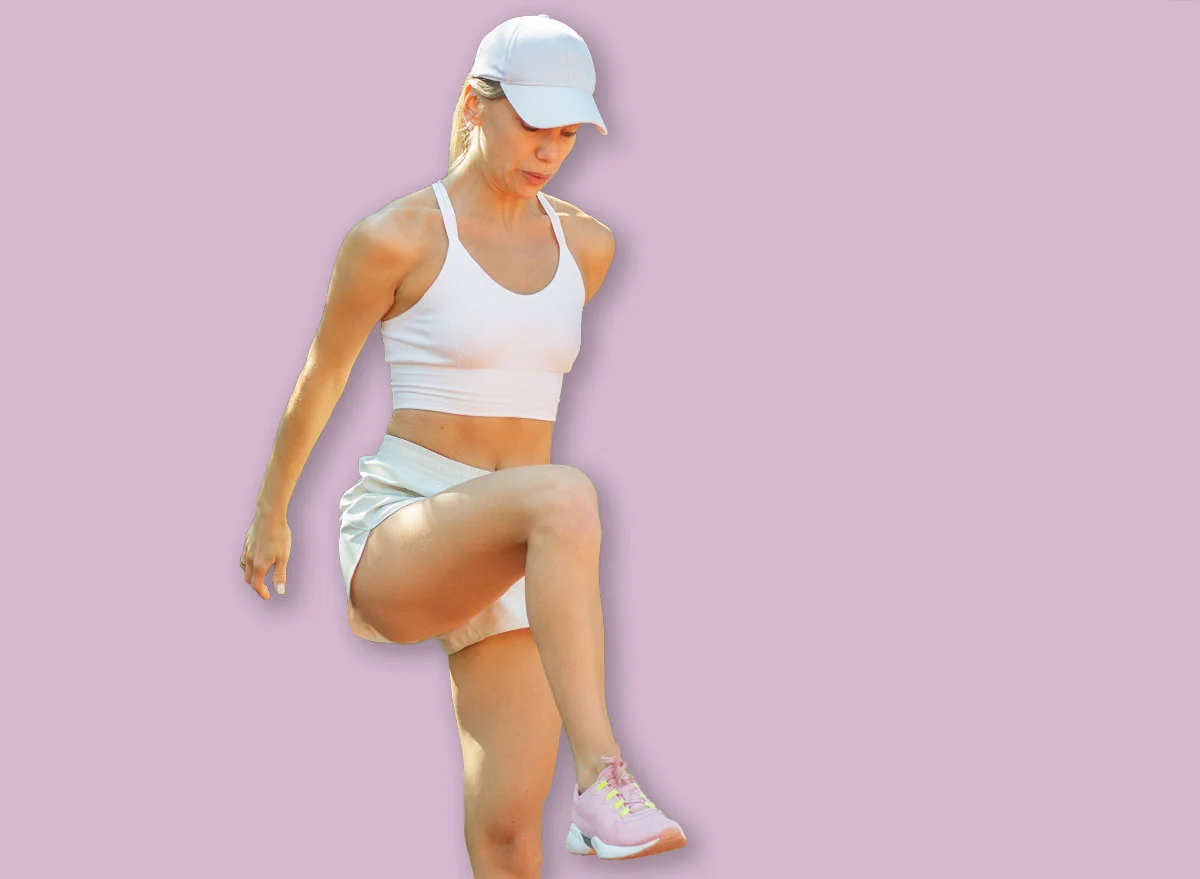
3. Standing Knee Raises: Deep Abdominal Engagement
"Standing knee raises strengthen your deep abdominal muscles without the discomfort of getting down onto the floor," says Bickerstaff. Because you are standing, your body must constantly recalibrate its center of gravity. This forces the deep transverse abdominis to stabilize the spine, providing a safer and more effective way to tighten the waist.
- How to do it: Stand tall with your feet hip-width apart. Engage your core, and lift one knee toward your chest while balancing on the other leg. Pause for a second at the top, focusing on the contraction in your lower abdomen. Return the foot to the floor and switch sides. Perform 20 total repetitions for 3 sets.
4. Standing Wood Chops: The Rotational Powerhouse
The wood chop is the definitive movement for functional core strength. It targets the obliques and the entire kinetic chain. By moving in a diagonal, rotational pattern, you replicate the twisting motions required for reaching, lifting, and turning in daily life—motions that often cause injury if the core is weak.
- How to do it: Stand with feet shoulder-width apart, knees slightly bent. Clasp your hands together or hold a light household object (like a water bottle). Reach your hands up toward one side of your body (as if grabbing an axe). In one controlled motion, pull your hands down and across your body toward the opposite hip. Keep your core tight and follow the movement with your eyes. Complete 10 reps per side.
The Implications for Long-Term Health
By integrating these movements into your weekly routine, you are doing far more than just tightening your midsection. You are addressing the core issues of aging: balance, metabolic decline, and joint health.
When you stand, you are forcing your body to act as a single, integrated unit. This "total body" approach is the most effective way to stimulate the hormonal and physiological changes necessary to shed body fat. As you continue to perform these exercises, you will likely notice improvements in your posture, your ease of movement, and your energy levels.
Conclusion: A New Approach to Aging Strong
The mat is not the enemy, but it is not the only path to health. For those over 60, the focus must shift from aesthetic-only abdominal training to functional, metabolic-boosting movement.
As you incorporate these four exercises, remember that consistency is your greatest asset. Start slowly, focus on your form, and listen to your body. By replacing the "crunch" with these standing alternatives, you are investing in a stronger, leaner, and more capable version of yourself—one that isn’t just surviving the aging process, but thriving through it.
