

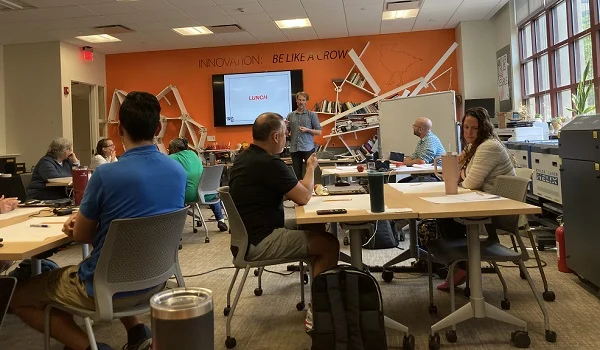
In the rapidly evolving landscape of 21st-century education, the traditional classroom model—often defined by rote memorization and linear instruction—is increasingly being challenged by the need for creative problem-solving and technical agility. This past August, NJTechWeekly.com visited the campus of Montclair State University (MSU) to observe a high-impact initiative aimed at transforming how New Jersey educators approach innovation.
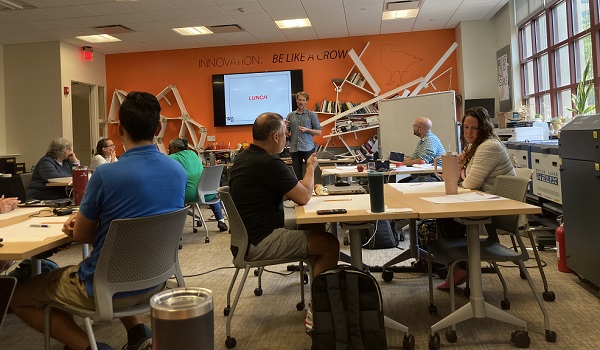
Professors Jason Frasca and Iain Kerr, the driving forces behind the MIX Lab at Montclair State, hosted an intensive 3D printing and innovation workshop designed to equip K-12 teachers with the tools necessary to foster a new generation of inventors. Supported by the Picatinny Arsenal—a premier U.S. Army research and engineering facility—the program serves as a critical bridge between military-grade technological expertise and the foundational needs of the modern classroom.
The Objective: Beyond Mere Printing
The goal of the workshop extends far beyond teaching educators how to operate a 3D printer. While hardware proficiency is a prerequisite, the curriculum focuses on the integration of digital-design software (CAD), the pedagogy of creativity, and the application of STEAM (Science, Technology, Engineering, Arts, and Math) frameworks.
The initiative aims to shift the educator’s role from "lecturer" to "facilitator." By mastering these technologies, teachers gain the ability to provide their students with the autonomy and agency required to navigate complex design challenges. As Frasca noted, the workshop models this autonomy for the teachers, ensuring that when they return to their classrooms, they are not just teaching software, but a philosophy of creation.
A Strategic Collaboration
The synergy between the Picatinny Arsenal and the MIX Lab represents a long-term investment in New Jersey’s educational infrastructure. The Arsenal, which provides funding for educators to attend these workshops, is deeply committed to nurturing the STEM pipeline.
"Picatinny Arsenal supports STEM and STEAM education in New Jersey K-12 school systems by providing 3D printers and support for 3D printing and robotics teams in high schools," Frasca explained. "They engaged us many years ago to teach the teachers how to use their 3D printers."
Over time, this partnership has matured. What began as a logistical request for technical training has evolved into a pedagogical mission. The Arsenal recognizes that to maintain a workforce capable of advanced research and defense-sector innovation, the foundation must be laid in the early years of schooling. By empowering teachers to be the conduits of this knowledge, the Arsenal ensures that their investment has a multiplier effect across school districts throughout the state.
Chronology of the Workshop: From Analog to Digital
The workshop day is carefully structured to deconstruct the "fear of the blank screen."
Morning: Grounding the Digital in the Analog
The morning session, led by Iain Kerr, focused on bridging the gap between physical reality and digital design. Many educators arrive with a hesitation regarding CAD software, viewing it as an intimidating, abstract hurdle. To mitigate this, Kerr utilized "analog" design exercises.
Teachers were encouraged to use their entire bodies to map out design concepts, using rudimentary drawing skills to connect geometric shapes—rectangles, circles, and cylinders—that serve as the fundamental building blocks of digital software. This approach builds a vital "muscle memory." By translating a physical sketch into a digital workspace, the educator begins to understand how to manifest a project from a mental concept into a physical, 3D-printed object.
The 25-Minute Rule
A core tenet of the Frasca-Kerr methodology is the rejection of the "tool-first" approach. In traditional CAD courses, students are often forced to spend months learning every sub-menu and button in a software program before ever producing a single object.
"Our approach is to, within 25 minutes, get everybody actually creating something that they could 3D-print," Frasca said. "We show how one object can be made into virtually anything they want to make." By focusing on the manipulation of a single cube into a sphere, and eventually into a complex design, the teachers gain immediate confidence. This rapid prototyping strategy is essential for K-12 classrooms, where student engagement is often contingent on seeing tangible results early in the process.
Implications for 21st-Century Skill Acquisition
The pedagogical implications of the MIX Lab’s approach are profound. In an era where artificial intelligence and machine learning can generate content, the human element—ideation and intentionality—becomes more valuable than ever.
Challenging Traditional Ideation
Frasca posits that traditional paths to innovation are inherently limited by human experience. "We can only ideate what we know, what you’ve already seen and been exposed to," he explained. "Novelty requires approaches and tools and frameworks to actually get to some different, innovative place."
The workshop introduces teachers to frameworks within the design software that force them to push past their preconceived notions of form and function. By teaching students to design "beyond what they can imagine," the instructors are cultivating a mindset of curiosity. This is the bedrock of 21st-century skills: the ability to use technology not just as a tool for replication, but as a scaffold for novel discovery.
The "Loft" and Non-Linear Learning
In the afternoon sessions, Iain Kerr emphasized the importance of self-directed discovery. Rather than spoon-feeding students instructions on how to reach a specific outcome, teachers were taught to encourage students to find their own paths.
Kerr introduced the concept of the "loft" tool—a feature that allows for the creation of complex, organic shapes. More importantly, he advocated for a non-linear workflow. He encouraged teachers to allow students to keep multiple tools and tabs open simultaneously, jumping between different design processes to see which yields the most effective result.
"There is not one right way to create a design, but multiple ways," Kerr emphasized. This realization is a major shift for many educators accustomed to grading based on a single "correct" answer. By celebrating the process over the final output, teachers can create an environment where failure is treated as data, and iteration is celebrated.
Peer Learning: The Gallery Walk
To conclude the workshop, the participants engaged in a "gallery walk." This exercise requires educators to circulate the room, viewing the designs created by their peers. This practice serves two purposes:
- Technique Sharing: It allows teachers to witness different ways of solving the same problem.
- Community Building: It reinforces the idea that the classroom should be a collaborative ecosystem rather than a competitive arena.
Kerr noted that this practice is easily transferable to K-12 settings. By presenting their work and receiving constructive feedback, students learn to articulate their design choices—a critical communication skill that is often overlooked in STEM education.
The Path Forward: Empowering Educators
The enthusiasm observed in the MSU classroom was a testament to the efficacy of the program. As the day progressed, teachers moved from tentative experimentation to confident design, producing objects they hadn’t previously imagined possible.
The collaboration between Montclair State University and the Picatinny Arsenal serves as a replicable model for how universities and research facilities can support public education. By shifting the focus from "teaching the software" to "teaching the process of innovation," these workshops are equipping New Jersey’s teachers with the necessary agency to transform their classrooms into spaces of true invention.
In the long term, this initiative aims to create a culture of continuous learning. As technology continues to shift beneath our feet, the ability to adapt, experiment, and learn new tools independently—the very skills imparted by Frasca and Kerr—will be the defining factor in the success of the next generation of students. Through the lens of 3D printing, the MIX Lab is not just printing objects; it is printing the future of education.
