

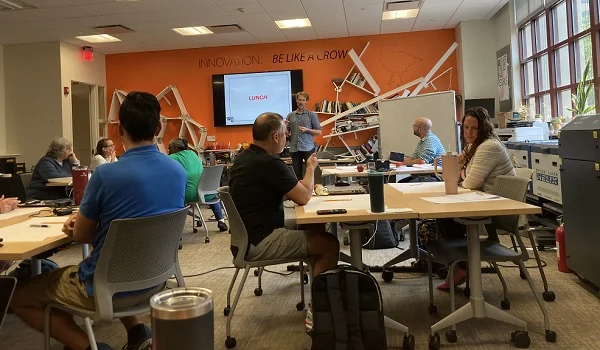
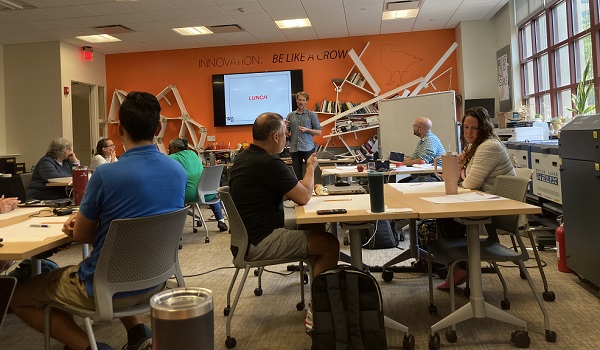
In the landscape of modern education, the gap between theoretical knowledge and practical application remains one of the most significant hurdles for K-12 educators. In August, NJTechWeekly.com visited Montclair State University (MSU) to observe a transformative initiative designed to bridge this divide. Professors Jason Frasca and Iain Kerr, leaders at the university’s renowned MIX Lab, hosted a specialized 3D printing and innovation workshop for New Jersey educators, signaling a shift in how schools approach technical literacy and creative problem-solving.
This initiative is more than a technical seminar; it is a pedagogical overhaul. By blending the precision of computer-aided design (CAD) with the tactile, fluid nature of artistic innovation, the workshop aims to equip teachers with the tools necessary to foster autonomy, agency, and 21st-century problem-solving skills in their students.
The Strategic Partnership: A Military-Academic Alliance
The workshop is the byproduct of a long-standing and high-impact collaboration between Picatinny Arsenal—a U.S. Army research and installation facility in Rockaway, New Jersey—and the MIX Lab at Montclair State. Recognizing that the future of defense and national innovation depends on a robust pipeline of STEM (science, technology, engineering, and math) and STEAM (science, technology, engineering, arts, and math) talent, Picatinny Arsenal has taken an active role in funding and resourcing local education.
"Picatinny Arsenal supports STEM and STEAM education in New Jersey K-12 school systems by providing 3D printers and support for 3D printing and robotics teams in high schools," Frasca noted during the session. "They engaged us many years ago to teach the teachers how to use their 3D printers, but the scope of our work has evolved significantly."
This evolution reflects a broader shift in educational philosophy. Where once the focus was purely on hardware maintenance and basic operation, the current program emphasizes cognitive processes. By underwriting the attendance of these educators, Picatinny Arsenal is effectively investing in a "train-the-trainer" model, ensuring that the influence of the MIX Lab extends far beyond the university campus and into classrooms across the state.
Chronology of the Workshop: From Analog Ideation to Digital Manifestation
The workshop was structured as an intensive, full-day immersion designed to break down the intimidation barrier often associated with advanced technology.
Morning Session: Bridging the Analog-Digital Gap
The morning began under the guidance of Iain Kerr, who led the educators through a series of exercises designed to decouple design from the constraints of software. Before touching a computer, teachers practiced "body-based" design. By utilizing physical movement and drawing rudimentary shapes, participants learned to visualize concepts in a three-dimensional space.
Frasca describes this as building "muscle memory." By mapping physical shapes—rectangles, circles, and spheres—onto the digital grid of CAD software, the transition from analog thought to digital execution becomes intuitive rather than mechanical. This approach directly challenges the traditional method of teaching CAD, which often involves months of rote memorization of toolbars and menu functions before a student ever produces a single physical object.
"Our approach is to, within 25 minutes, get everybody actually creating something that they could 3D-print," Frasca explained. By using basic tools to manipulate a simple cube into a complex sphere, students and teachers quickly realize that a single digital object can serve as a foundation for virtually anything.
Afternoon Session: Independent Inquiry and Design Pathways
As the day progressed, the focus shifted from technical proficiency to pedagogical strategy. Kerr emphasized the importance of self-directed learning. Rather than providing a step-by-step tutorial, the instructors encouraged participants to explore the software’s capabilities independently.
The class explored advanced techniques like the "loft" tool, which allows for the fluid transition between different cross-sections, providing creators with greater flexibility. Crucially, Kerr encouraged participants to keep multiple design tabs and tools open simultaneously. This multitasking approach fosters a "creative laboratory" mindset, where failure is not a setback but a necessary part of the design pathway. As the instructors reiterated, there is no "one right way" to create; there are multiple, valid paths to a single physical outcome.
Supporting Data: Why Modern Pedagogy Requires "Innovation Frameworks"
The pedagogical backbone of the MIX Lab’s philosophy is rooted in the limitation of human imagination. Frasca posits that traditional ideation is inherently flawed because individuals can only conceptualize what they have already experienced.
"We can only ideate what we know, what you’ve already seen and been exposed to, heard or engaged with," Frasca argued. "Therefore, we can never ideate anything novel or unique. Novelty requires approaches and tools and frameworks to actually get to some different, innovative place."
This is where the software becomes a partner in creativity. By providing teachers with frameworks that force them to think algorithmically and spatially, the MIX Lab helps them move beyond the limits of their own imagination. This is the essence of 21st-century skill-building: learning to use tools that augment human cognition to solve problems that were previously unthinkable.
The "Gallery Walk" exercise served as the capstone of this philosophy. By forcing participants to walk the room and critique one another’s projects, the workshop modeled the collaborative nature of professional engineering and design studios. It turned the classroom into a community of practice, a dynamic that the instructors urged the teachers to replicate in their own K-12 environments.
Implications for K-12 Education: Fostering Autonomy and Agency
The implications of the Montclair State/Picatinny Arsenal workshops are profound. By shifting the focus from "how to use a printer" to "how to teach creative agency," the program is helping to redefine the role of the teacher in a technology-rich environment.
The Shift from Instructor to Facilitator
In a traditional classroom, the teacher is the source of all information. In the MIX Lab model, the teacher becomes a facilitator of inquiry. When students learn to navigate software independently and troubleshoot their own design failures, they develop a sense of autonomy. This sense of agency is critical for long-term success in any STEM field; students who believe they have the tools to solve a problem are far more likely to persist when faced with complex challenges.
Preparing for the Future Workforce
The skills being taught—CAD proficiency, iterative design, spatial reasoning, and collaborative critique—are precisely those demanded by modern manufacturing, aerospace, and architecture firms. By exposing students to these processes early, the program helps build a workforce that is comfortable with ambiguity and proficient in the tools of the future.
Institutional Resilience
The partnership between a major military research facility and a public university creates a sustainable ecosystem. Picatinny Arsenal provides the capital and the real-world application, while Montclair State provides the pedagogical research and the training facilities. This model provides a blueprint for how other states can integrate high-level technical expertise into their public school systems.
Official Perspective: The Vision for the Future
The enthusiasm among the participating teachers was palpable. By the end of the workshop, educators who arrived with little more than a basic understanding of 3D printing were creating complex, innovative geometries that they had previously believed were out of their reach.
The MIX Lab’s mission remains clear: to provide the bridge between the digital and the physical, and in doing so, to unlock the creative potential of the next generation. As Jason Frasca and Iain Kerr continue to scale these workshops, their influence is rippling through New Jersey’s educational system. They are not merely teaching teachers how to use machines; they are teaching them how to build thinkers who are capable of designing the future.
In an era where technology is rapidly changing, the ability to learn, adapt, and iterate—skills that were at the heart of this summer’s workshop—is the most valuable education a student can receive. Through the sustained support of partners like Picatinny Arsenal, the MIX Lab ensures that New Jersey’s classrooms remain at the forefront of this global movement.
