

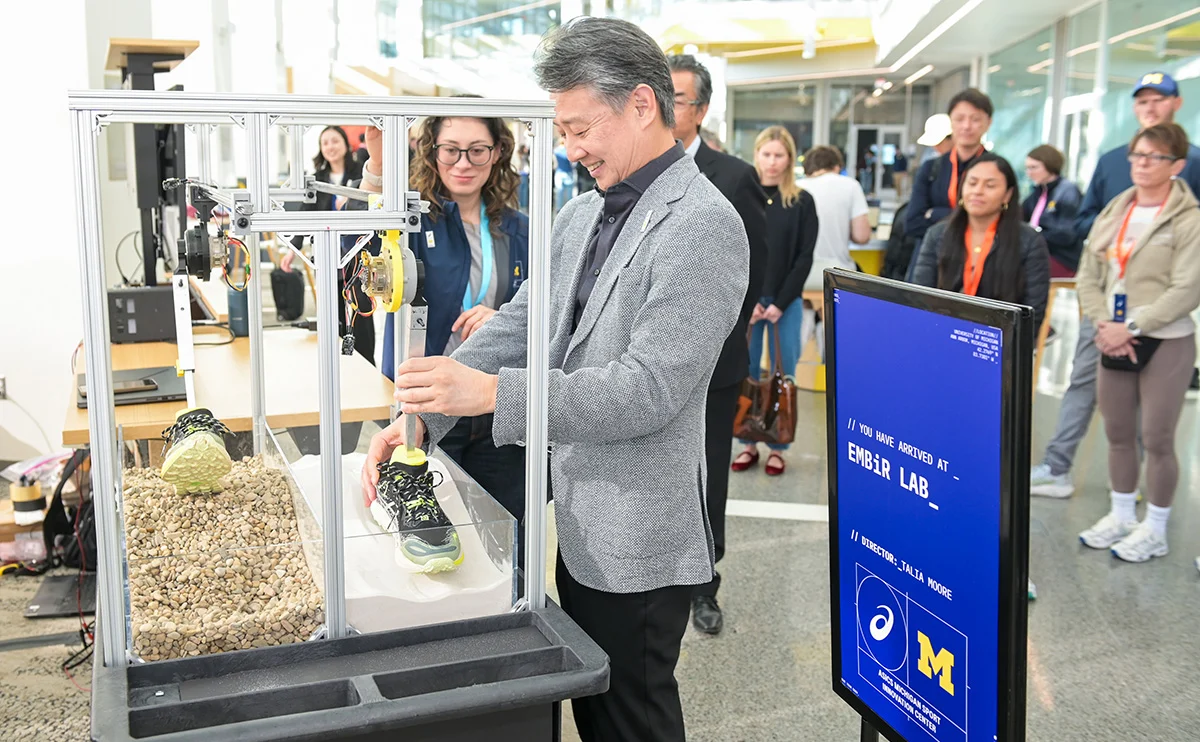
ANN ARBOR, MI — In a move that signals a significant shift in the landscape of athletic performance research, Japanese sportswear giant Asics has officially inaugurated the Asics Michigan Sport Innovation (AMSI) Lab. Situated on the campus of the University of Michigan in Ann Arbor, this state-of-the-art facility represents a $25 million investment aimed at collapsing the distance between high-level academic inquiry and consumer-ready footwear and apparel.
The AMSI Lab is not merely a satellite office; it is a collaborative powerhouse designed to integrate the rigorous scientific methodologies of one of America’s premier research universities with the industrial scale and product expertise of a global athletic leader. By fostering an environment where biomechanists, materials scientists, and roboticists work alongside elite athletes and product developers, Asics aims to redefine the boundaries of human performance.
I. Main Facts: A $25 Million Bet on Academic Synergy
The establishment of the AMSI Lab marks a cornerstone in Asics’ global research and development strategy. The project is backed by a $25 million commitment from the corporation, a figure that underscores the importance of the North American market and the value of American scientific talent to the brand’s future.
The Mission of the AMSI Lab
The primary objective of the AMSI Lab is to create what Asics describes as a "direct path" from the laboratory to the retail shelf. Historically, academic research in sports science often remains siloed within peer-reviewed journals, taking years or even decades to influence commercial product design. The AMSI Lab seeks to disrupt this timeline.
Collaborative Structure
The lab serves as a physical and intellectual crossroads. It brings together three distinct groups:
- University of Michigan Faculty: Experts in diverse fields ranging from robotics to computer vision.
- Asics Scientists and Developers: Professionals from the Asics Institute of Sport Science (ISS) who specialize in translating data into wearable technology.
- Athletes: Individuals ranging from collegiate stars to recreational runners who provide the "human feedback loop" necessary to validate laboratory findings.
Geographic and Strategic Significance
The choice of Ann Arbor is strategic. The University of Michigan is a global leader in engineering and kinesiology, and its athletic programs are among the most storied in the United States. By embedding itself within this ecosystem, Asics gains access to a pipeline of talent and a living laboratory of high-performance human movement.
II. Chronology: From Partnership to Physical Presence
The opening of the AMSI Lab is the culmination of a multi-stage strategic rollout that began in late 2023.
December 2023: The Foundation
The partnership was first formalized in December of last year when Asics and the University of Michigan announced a broad research collaboration. This initial agreement laid the groundwork for the joint research program known as the Asics Michigan Sport Innovation (AMSI) initiative. At that time, the focus was on establishing the intellectual framework for how a private corporation and a public university could ethically and effectively share intellectual property and research goals.
The Launch of ISS America
Simultaneous with the Michigan partnership, Asics established the Asics Institute of Sport Science America (ISS America). This entity serves as the brand’s first U.S.-based research arm, acting as a bridge between the Michigan lab and the global headquarters in Kobe, Japan.
2024: The Lab Opening
The recent ribbon-cutting in Ann Arbor signifies the transition from theoretical planning to operational research. The lab is now fully staffed and has begun its first cycle of projects.
2028: The Product Horizon
While the lab is operational today, the "real-world" impact for consumers has a clear timeline. Asics has noted that findings from the AMSI Lab are expected to begin informing new running and performance products by 2028. This four-year window allows for the rigorous testing, prototyping, and manufacturing cycles required to bring cutting-edge innovations to a global market.
III. Supporting Data: The Six Pillars of Innovation
The AMSI Lab’s research agenda is divided into six distinct but intersecting disciplines. To bring this vision to life, the lab has partnered with six key faculty members from the University of Michigan, each a leader in their respective field.
1. Biomechanics and Robotics
Faculty Leads: Elliott Rouse, Ph.D., and Ram Vasudevan, Ph.D.
The intersection of robotics and human movement is one of the lab’s most ambitious frontiers. Research here explores how wearable robotic systems or "exoskeletons" can assist in injury recovery or enhance performance efficiency. Dr. Rouse’s expertise in bionic systems and Dr. Vasudevan’s work in modeling human movement provide the data needed to create footwear that works in perfect harmony with the body’s natural mechanics.
2. Materials Science
Faculty Lead: Max Shtein, Ph.D.
The quest for the next "super foam" or carbon-plated breakthrough continues. Dr. Shtein’s work focuses on the molecular level of materials, exploring how new polymers and structural designs can provide better energy return while maintaining durability and sustainability.
3. Design and Adaptive Structures
Faculty Lead: Sean Ahlquist, Ph.D.
Dr. Ahlquist’s research focuses on "architected" textiles—materials that can change their physical properties based on tension or environment. This has direct applications for apparel that adapts to an athlete’s temperature or footwear that adjusts its support based on the terrain.
4. Computer Vision and AI
Faculty Lead: Richard Gonzalez, Ph.D.
By using advanced computer vision, the lab can analyze an athlete’s gait in real-time without the need for cumbersome sensors. This data allows for more precise product testing and could eventually lead to personalized digital coaching tools for consumers.
5. Ecology and Evolutionary Biology
Faculty Lead: Talia Moore, Ph.D.
Dr. Moore brings a unique perspective by studying the mechanics of movement in the natural world. By understanding how different species have evolved to move efficiently over varied terrain, the team can apply "bio-inspired" design principles to future performance gear.
6. Athlete Behavior and Preferences
Beyond the physical, the lab investigates the psychological. Understanding why an athlete chooses a specific shoe—and how they feel while wearing it—is critical for commercial success. This data ensures that scientific breakthroughs are matched with consumer desires.
IV. Official Responses: A Shared Vision for Movement
The leadership of both Asics and the University of Michigan have emphasized that this partnership is rooted in a shared philosophy: the belief that movement is essential to a high quality of life.
Mitsuyuki Tominaga, President and COO of Asics Corporation:
"Working with the University of Michigan allows us to engage with new thinking across science, engineering, and design that can challenge how we approach performance innovation. Asics has always placed athletes at the center of its research and product development. Our goal is to turn that knowledge into meaningful advances that help people move."
Domenico Grasso, President of the University of Michigan:
"The university and Asics share the conviction that research should benefit people by providing what they need to live and move well. Today, that shared philosophy finds a home here in Ann Arbor. The AMSI Lab connects Michigan researchers from across the university with Asics innovators to advance scientific research and accelerate the development of materials to help athletes of all levels."
Norihiko Taniguchi, CEO of ISS America and Co-Director of AMSI:
"AMSI Lab gives us a way to move more quickly from research questions to experimentation, athlete feedback, and product learning. What we learn here can directly inform future Asics research and help shape new approaches to running and performance innovation."
V. Implications: The Future of the Athletic Industry
The launch of the AMSI Lab carries significant implications for the athletic footwear industry, the academic community, and the consumer market.
A New Model for Corporate R&D
For decades, athletic brands have relied on internal labs (like Nike’s Sport Research Lab or Asics’ Institute of Sport Science in Kobe). However, the complexity of modern technology—incorporating AI, robotics, and advanced chemistry—requires a level of expertise that even the largest corporations struggle to maintain in-house. By partnering with a Tier-1 research university, Asics is adopting an "open innovation" model that leverages public-sector brilliance for private-sector advancement.
The "Personalization" Frontier
The heavy focus on computer vision and athlete behavior suggests that the future of Asics lies in personalization. By 2028, we may see products that are not just "off the shelf," but are digitally optimized for an individual’s specific biomechanical profile, informed by the data gathered at the AMSI Lab.
Competitive Pressure in the "Super Shoe" Era
The running industry is currently in an arms race. Since the introduction of carbon-plated, high-stack foams, every major brand (Nike, Adidas, Saucony, and Asics) has been desperate to find the next "1%" gain. The Michigan partnership gives Asics a potential technological edge, particularly in the realm of robotics and bio-inspired design, which could leapfrog current carbon-plate technologies.
Strengthening the Talent Pipeline
Beyond products, this lab serves as a recruitment tool. By working with Michigan PhDs and graduate students, Asics is securing a front-row seat to the next generation of scientific talent. For the University of Michigan, the $25 million investment provides its researchers with the funding and real-world data sets that are often difficult to obtain through traditional grants.
Conclusion
The Asics Michigan Sport Innovation Lab represents more than just a new building on a campus; it is a declaration of intent. As the athletic market becomes increasingly driven by data and deep tech, the brands that can most effectively bridge the gap between the "ivory tower" of academia and the "finish line" of the marathon will be the ones that lead. With a 2028 target for its first major product releases, the industry will be watching Ann Arbor closely to see if this $25 million experiment can truly change the way the world moves.
