

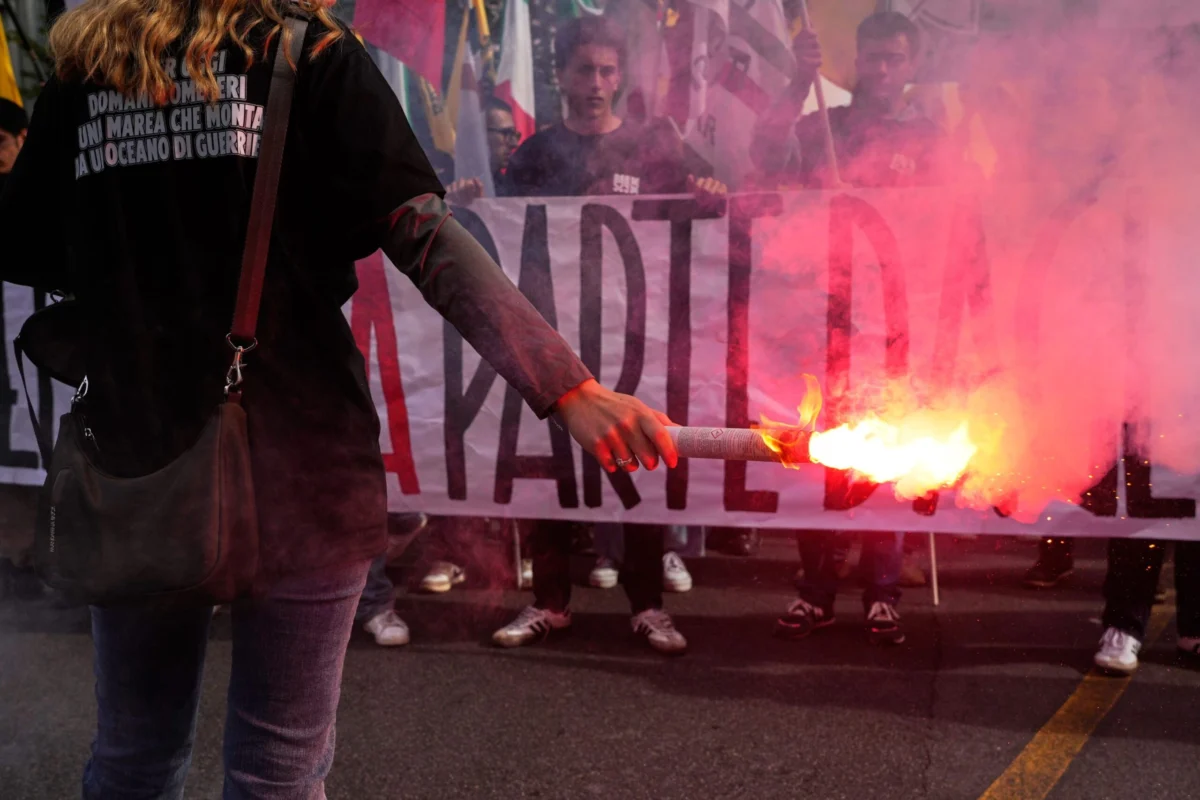
As the autumn chill settles over Europe, the political and social atmosphere across the continent has reached a boiling point. From the cobblestone streets of Milan to the plazas of Madrid and the boulevards of Tirana, citizens are taking to the streets in a wave of synchronized, yet disparate, protests. Driven by the rising cost of living, housing crises, and a perceived breakdown in the social contract, these demonstrations have pushed security forces to their limits and forced governments into an increasingly defensive posture.
The Milan Standoff: A City on Lockdown
In Italy, the tension is palpable. One week after Milan—the nation’s beating heart of finance and high fashion—was shaken by violent clashes and organized looting, the city has been transformed into a militarized zone. Prime Minister Giorgia Meloni’s administration, signaling a zero-tolerance policy toward civil disorder, has ordered the deployment of 500 additional soldiers to bolster the existing security apparatus.
This influx of military personnel joins a force of roughly 5,000 police officers and specialized law enforcement units tasked with maintaining order. The strategy is comprehensive, involving drone surveillance, strict perimeter checks at major railway hubs, and the deployment of rapid-response tactical teams.
The visual impact of this escalation is stark. Along the prestigious thoroughfares surrounding the Duomo, world-renowned luxury boutiques—including Gucci, Omega, and Tiffany—have been fortified behind wooden planks. The defensive measure follows last weekend’s chaos, during which rioters targeted high-end retail stores, specifically making off with high-value sneakers and athletic apparel.
The Limits of Military Intervention
While the presence of the army is intended to provide a visible deterrent, its effectiveness remains a point of contention. Defense Minister Guido Crosetto has been candid about the limitations of the deployment. In a series of social media posts, he noted that the soldiers currently stationed in the city lack the specialized training and equipment necessary for urban public-order operations.
"Soldiers are not law enforcement officers," Crosetto emphasized, noting that their authority is constrained by legal frameworks that prevent them from utilizing standard crowd-control tools like pepper spray or tasers. Even their ability to use plastic restraint ties is restricted to specific areas, such as train stations, rather than the urban center at large. Valter Mazzetti, secretary-general of the Fsp police union, echoed these sentiments, arguing that while soldiers offer temporary reinforcement, they cannot address the systemic staffing shortages that have plagued Italian police departments for years.
Chronology of a Crisis: From Protest to Riot
The unrest in Milan is being driven by a coalition of student federations, grassroots trade unions, and anti-war groups under the banner of the newly formed "Oct. 17 Movement." However, the events of the past week have raised serious questions about the composition of the crowds.
Police reports from last weekend indicate that the riots were spearheaded by approximately 2,000 individuals, many of whom were minors. Of the 45 individuals arrested during the two-day surge of violence, 34 were under the age of 18. Perhaps most significantly for the Italian political discourse, authorities noted that a substantial number of those detained were "naturalized, second-generation Italians" alongside foreign nationals.
This demographic reality has ignited a fierce debate regarding social integration and economic disenfranchisement. Lamberto Bertolé, Milan’s welfare councilor, argues that the violence is symptomatic of a deeper malaise. "Many young people increasingly lack a sense of belonging and prospects for the future," Bertolé stated. "Part of our society feels excluded, amid social and economic inequalities. We are seeing a generation that feels the state has no place for them."
A Continental Ripple Effect
While Milan occupies the headlines, the unrest is far from isolated. Across Europe, the grievances are broad and deeply entrenched, spanning education, pension security, and anti-corruption movements.
Albania: The Clashes in Tirana
In the Albanian capital of Tirana, the situation has turned arguably more volatile. Riot police have resorted to the use of water cannons and tear gas against protesters who have responded with flares, firebombs, and rocks. With 2,500 police officers deployed, the city center has become a site of persistent skirmishes.
The protesters—primarily high school and university students—are demanding a radical overhaul of the education system, citing excessive tuition fees and rampant corruption. The movement has also been co-opted by the political opposition, which is calling for the resignation of Prime Minister Edi Rama. Rama, for his part, has attempted to pivot to diplomacy, inviting student leaders to a dialogue while simultaneously warning that violent actors will face the full force of the law.
Spain: Pensioners and the Housing Crisis
In Madrid, the protest culture takes a different form. Thousands of retirees, waving colorful banners, marched through the capital to demand the protection of public pensions. The protest serves as a precursor to next month’s snap election, where the future of the Spanish social safety net has become a central campaign issue.
Underpinning the pension protests is a more desperate struggle: the housing crisis. A surge in rental costs, coupled with a lack of supply and the proliferation of short-term tourist rentals, has pushed many residents to the brink. In Puerta del Sol, a tent camp has remained in place for nearly a month, serving as a permanent, visible reminder of the thousands of citizens priced out of their own neighborhoods.
Portugal: The Battle Over Rental Caps
Lisbon is experiencing a similar wave of discontent. Protesters are rallying against government policies that they claim prioritize landlords over tenants. The administration of Prime Minister Luis Montenegro has recently eased caps on yearly rent increases and simplified the eviction process for non-payment. While the government insists these measures are necessary to restore investor trust in the rental market, activists argue that they have rendered the most vulnerable members of society homeless.
Official Responses and Implications
The response from European leaders has been a mixture of increased security and calls for social reform. In Italy, Prime Minister Meloni has proposed tougher penalties for minors involved in public disorder, a move designed to satisfy a base that is increasingly worried about the breakdown of law and order.
However, the political opposition and social advocates argue that legislative crackdowns will do little to address the root causes of the anger. The "Oct. 17 Movement" and similar grassroots organizations are tapping into a sentiment that transcends borders: the feeling that the European post-war economic model—which promised a better life for each successive generation—has stalled.
The Question of Infiltration
A significant concern for authorities across all these nations is the potential for peaceful protests to be hijacked. In Rome, where luxury shopping districts were locked down to prevent a repeat of Milan’s looting, student groups have gone to great lengths to distance themselves from the violence.
"I think the images from last week were truly something terrible," said Riccardo Ponzio, a national president of a student association. "We do not accept being represented by those who use issues and needs to devastate entire cities."
Despite these efforts, the specter of "infiltration" remains high. In many cities, organizers have taken to asking participants to keep their faces uncovered and their hands visible, a stark acknowledgment that the line between civil dissent and criminality is being tested daily.
Conclusion: A Precarious Winter
As winter approaches, the challenge for European governments is twofold: maintaining public safety while addressing the underlying economic structural issues that have sparked this unrest. Whether it is the housing crisis in Madrid, the educational inequality in Tirana, or the social alienation of youth in Milan, the message from the streets is clear.
The current reliance on militarized security measures may provide a temporary shield for high-end retail and government institutions, but it offers no solution to the systemic frustration brewing among the populace. If the current wave of protests is any indication, the coming months will require a delicate balance of law enforcement and significant, tangible economic reform if the continent is to avoid a winter of profound domestic volatility. The protests of today are not merely about specific policies; they are a manifestation of a continent searching for a new social contract in an era of uncertainty.
