

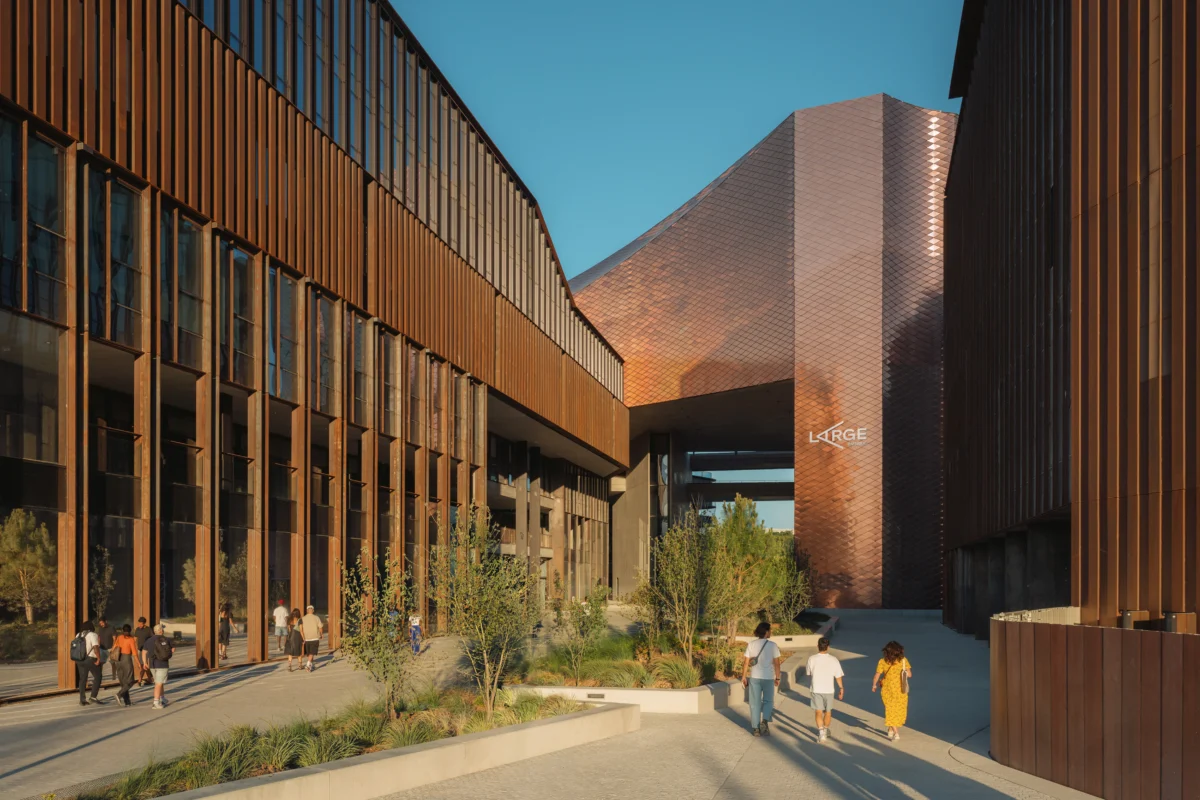
The narrative of Île Seguin, a slender strip of land cradled by the Seine in the western Parisian suburb of Boulogne-Billancourt, has long been defined by the heavy, rhythmic thrum of industrial machinery. For decades, this site served as the beating heart of the Renault manufacturing empire—a place where labor movements were forged and the rhythm of French industrial life was dictated. Today, that narrative has shifted irrevocably toward the aesthetic.
With the grand opening of Le Large, a sprawling 53,800-square-foot contemporary art center, the island has finally realized a long-held ambition to become a premier cultural destination. This is the museum that, by many accounts, almost never came to be. Twenty years ago, the island was the focus of an ambitious proposal by billionaire François Pinault, who sought to transform the derelict Renault site into a world-class art institution. That plan, however, collapsed under the weight of bureaucratic stagnation and political friction.
Today, Le Large—the passion project of Laurent Dumas, founder of the Emerige real estate group—stands as a testament to persistence. As part of a 200-million-euro investment into the "Pointe des Arts" district, the new center is not merely a gallery; it is a profound reclamation of industrial history, aiming to bridge the gap between high art and the public.
A Chronology of a Cultural Transformation
The history of Île Seguin is a microcosm of the French 20th-century experience. From the 1930s through the 1990s, the Renault factory employed over 30,000 workers. It was a site of immense social significance, famously encapsulated by the adage: "When Billancourt sneezes, France catches a cold."
The site’s transition began in earnest following the factory’s closure. François Pinault’s initial attempt to build a museum on the island in the early 2000s became a cautionary tale in the Parisian art world. According to Laurent Dumas, who has long been a fixture in the French art scene—having previously served as chairman of the board at the Palais de Tokyo—the failure of the Pinault project was a matter of timing and political alignment.

"I want to mention him because a great deal of nonsense has been said," Dumas noted during the opening festivities. "The reason François Pinault was unable to build his museum was beyond his control: it was because he lacked the support of the local elected official at the time."
While Pinault eventually found his home in Paris with the 2021 opening of the Bourse de Commerce, the void on Île Seguin remained. Dumas, who bought his first painting at the age of 18, saw the island not as a lost cause, but as a blank canvas for a different kind of institution—one that prioritizes public accessibility and civic engagement.
Architectural Vision: The Pritzker Pedigree
Designed by the Pritzker Prize-winning Catalan firm RCR Arquitectes, the architecture of Le Large is designed to harmonize with its unique riverfront geography. The building is a key component of a larger master plan that includes a hotel, the Seine Musicale—a celebrated music and performing arts center—a sculpture park, and a multiplex.
The design philosophy prioritizes transparency and accessibility. Nearly half of the center is designated as free-access space, including a soaring, light-filled central atrium and a fourth-floor café that boasts a panoramic terrace overlooking the Seine. By integrating public amenities with high-concept gallery spaces, the architects have sought to demystify the contemporary art experience, inviting the local community—not just the art-world elite—to claim the space as their own.
"Imaginary Engine": An Inaugural Reflection
To inaugurate the space, the institution appointed Cecilia Alemani, the visionary curator behind the High Line’s public art program and the 59th Venice Biennale. Her inaugural exhibition, titled Imaginary Engine, serves as a poignant nod to the site’s industrial soul.

The exhibition is, in many ways, an act of historical excavation. For the first time in France, the public can view masterpieces from the Renault Group’s Fund for Art and Culture. These works, which include pieces by Jean Dubuffet, Jean Tinguely, and Victor Vasarely—the latter of whom redesigned the iconic Renault diamond logo in 1972—were originally commissioned to decorate the factory’s staff canteens and administrative offices.
A centerpiece of the exhibition is the restoration of Julio Le Parc’s massive, multicolored frieze. Originally created between 1971 and 1974 to brighten the lives of workers on the assembly line, the frieze, crafted with industrial automotive paint, is a vivid reminder of the intersection between labor and beauty.
"It’s about trying to shake a little bit the narrative," Alemani explained. "I chose to focus on a story that is less known, and somehow maybe more European, than the American mythology of car culture."
The show also features 17 new commissions, including Mohamed El Khatib’s R12 Cathedral. The installation features a Renault R12 with a roof rack overflowing with luggage—a visceral, emotional representation of North African families embarking on long drives home for the holidays. It is a work that speaks to the diaspora, to the workers who fueled the factory, and to the modern identity of the French suburb.
Institutional Mission and Social Impact
Under the leadership of Paula Aisemberg, the former director of La Maison Rouge, Le Large has established a nonprofit mission that is as ambitious as it is democratic. The center intends to host two major exhibitions annually, supplemented by a robust program of free workshops for children and families.

"Le Large is an opening onto the wider world—an opening that is as broadly generous as possible, extending to people with limited access to the arts," Dumas said.
This commitment to accessibility is backed by a focus on the French art scene. The institution plans to showcase artists from a wide array of backgrounds, supporting both emerging talent and established figures. The production of new, site-specific work is a central pillar of this mandate. By curating exhibitions that draw from Dumas’ personal collection of nearly 2,000 works, alongside partnerships with global institutions, Le Large aims to position itself as a sustainable, forward-thinking player in the European art market.
The Future of the Île Seguin District
The success of Le Large will be closely watched, particularly as it relates to the broader development of Île Seguin. While past projects failed due to a lack of transit and logistical support, the current administration has signaled a strong commitment to the island’s growth.
Key to this is the upcoming expansion of the Grand Paris Express, which is set to significantly improve transport access to the island starting next year. This, combined with the presence of the Seine Musicale and the new cultural district, positions the site as a potential "cultural magnet" for the western Parisian suburbs.
Looking ahead, the programming calendar at Le Large is already filling up. Upcoming projects include a large-scale installation by Eva Jospin featuring historical treasures from the Kugel antiques gallery, and a monographic exhibition dedicated to Martin Barré.

Conclusion: A New Chapter
Le Large represents a significant shift in how cultural institutions are developed in modern France. It is an acknowledgment that the legacy of a site is not something to be erased, but something to be interrogated and honored. By transforming a place once defined by the "sneeze" of industrial labor into a sanctuary for contemporary thought, Laurent Dumas and his team have achieved something rare: a space that feels both intellectually rigorous and genuinely communal.
As the sun sets over the Seine, reflecting off the glass and steel of the RCR-designed building, one senses that the spirit of the island has finally found its rhythm. It is no longer a place of production in the traditional sense; rather, it is a place for the production of ideas, connections, and, ultimately, a broader understanding of what it means to be part of a changing society. Le Large is not just an art museum; it is an open door, inviting the public to step inside and find their own narrative in the art that surrounds them.
