

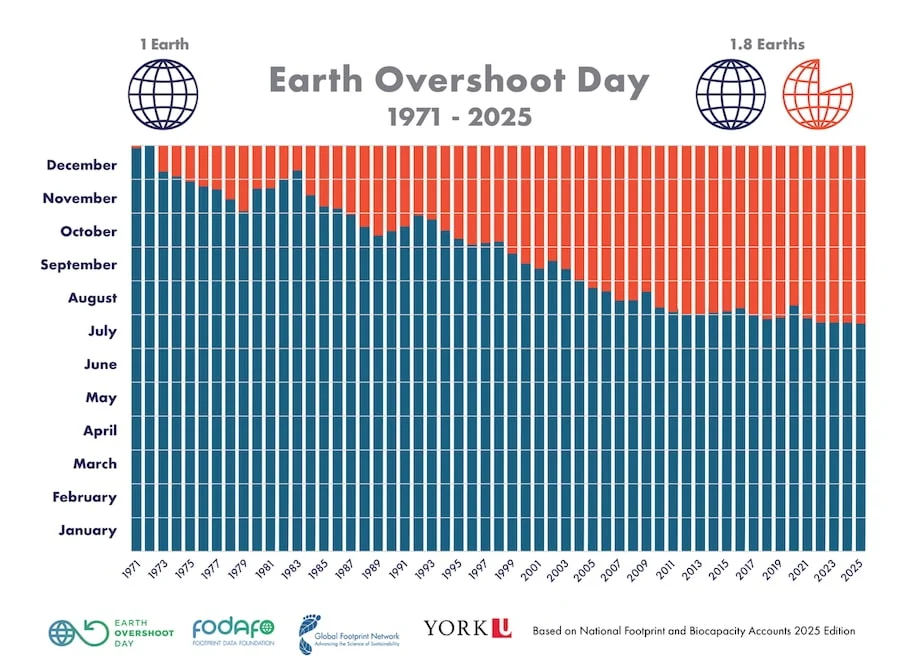
On July 24, 2025, humanity reached a somber milestone: Earth Overshoot Day. This date marks the precise point in the calendar when human demand for natural resources and ecological services exceeds what the Earth’s ecosystems can naturally regenerate within a single year. According to the Global Footprint Network, which calculates this annual threshold, 2025 has set a distressing record, marking the earliest arrival of Overshoot Day since the metric was first established in 2006.
We are currently operating at a deficit, consuming the planet’s renewable resources—such as freshwater, timber, and seafood—at a rate 1.8 times faster than the Earth’s capacity to replenish them. This ecological bankruptcy is not merely a theoretical concern; it is a physical reality that signals the rapid depletion of the very systems that sustain human life.
The Chronology of Consumption: A Long-Term Trend
To understand the gravity of the 2025 data, one must look at the historical trajectory of human consumption. In a significant move toward transparency, the Global Footprint Network recently recalculated historical data to provide a more accurate picture of our ecological footprint, even dating back to the mid-20th century.
In 1972, humanity lived within its means, with Earth Overshoot Day falling on December 31. By the end of that decade, however, the trend had shifted toward unsustainable consumption, with the date moving to November 3, 1979. Throughout the 1980s and 1990s, the date crept steadily earlier, reaching October 12 in 1989 and September 25 in 1999.
The turn of the millennium accelerated this decline. When the concept was first popularized in 2006, the date fell on August 22. By 2018, the world reached this threshold in July for the first time. Aside from a brief reprieve in 2020—largely attributed to the global economic slowdown caused by the COVID-19 pandemic—the date has remained firmly in July. The previous record, July 25, stood for two years (2022 and 2023) before being surpassed by the 2025 date of July 24.
Supporting Data: The Mechanics of Ecological Deficit
The Global Footprint Network calculates Overshoot Day by comparing the Earth’s "Biocapacity"—the amount of ecological resources the planet can generate—against humanity’s "Ecological Footprint," or the total demand for land, water, and atmosphere.
The core of the problem lies in the imbalance between regeneration and depletion. Humanity is not just harvesting renewable resources; we are also emitting carbon dioxide into the atmosphere at a rate far exceeding the capacity of our forests and oceans to sequester it. This carbon debt is the largest single component of our ecological footprint.

Furthermore, the impact is cumulative. Even if the date were to stabilize, the pressure on planetary systems continues to mount. Scientists have warned that we are pushing against critical thresholds; currently, humanity has already exceeded seven of the nine identified "planetary boundaries." These boundaries represent the safe operating space for humanity, and breaching them risks triggering irreversible environmental changes, such as catastrophic climate change, biodiversity loss, and ocean acidification.
Official Responses and Expert Analysis
The scientific community and those monitoring the Earth’s health have issued stark warnings regarding this trajectory. Lewis Akenji, a board member of the Global Footprint Network, emphasized that the damage is now deep-seated.
"We are stretching the limits of how much ecological damage we can get away with," Akenji stated. "It is now a quarter into the 21st century, and we owe the planet at least 22 years of ecological regeneration, even if we stop any further damage now. If we still want to call this planet home, this level of overshoot calls for a scale of ambition in adaptation and mitigation that should dwarf any previous historical investments we have made, for the sake of our common future."
Mathis Wackernagel, co-founder of the Global Footprint Network, framed the issue as an unavoidable choice between proactive management and reactive catastrophe. "Because of the nature of physics, overshoot cannot last," Wackernagel warned. "It will end either by deliberate design or dumped-on disaster. It should not be too hard to choose which one is preferable, particularly in light of so many possible choices."
Implications: The Price of Inertia
The implications of a July 24 Overshoot Day are profound. Operating in an ecological deficit means that we are liquidating our natural capital. We are effectively "eating" the planet’s future to fuel current consumption.
The consequences manifest in localized ways that are becoming increasingly global: water scarcity in regions that once had abundance, the collapse of commercial fisheries due to over-extraction, and the loss of forest cover which exacerbates global warming. When we consume beyond the Earth’s capacity, we reduce the planet’s ability to provide food, clean air, and water for the generations that follow.
The economic model that prioritizes infinite growth on a finite planet is clearly failing to account for the physical constraints of the biosphere. The "dumped-on disaster" that Wackernagel warns of is already appearing in the form of extreme weather events, which are exacerbated by our current ecological overreach.

The Power of Possibility: A Roadmap to Change
Despite the bleakness of the current data, the Global Footprint Network maintains that the situation is not irreversible. Through their "Power of Possibility" campaign, they have outlined structural, systemic changes that could significantly shift the date back toward the end of the year.
The most effective levers for change include:
- Decarbonizing Energy: The most significant impact would come from cutting global carbon emissions by 50%. This single action could shift Earth Overshoot Day by three months, effectively returning humanity to a much more sustainable trajectory.
- Transforming Food Systems: Reducing global food waste by half would push the date back by 13 days. Given that roughly one-third of all food produced for human consumption is currently wasted, this is a target that could be met with improvements in logistics, storage, and consumer behavior.
- Renewable Energy Transition: Moving toward a grid where at least 75% of electricity is generated from renewable sources like wind, solar, and hydro could shift the date by 26 days.
- Policy Reform: Implementing a "Green New Deal" at a global scale—comprising comprehensive climate legislation and sustainable infrastructure investment—has the potential to move the date by 42 days.
Conclusion: A Turning Point
The arrival of Earth Overshoot Day on July 24, 2025, serves as a sobering alarm. It is a reminder that the resources we often take for granted—the air we breathe, the water we drink, and the soil that grows our food—are not infinite.
The path forward requires a fundamental shift in how societies define progress. Moving from an extractive economy to a regenerative one is the defining challenge of our era. While the trend line has been moving in the wrong direction for decades, the solutions are well-documented and scientifically backed. The question is no longer whether we possess the knowledge or the technology to live within our planet’s limits, but whether we possess the political and social will to enact the systemic changes required to stop the clock on our ecological debt.
As Wackernagel noted, overshoot will end. Whether it ends through the deliberate design of a sustainable future or through the chaos of ecological collapse is the decision we face today. The date of July 24 is a challenge to humanity: we are currently failing, but the tools to reverse this trend remain within our reach.
