

Main Facts: The Intersection of St. Gallen Craftsmanship and Global Artistry
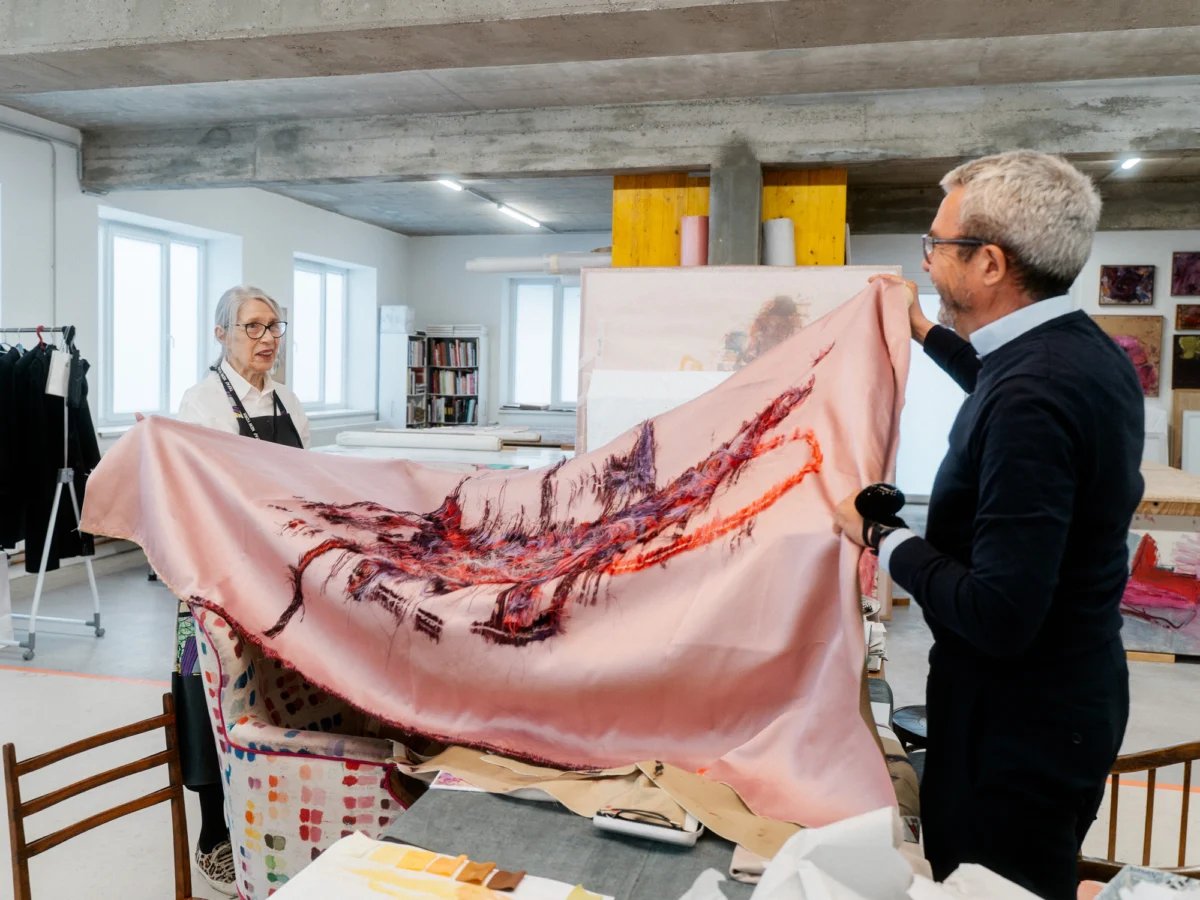
In the rarefied world of European luxury, few houses maintain the quiet, intellectual rigor of Akris. At the center of this Swiss powerhouse is Albert Kriemler, a creative director who has spent over four decades redefining the relationship between high fashion and fine art. While many brands engage in "collaborations" that amount to little more than printing an artist’s work on a T-shirt, Kriemler’s approach is fundamentally structural. His designs do not merely reference art; they ingest it, translating the texture of a canvas, the luminescence of a pigment, and the architectural proportions of a sculpture into wearable garments.
The most recent manifestation of this philosophy is the Akris Fall 2026 collection, a vibrant collaboration with the 94-year-old Colombian textile artist Olga de Amaral. Known for her monumental works that incorporate gold and silver leaf into woven tapestries, de Amaral provided the catalyst for Kriemler to push the boundaries of his signature "luxurious understatement." The resulting collection is a masterclass in texture, featuring metallic finishes and bold colors that depart from the house’s usual muted palette. This was followed closely by the announcement of the Spring 2027 collection, inspired by the expressive, linen-based works of Austrian artist Martha Jungwirth.
Kriemler’s methodology is rooted in a deep, personal curiosity. He does not delegate the search for inspiration to a mood-board team; instead, he travels to remote studios, visits museums in the quiet hours before closing, and builds long-term friendships with the artists who move him. This hands-on intellectualism has turned Akris into a beacon for a specific type of clientele—one that values the narrative and technical complexity of their wardrobe as much as its aesthetic appeal.
Chronology: From St. Gallen to the Paris Runway
To understand Albert Kriemler’s trajectory, one must look at the heritage of Akris. Founded in 1922 by his grandmother, Alice Kriemler-Schoch, in St. Gallen, Switzerland—a city world-renowned for its embroidery—the brand began as a maker of polka-dot aprons. Albert’s father, Max, eventually took over, expanding the business into a global fashion house.

- The Formative Years (1970s): As a teenager, Kriemler was immersed in the world of textiles, accompanying his family to fabric fairs across Europe. He was also a witness to the golden age of Yves Saint Laurent. Seeing how Saint Laurent brought the works of Piet Mondrian, Vincent van Gogh, and Georges Braque to life on the runway left an indelible mark on the young designer, showing him that fashion could be a legitimate medium for art history.
- The Transition (1980): At just 20 years old, Kriemler took over the creative direction of Akris following the sudden death of his father. He began the slow process of modernizing the house while maintaining its commitment to Swiss precision and textile innovation.
- The Paris Debut (2004): Although Akris was a successful business, it remained something of a "best-kept secret" among the global elite until 2004. Kriemler chose this year to debut on the Paris runway, a move that signaled the brand’s entry into the top tier of international luxury. Tellingly, this first show was inspired by the Swiss-French painter Félix Vallotton, establishing the "art-to-wear" precedent that would define his career.
- Technological Breakthrough (2014): The Fall 2014 collection marked a pivotal moment in the fusion of technology and art. Inspired by the German photo artist Thomas Ruff and his "Stars" series, Kriemler collaborated with the St. Gallen-based fabric house Forster Rohner to create LED-equipped dresses.
- The Modern Era (2020–2026): In recent years, Kriemler has accelerated his collaborative efforts, focusing on artists who challenge his technical capabilities. From the pixelated realism of Reinhard Voigt (Fall 2022) to the golden tapestries of Olga de Amaral (Fall 2026), the timeline shows a designer increasingly willing to take risks with color and volume.
Supporting Data: The Technicality of Inspiration
Kriemler’s work is supported by a rigorous technical infrastructure that allows for the literal translation of art into fabric. Unlike brands that rely on digital printing, Akris often develops entirely new weaving and embroidery techniques to mimic an artist’s hand.
Materiality and the "De Amaral" Effect
For the Fall 2026 collection, the challenge was to replicate Olga de Amaral’s use of gold leaf. De Amaral’s work is characterized by "tectonic" shifts in fabric—heavy, layered, and luminous. To translate this, Kriemler utilized Akris’s signature horsehair fabric (crin), a material the house has used since the 1980s for its structured handbags. By weaving metallic threads into the horsehair and applying innovative coating techniques, the atelier was able to create jackets that possessed the weight and shimmer of a de Amaral sculpture while remaining supple enough for the female form.
The LED Revolution
The Fall 2014 Thomas Ruff collection remains a landmark in "wearable tech." The collaboration with Forster Rohner involved embedding tiny light-emitting diodes (LEDs) into the embroidery of the garments. This was not a gimmick; it was a structural necessity to capture the "light-from-within" quality of Ruff’s astrophotography. The data from this project helped Akris refine its "e-textiles," a niche field that merges traditional Swiss embroidery with electronic engineering.
The Linen Canvas of Martha Jungwirth
In the upcoming Spring 2027 collection, the focus shifts to the work of Martha Jungwirth. Kriemler was particularly struck by her refusal to work on white-primed canvases, preferring raw, natural linen. This has led the Akris design team to develop a series of custom-woven linens that maintain the "organic" feel of a painter’s drop cloth while meeting the durability standards of luxury ready-to-wear.

Official Responses: In the Words of Albert Kriemler
Kriemler’s philosophy is best articulated through his own reflections on the creative process. He views his relationship with artists not as a transaction, but as a form of "open-sourcing" creativity.
Reflecting on his time with Olga de Amaral in Bogotá, Kriemler noted: "I found out that when you get involved in an artist’s work and how she does art, that you get a much broader base for inspiration. You learn how she thinks about color, how she thinks about light, how she thinks about proportion." This statement highlights his belief that the process of making art is more important than the final image.
On the subject of technology, Kriemler remains an optimist, viewing the laboratory as a "playground." Referring to the development of electronic embroideries, he stated: "It’s always interesting when you can infuse new technologies into the workmanship process, because you create a new appearance. It’s like a new playground."
His approach to discovery is equally personal. He describes his 2019 encounter with the works of Vilhelm Hammershøi at the Musée Jacquemart-André in Paris as a transformative moment: "I’ll never forget that moment: An artist I’d never heard about before, and then you get to see such an exquisite work." This commitment to "unexpected discovery" is what keeps the Akris aesthetic from becoming stagnant or overly academic.

Implications: The Legacy of Structural Collaboration
Albert Kriemler’s work has significant implications for the future of the luxury fashion industry. In an era of "fast luxury," where brands often prioritize viral social media moments over craftsmanship, Akris serves as a counter-narrative.
- Elevating the Collaboration Model: By moving away from superficial prints and toward structural interpretations of art, Kriemler has set a new standard for how fashion houses interact with the art world. This approach respects the integrity of the artist’s work by treating it as a foundational element of design rather than an accessory.
- Preservation of Swiss Craftsmanship: Akris’s success ensures the continued relevance of the St. Gallen textile industry. By finding new, avant-garde applications for traditional embroidery and weaving, Kriemler provides a vital economic and creative lifeline to specialized Swiss artisans.
- The "Slow Fashion" Ethos: Because Kriemler’s collections are so deeply researched—often taking years to move from an initial museum visit to a finished runway show—they naturally align with the principles of "slow fashion." These are not "disposable" luxury goods; they are pieces designed to be collected and kept, much like the artworks that inspired them.
As Akris moves toward its 2027 collections, the influence of Albert Kriemler remains a testament to the power of curiosity. By turning the runway into a gallery and the garment into a canvas, he has ensured that Akris is not just a fashion house, but a vital participant in the global dialogue of contemporary art.
