

The global race to decarbonize the energy sector is no longer just a matter of policy—it is a massive, complex engineering challenge. As nations and corporations pivot toward renewable energy to achieve climate goals and secure energy independence, the demand for solar infrastructure has reached an unprecedented scale. However, this transition is hitting a significant, human-sized bottleneck: a severe labor shortage.
In the midst of this crunch, a new entrant has emerged from stealth mode with a bold proposition. Gritt, a startup founded by Carnegie Mellon-trained roboticists Puneet Puri and Vishal Dugar, has secured $26 million in Series A funding. With a total of $34 million in capital, the company is betting that the solution to the construction industry’s labor woes lies not in more workers, but in a new generation of "physical AI" capable of mastering the chaotic, unstructured environment of the modern construction site.
The Core Mission: Bridging the Construction Gap
The solar energy build-out requires the installation of millions of panels across vast, often remote, landscapes. Traditionally, this is a grueling, labor-intensive process. A standard crew of eight people might manage 800 panels in a single shift, a pace that many analysts fear is insufficient to meet the ambitious climate targets set by international accords.
Gritt’s philosophy is rooted in the idea of "building civilization faster." By deploying intelligent robotic systems, the startup aims to augment the human workforce, allowing companies to scale operations without being limited by the availability of specialized labor. "Our thesis is that if we truly want to speed up construction, you need an intelligence which can work in the outdoor, chaotic environments of these construction sites, and it has to be generalizable enough that it can work in these varied environments," says CEO Puneet Puri.
A Chronology of Innovation and Funding
The journey for Gritt began with a focus on the intersection of advanced machine vision and heavy machinery. By leaning on their deep academic roots at Carnegie Mellon, Puri and Dugar sought to solve the "unstructured environment" problem—the primary reason why industrial robots have historically failed outside of the pristine, predictable floors of automotive factories.
- Seed Stage: Gritt initially secured backing from notable firms including First Round Capital, Climactic, Congruent Ventures, and VSC Ventures. This funding allowed the team to develop the core AI pipeline and prove that their software could govern off-the-shelf hardware.
- Proof of Concept: The team moved beyond simulations to real-world deployment, testing their software on rented skidders and robotic arms from industry stalwarts like Kawasaki.
- Series A Milestone: Announced this Tuesday, the $26 million Series A round was led by Obvious Ventures, with participation from Union Square Ventures and Active Impact Investment. This injection of capital marks the company’s transition from a developmental startup to a scaling enterprise.
- Current State: Today, Gritt has two active systems in the field. These machines are not just working; they are learning. Every movement, every adjustment to wind or terrain, and every sub-millimeter placement of a glass panel feeds back into the model to improve performance for future iterations.
The Technical Edge: Off-the-Shelf Versatility
One of the most distinct aspects of Gritt’s strategy is its refusal to manufacture custom hardware. While competitors like Luminous Robotics, Cosmic, and China’s Trinabot focus on building proprietary robots from the ground up, Gritt operates as a software-first entity.
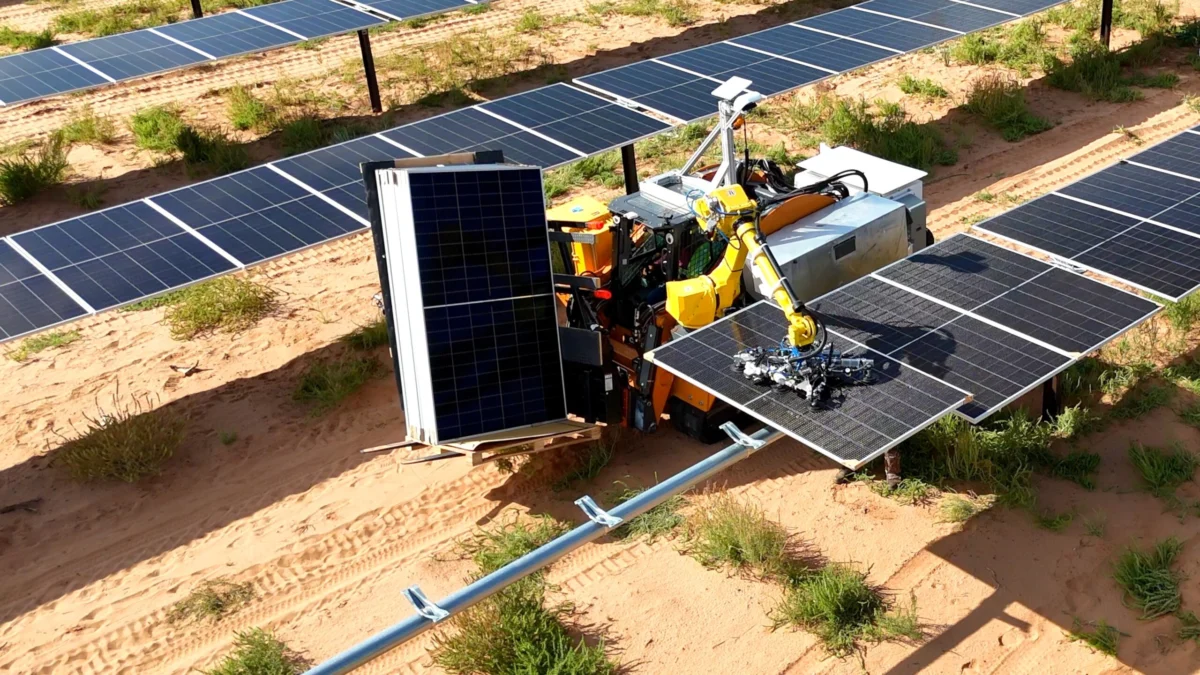
By utilizing off-the-shelf robotic arms and vehicles, Gritt significantly reduces its overhead and accelerates its deployment timeline. Their systems currently handle the most physically demanding and repetitive tasks: picking up heavy, fragile glass solar panels, transporting them across uneven terrain, and positioning them on metal mounting frames with sub-millimeter precision. This allows human workers to pivot from "heavy lifters" to "quality control and fastening technicians."
This approach offers a leaner cost structure that could prove vital as the competition for solar installation dominance intensifies. By decoupling the "brain" (Gritt’s AI) from the "body" (the rented hardware), the company can pivot to new equipment or upgrade sensors without having to redesign an entire mechanical platform.
Official Responses and Industry Support
The investment community has taken note of the company’s pragmatic approach. Andrew Beebe, the partner at Obvious Ventures who led the Series A round, highlights the rare combination of technical and operational skills found in the founding team.
"There are people who used to build rockets that went into space and had infinite budget for the smallest little part, and then there are people who know what it means to get into dirty, dull, and dangerous jobs and scale them like mad," Beebe remarked. "These guys are in the second camp, and that’s a special kind of entrepreneur that has the technical chops, the AI, and the machine vision skills to make it work."
The impact on the ground is equally compelling. While the identity of their clients remains confidential for competitive reasons, those currently utilizing Gritt’s systems report a dramatic increase in efficiency. One customer noted that the system is a game-changer for remote projects, where attracting and housing labor is prohibitively expensive. Furthermore, by removing the need for workers to manually hoist 100-pound panels, the system significantly lowers the rate of musculoskeletal injuries—a massive hidden cost in the construction sector.
Supporting Data: By the Numbers
The efficiency gains reported by Gritt are significant:
- Productivity Boost: An eight-person crew, which typically installs 800 panels per day, can scale to 3,000 to 4,000 panels daily when supported by Gritt’s robotic systems.
- Market Reach: The company is currently under contract to facilitate the installation of 2.8 gigawatts of solar capacity over the next 18 months.
- Client Base: Gritt counts three of the top 10 US power construction companies among its customers.
- Deployment Goal: The company aims to have 48 of its systems operational within the next six months, representing a massive scaling effort.
Future Implications: Beyond Solar
The rise of large language models and general-purpose AI has provided the foundation for what Gritt calls "physical AI." As Puri explains, the ability to generalize is the key to their success. "Making a system for one solution was still possible to some extent five years ago," he says. "But AI is now making that work generalizable—the same underlying pipeline can be reused and improve across tasks."
The evidence for this adaptability is clear: training the system to stack cinder blocks took weeks of engineering, whereas the transition to the task of tying rebar—a similar, yet distinct, construction chore—took only a single day.
Looking forward, Gritt plans to expand its capabilities to include drilling posts, building mounting racks, and even complex tasks like rebar tying for concrete foundations. But the long-term vision is even more ambitious: Gritt intends to function as a site-wide management layer. By utilizing its suite of sensors and cameras, the system could monitor site safety, flag missing inventory, or alert managers to environmental risks, such as an uncovered trench before an impending storm.
Conclusion: The New Construction Paradigm
Gritt is not just building robots; it is building a new infrastructure for the energy transition. By successfully navigating the "dirty, dull, and dangerous" reality of construction, the company is proving that the future of physical labor is not entirely human-led, nor is it entirely automated. Instead, it is a symbiotic relationship where AI handles the precision and the burden, and humans provide the oversight and the craftsmanship.
As the world continues to sprint toward a renewable future, the speed of construction will be the ultimate determinant of success. If Gritt’s trajectory is any indication, the next time you see a massive solar field being installed, there is a good chance that a silent, tireless fleet of machines is doing the heavy lifting, guided by the latest breakthroughs in artificial intelligence.
