

DoorDash, once synonymous exclusively with restaurant delivery, is undergoing a profound metamorphosis. In a whirlwind month of strategic expansion, the company has signaled its intent to become the primary operating system for local commerce. By blending high-profile retail partnerships, cutting-edge generative AI, and a deep commitment to accessibility programs like SNAP/EBT, DoorDash is aggressively pursuing its vision of creating a “mall in your pocket.”
This transformation represents a pivot from "on-demand convenience" to a "routine shopping utility." As consumer habits shift toward multi-category purchasing, DoorDash is moving to capture the entirety of the household budget, not just the occasional Friday night takeout order.
The Strategic Expansion: A New Retail Footprint
The most visible facet of DoorDash’s recent growth is its rapidly expanding retail marketplace. This week, the company announced the addition of a suite of major national brands: Macy’s, Anthropologie, The North Face, Vans, and Timberland. These additions signify a move into apparel and lifestyle goods, moving the platform well beyond the grocery and convenience aisles that defined its early retail strategy.
This expansion follows what is arguably the company’s most significant milestone of the year: the launch of its partnership with Costco. For years, the warehouse giant sat at the top of DoorDash’s internal "wish list." By finally bringing Costco into the fold, DoorDash has achieved a critical threshold—it now hosts eight of the top 10 U.S. grocers on its platform.
This is not merely about brand count; it is about infrastructure. Alongside these partnerships, DoorDash has introduced "Dasher Returns," a service designed to solve one of the most persistent pain points in e-commerce: the logistics of returning items. By coordinating a Dasher to pick up returns directly from a consumer’s doorstep, the company is attempting to remove the friction that traditionally makes online shopping for non-perishable goods cumbersome.
The Chronology of a Transformation
The recent surge in activity is the culmination of a multi-year strategy to transition from a single-vertical delivery app to a horizontal marketplace.
- Foundation (2020-2022): DoorDash leaned heavily into grocery and convenience as pandemic-era demand spiked. During this period, the company established its SNAP/EBT payment infrastructure, laying the groundwork for broad consumer inclusivity.
- Expansion (2023): The company began integrating non-grocery retailers, testing the appetite for beauty, pet supplies, and electronics delivery.
- The AI Pivot (Early 2024): Recognizing that massive product catalogs can overwhelm users, DoorDash began deploying conversational AI to act as a digital concierge.
- The Current Phase (Present): The focus has shifted to "agentic" shopping—where the app doesn’t just display products but proactively helps the user build carts, optimize for price, and handle post-purchase logistics like returns.
Data-Driven Growth: The Power of Inclusivity
DoorDash’s commitment to accessibility has been a major engine for its scale. The company’s SNAP/EBT program, now three years old, has become a cornerstone of its business model. Today, over 4.5 million users have linked their SNAP benefits to the platform.
The reach is staggering: approximately 75,000 stores now accept these benefits through DoorDash, providing 99% of all SNAP-eligible households in the United States with access to at least one participating retailer. By adding regional powerhouses like Albertsons Market, Amigos, and Boyer’s Food Markets to this network this month, DoorDash is cementing its role as a critical utility for food security.
The data suggests that this strategy is working. According to Mike Goldblatt, VP of Enterprise Partnerships at DoorDash, the company is observing a fundamental change in user behavior. Customers are moving away from one-off, convenience-geared orders toward a "routine shopping cadence." When a user views DoorDash as a place to do their weekly grocery haul rather than just a quick snack run, the platform’s stickiness increases exponentially.
The AI Frontier: "Agentic" Shopping and Friction Reduction
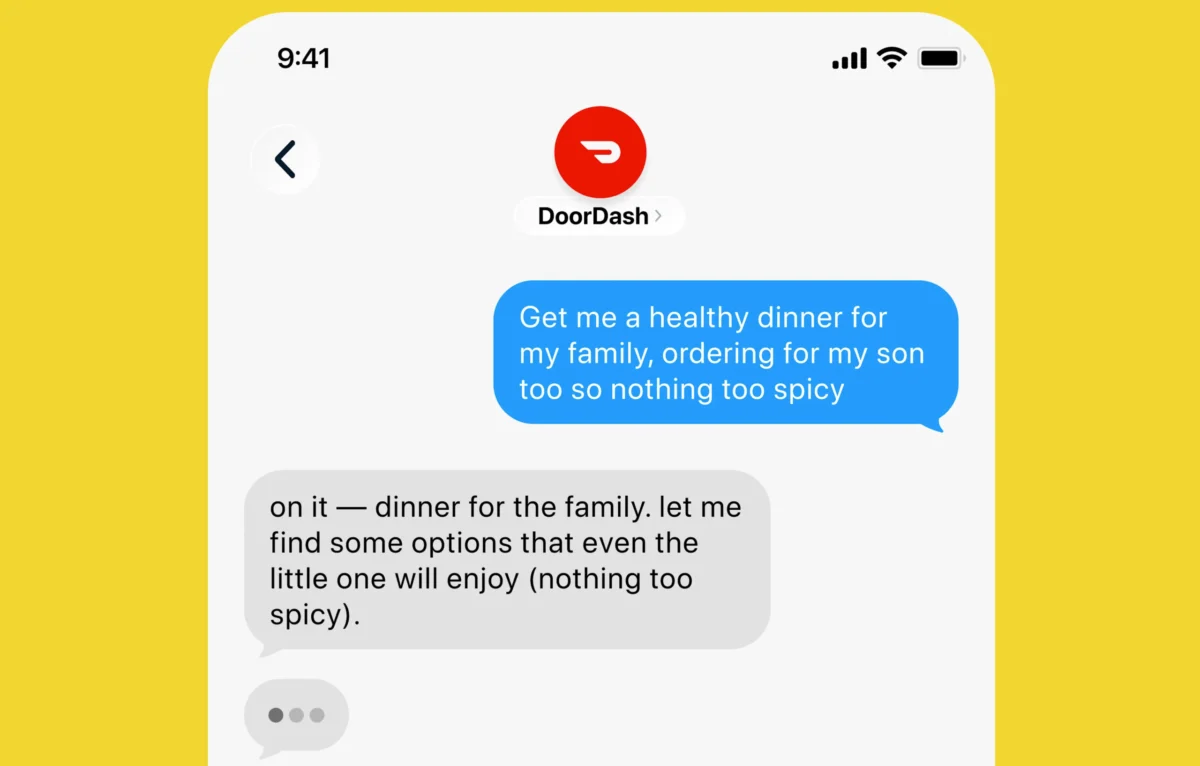
If partnerships are the body of the new DoorDash, AI is its brain. The company’s recent technological announcements—including "Text DoorDash" and an expanded, AI-powered in-app assistant—are designed to solve the "paradox of choice."
The "Ask DoorDash" Evolution
The "Ask DoorDash" feature is moving from a simple search tool to an agentic assistant. It can interpret complex natural language queries, such as "Give me a recipe for lasagna and add all the ingredients to my cart."
Goldblatt notes that this is a direct response to the "slow process" of traditional app navigation. "That is a slow process, and you’re not going to see the high conversion that the agentic solutions do," he said. "The basket size becomes 2X because people are getting what they want quickly."
Balancing Tech with User Intent
DoorDash is keenly aware that not every user wants an AI interaction. "Some consumers come to the app and just know exactly what they want at that moment, and are in and out in 25 seconds without even considering an agentic option," Goldblatt explained.
The goal is to provide a "frictionless" experience that adapts to the user. For a power user, the interface remains fast and transactional. For a discovery-oriented user, the AI steps in to suggest, curate, and optimize.
Official Perspective: The "Mall in Your Pocket" Vision
In an exclusive discussion with Modern Retail, Mike Goldblatt outlined the philosophy driving these changes. The core mission, according to Goldblatt, is to remove the "friction that comes with browsing and decision-making."
"We’re really excited to bring that value and that selection to the consumer base," Goldblatt said, referencing the Costco integration. "Prior to bringing on the warehouse club, users had been searching for it on DoorDash for years."
He emphasizes that while AI is the "shiny" new tool, it is ultimately a means to an end: trust. By using AI to surface budget-friendly alternatives—such as suggesting a private-label item or a more cost-effective pack size—DoorDash is building a reputation for value. "Affordability is so crucial that we want to surface options to the consumer and build the trust, so they know when they come to a retailer on DoorDash, they’re getting maximum value."
Implications: What This Means for the Future of Retail
The implications of DoorDash’s expansion are significant for three key stakeholders:
1. For Retailers
Physical retailers are facing a binary choice: integrate into the "super-apps" or risk losing visibility. By partnering with DoorDash, retailers like Macy’s or The North Face gain access to a massive, existing logistics network that they would otherwise have to build from scratch. However, they also cede a degree of control over the customer relationship and data to the marketplace platform.
2. For the Consumer
The "mall in your pocket" creates a seamless shopping experience where the boundaries between categories (groceries, apparel, pharmacy, gifts) are dissolved. For the time-strapped consumer, the ability to have a Costco bulk order, a new pair of sneakers, and dinner ingredients arrive via the same platform—and to return items through that same system—is a high-value proposition.
3. For the Market
DoorDash is positioning itself as a challenger to the traditional e-commerce giants. By focusing on hyper-local delivery, it is tackling the "last mile" problem that companies like Amazon have long struggled to master for perishable and immediate-need goods.
As DoorDash continues to refine its AI, the platform will likely become more predictive. Imagine an app that knows you are running low on coffee based on your past purchase cadence and suggests a replenishment order before you even realize you need it.
Conclusion: The Path Ahead
DoorDash’s recent flurry of activity is not a series of disconnected initiatives; it is a coherent strategy to dominate the "everyday" economy. By successfully marrying a massive retail footprint with sophisticated, helpful AI, the company is transforming from a delivery service into an essential retail infrastructure.
Whether it is the convenience of an AI-optimized cart or the utility of a simple text message to order groceries, the message is clear: DoorDash wants to be the interface through which you interact with your local economy. As the company continues to iterate, the challenge will be maintaining that "frictionless" promise while scaling its operations to encompass the entirety of the retail world. For now, the strategy appears to be working, one order—and one return—at a time.
