

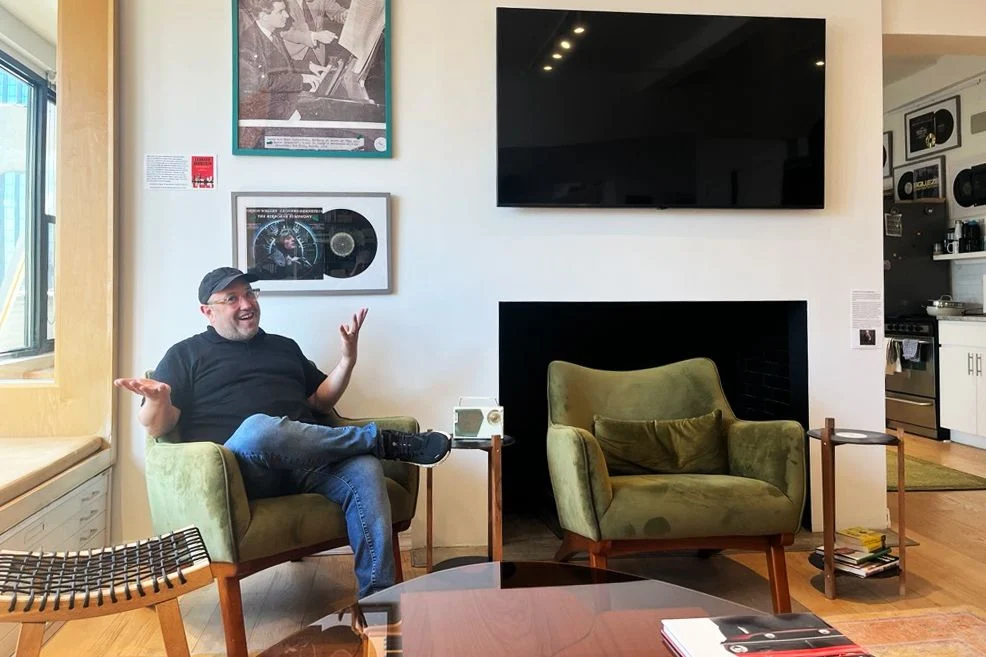
Political consultant Stu Loeser has transformed his Broadway workspace into a living archive of New York’s musical history, proving that even the most high-pressure professional environments can coexist with the city’s storied past.
For the high-powered political consultant Stu Loeser, the search for new office space two years ago was driven by practical, professional needs. As the former press secretary to Mayor Michael Bloomberg and former communications director for Senator Chuck Schumer, Loeser had long operated his eponymous consultancy, Stu Loeser & Company, out of the iconic Chrysler Building. While the address carried prestige and convenience, his growing firm required more space, particularly a venue capable of hosting book launches, media briefings, and industry mixers.
"Our broker said, ‘Come see this place—it has roof decks,’" Loeser recalls. The space in question was a sprawling, sun-drenched loft at 1239 Broadway, situated just south of Herald Square. It was architecturally striking, characterized by an expansive, top-floor layout and, perhaps most importantly, the outdoor terraces he sought. However, the broker added a cryptic, intriguing footnote: the loft had once been the home of "some musician."
That "musician" turned out to be none other than Leonard Bernstein. In the mid-1940s, during the meteoric rise that would define his career, Bernstein lived in this very loft. When Loeser stepped into the space, he found it largely preserved. The previous tenant, an architecture firm, had polished the interior, but the essential DNA of the room—the central fireplace and the rugged brick parapets outside—remained identical to the photos of Bernstein’s 1940s residence. For a man who counts himself among New York’s most dedicated "city-lore" enthusiasts, the discovery was kismet.
A Chronology of a Musical Haven
The history of 1239 Broadway is tethered to a pivotal moment in American culture. Leonard Bernstein’s arrival in New York in the early 1940s was defined by his sudden, legendary debut with the New York Philharmonic in 1943. When regular conductor Bruno Walter fell ill with the flu, the 25-year-old Bernstein stepped onto the podium on mere hours’ notice. The event was so last-minute that the concert programs had to be corrected by typewriter.
Shortly after this triumph, Bernstein moved into the Broadway loft. It was a period of intense creative output; his first musical-theater hit, On the Town, was playing at the 44th Street Theatre, and he was quickly becoming the face of a new generation of American classical music.
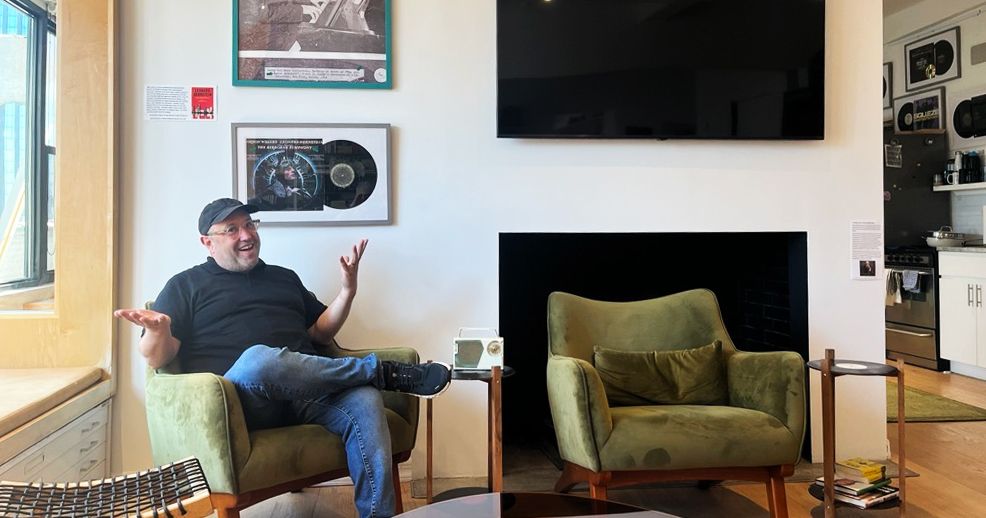
The loft was not a place of luxury in the traditional sense, but a young artist’s sanctuary. An early interview with the conductor, published in Seventeen magazine, described the apartment as "a stunning penthouse on top of a tall office building in a business section." During his residency, Bernstein also served as the conductor for the New York City Symphony, a project championed by Mayor Fiorello La Guardia to provide accessible, affordable orchestral music to the public.
Curation and the "Microseum"
Upon moving in, Loeser realized that a space with such a lineage required more than just standard office furniture. He embarked on a secondary career as a self-taught exhibition designer. Through meticulous research—spending hours in libraries, scouring eBay for period artifacts, and diving into digital archives—Loeser curated a collection that now lines the walls of his consultancy.
The office features an array of framed concert-ticket stubs, original Playbills, and vintage LP jackets. One of the centerpiece displays is a large-format photograph of Bernstein at the piano, situated exactly where the office fireplace now sits. He is seen reviewing the score for Marc Blitzstein’s The Airborne Symphony. Below the photograph hangs an original LP of the performance, which featured narration by Orson Welles.
Loeser’s curation extends to the whimsical. In a nod to the building’s musical history, the office restroom doors are adorned with icons representing West Side Story—a shark and a jet—while another is marked "L.B." for "Lavatory Bathroom." The shelves are further populated with vintage media hardware, such as Bakelite radios and press cameras, that echo the communications industry of the 1940s.
Supporting Data and Historical Context
It is important to distinguish this "Microseum" from the other, more famous residences of Leonard Bernstein. While this loft was his first significant New York home, it stands apart from his later, more celebrated addresses. In the 1960s and 70s, Bernstein and his wife, Felicia, resided in a grand apartment on Park Avenue—the site of the infamous "Radical Chic" party famously skewered by Tom Wolfe in New York magazine. Later, the family moved to the Dakota on the Upper West Side, where Bernstein spent the remainder of his life.
Loeser’s office, however, captures a different, more transient version of the conductor. It documents the period when Bernstein was just beginning to grapple with his public image and the tensions of fame. For instance, the office archives contain evidence of a minor public dispute between Bernstein and Mayor La Guardia regarding the funding levels of the New York City Symphony. It was a fleeting, minor political scuffle—a "day’s news" in the 1945 New York Times—but it serves as an apt reminder of the intersection between politics and culture, a subject Loeser, as a political operative, finds particularly resonant.

Implications: The City as a Living Document
Loeser’s approach to his workspace reflects a broader philosophy about the nature of New York City itself. In a city where the impulse to "re-re-rebuild" often leads to the erasure of history, Loeser argues for the importance of retaining a connection to the past.
"In a city that’s constantly renewing, you have this extraordinary ability to be in the present and in the past," Loeser explains. For him, the office is more than just a place to conduct business; it is a tool for engagement. He notes that the artifacts serve as instant "icebreakers" for clients and visitors. If a conversation stalls, there are two centuries of history—or at least eight decades of Bernstein—to discuss.
The project also highlights a shift in how professionals view their environments. Post-pandemic, the traditional office is no longer merely a place for desks and cubicles; it is a space that must provide a unique experience. By leaning into the building’s history, Loeser has created a workspace that is intellectually stimulating, personally meaningful, and undeniably unique in a city of thousands of generic offices.
A Legacy Preserved
Loeser’s collection is not static. He continues to search for items that add texture to the story of the room. He recounts with pride the custom-built end table in the office, topped with a damaged Bernstein LP—a piece he commissioned from an Etsy maker specifically to avoid ruining a playable record.
When visitors like Kathy Wylde, the CEO of the Partnership for New York City, visit the office, the reaction is often one of recognition and delight. "I knew you’d have an office like this," she remarked, acknowledging the synthesis of Loeser’s political identity and his passion for history.
Ultimately, the Leonard Bernstein "Microseum" at 1239 Broadway stands as a testament to the idea that heritage is not just something found in grand institutions or museums behind glass. It is something that can be lived in, worked in, and, most importantly, shared. In preserving this small corner of Manhattan history, Stu Loeser has ensured that the "stunning penthouse" remains a site of inspiration, just as it was when the young Leonard Bernstein first looked out over the city from its parapets eighty years ago.
