

The global automotive landscape is currently defined by a profound irony. While the Trump administration has consistently prioritized policies aimed at curbing the growth of electric vehicles (EVs) in the United States, a seismic shift in global geopolitics—triggered by the U.S. conflict with Iran in early 2026—has inadvertently ignited the most rapid transition to electric mobility in modern history.
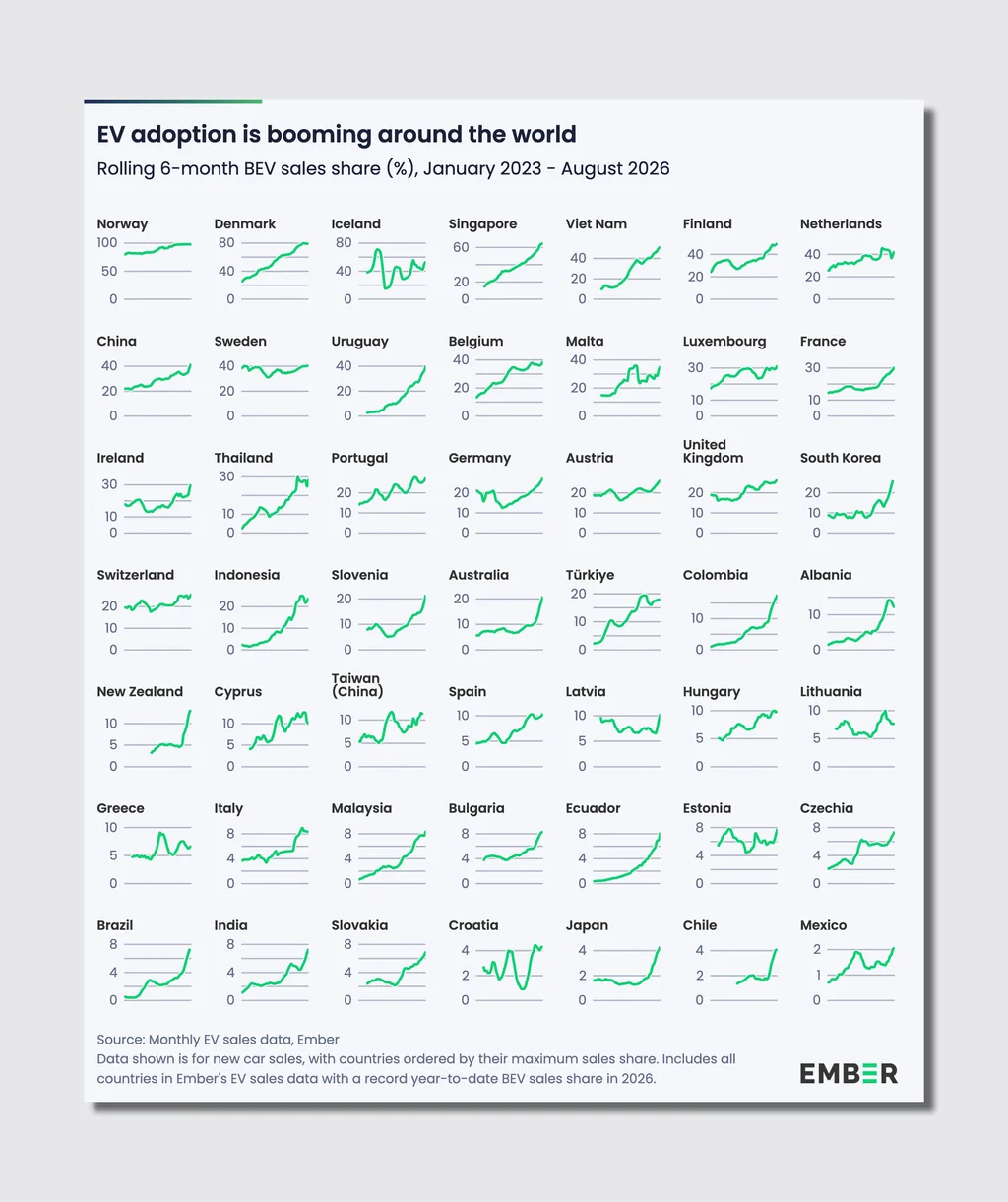
As crude oil prices skyrocketed following the February 2026 military engagement, the economic incentive to abandon internal combustion engines reached a breaking point for consumers worldwide. A comprehensive new report from the energy think tank Ember reveals that 49 of the 56 countries monitored have hit record-breaking EV adoption rates this year, proving that market forces are proving far more potent than regulatory headwinds.
The Chronology of the 2026 Energy Shock
The catalyst for this global shift can be traced to the late February 2026 escalation between the United States and Iran. The conflict, which centered on the security of the Strait of Hormuz, effectively throttled a vital artery of global energy transit.
- Late February 2026: Military tensions culminate in a direct confrontation. Global oil markets react with immediate volatility, driving crude prices to multi-year highs.
- March 2026: The immediate fallout of the conflict results in a dramatic, sustained increase in retail gasoline prices across Europe, Asia, and the Americas.
- April–June 2026: As the geopolitical situation remains unresolved, consumer behavior begins to shift. Potential car buyers, faced with the prospect of long-term high fuel costs, pivot toward battery electric vehicles (BEVs) at an unprecedented pace.
- July–August 2026: Data from Ember confirms that the trend is not merely a temporary blip but a sustained structural change in the automotive market. Sales growth in key regions like New Zealand, Australia, and Chile accelerates into the triple digits.
Supporting Data: A Global Surge in Adoption
The data provided by Ember offers a granular look at how a volatile energy market can force the hand of the automotive consumer. The shift is most visible in countries that were already primed for transition but needed a price-based catalyst to push them over the threshold.
The Triple-Digit Growth Markets
In the six months following the closure of the Strait of Hormuz, the market penetration of EVs in several nations surged:
- New Zealand: EV sales growth skyrocketed by 165% compared to the preceding six-month period.
- Australia: Similarly, the Australian market saw a 136% surge in sales as consumers sought relief from high pump prices.
- Chile: The South American nation reported a 124% increase in BEV adoption.
- India: Despite starting from a smaller base, India saw a 58% increase, signaling that even developing economies are feeling the pressure to electrify their transport sectors.
Market Leaders and Emerging Players
The report underscores that this is a truly global phenomenon. Norway, which has long served as the world’s laboratory for EV adoption, has reached near-total saturation, with nearly 98% of all new vehicle sales in August 2026 being electric. Other nations have shown equally impressive, if more recent, trajectories:
- Vietnam: Reached an astonishing 51% market share.
- Uruguay: Capitalizing on over a decade of proactive policy support, the nation hit 38% market share.
- Germany: Despite being a traditional automotive powerhouse, the country hit 27.5% EV market share in August—a 50% increase year-over-year—fueled by the convergence of high gas prices (reaching $8.52 per gallon) and favorable domestic policy.
The Role of Policy and Product Availability
While the geopolitical energy crisis provided the push, industry analysts point out that the pull factor—the availability of affordable, high-quality EVs—has been equally critical.
Euan Graham, a senior energy analyst at Ember, notes that the timing of this crisis coincided with a maturation of the EV manufacturing cycle. "First, you had fuel efficiency standards—which effectively forced manufacturers to introduce more affordable electric car models at the start of this year," Graham explains. "When you pair that with direct policy support in places like Germany, you create a perfect storm. Consumers were looking for an exit from volatile petrol prices, and for the first time, they had a menu of affordable, reliable electric options to choose from."
This confluence of factors has resulted in a global EV sales growth rate of 11% year-over-year for the first eight months of 2026. However, when the data is adjusted to exclude the U.S. and China—where market saturation or overall sales declines have skewed the numbers—the growth rate in the rest of the world stands at a staggering 45%.
Official Responses and Strategic Shifts
The official response to this data has been mixed, reflecting the complex political landscape in which these companies operate. In the United States, the administration remains publicly committed to its stance on favoring traditional energy sectors. However, behind closed doors, U.S.-based automotive manufacturers are finding themselves in a bind: they must compete globally with European and Asian brands that are now enjoying the benefits of a highly advanced and rapidly scaling EV supply chain.
International bodies and energy agencies are now beginning to characterize the 2026 surge as a "permanent decoupling" of the automotive industry from crude oil reliance. The shift is no longer viewed as an environmental mandate driven by climate activists, but as a strategic national security imperative. Governments are realizing that the more they can electrify their transport, the less vulnerable they are to the geopolitical whims of the Strait of Hormuz or the volatility of OPEC-influenced pricing.
Implications for the Future of Transportation
The long-term implications of the 2026 surge are profound and likely irreversible.
1. The Death of the "Niche" EV
The data clearly indicates that EVs have moved from a niche luxury product to a mainstream, mass-market utility. With countries like India, Australia, and Chile seeing rapid adoption, the barrier to entry has lowered significantly. As these nations build out charging infrastructure, the "range anxiety" that historically hampered adoption is being replaced by "infrastructure abundance."
2. Geopolitical Security via Electrification
Energy independence is no longer about finding more oil; it is about reducing the need for oil altogether. Nations that have aggressively pursued electrification are finding themselves significantly more resilient to the supply chain shocks of 2026. This is expected to trigger a new wave of industrial policy, where nations prioritize the domestic production of batteries and electric drivetrains as a matter of sovereignty.
3. The U.S. Isolation Dilemma
The most critical implication concerns the United States. While the domestic administration has attempted to slow the transition, the global market is moving ahead regardless. By resisting the global shift toward electrification, the U.S. risks falling behind in the next generation of industrial innovation. Manufacturers who do not pivot are finding their exports uncompetitive in markets like Germany, the UK, and even emerging economies that have set strict EV targets for 2030.
4. The Acceleration of Infrastructure
The surge in sales has forced a rapid acceleration in grid modernization. To support the 45% growth seen outside of the U.S. and China, nations are being forced to upgrade their electrical grids to handle the increased load. This is creating a secondary boom in renewable energy integration, as grid operators realize that the cheapest and most secure way to charge a fleet of EVs is through local, distributed solar and wind power.
Conclusion: The Irony of Innovation
History often moves in ways that defy political intent. The Trump administration’s attempt to protect the legacy energy industry has, through a series of geopolitical shocks, accelerated the transition to a post-oil economy faster than any climate regulation could have.
The year 2026 will likely be remembered as the "tipping point." It was the year when the high cost of oil, combined with the availability of affordable electric vehicles, made the transition to electric mobility a logical, rather than ideological, decision. As the data from Ember demonstrates, the global market is not waiting for political permission; it is responding to the clear reality that in an unstable world, electricity is the only truly secure fuel.
