

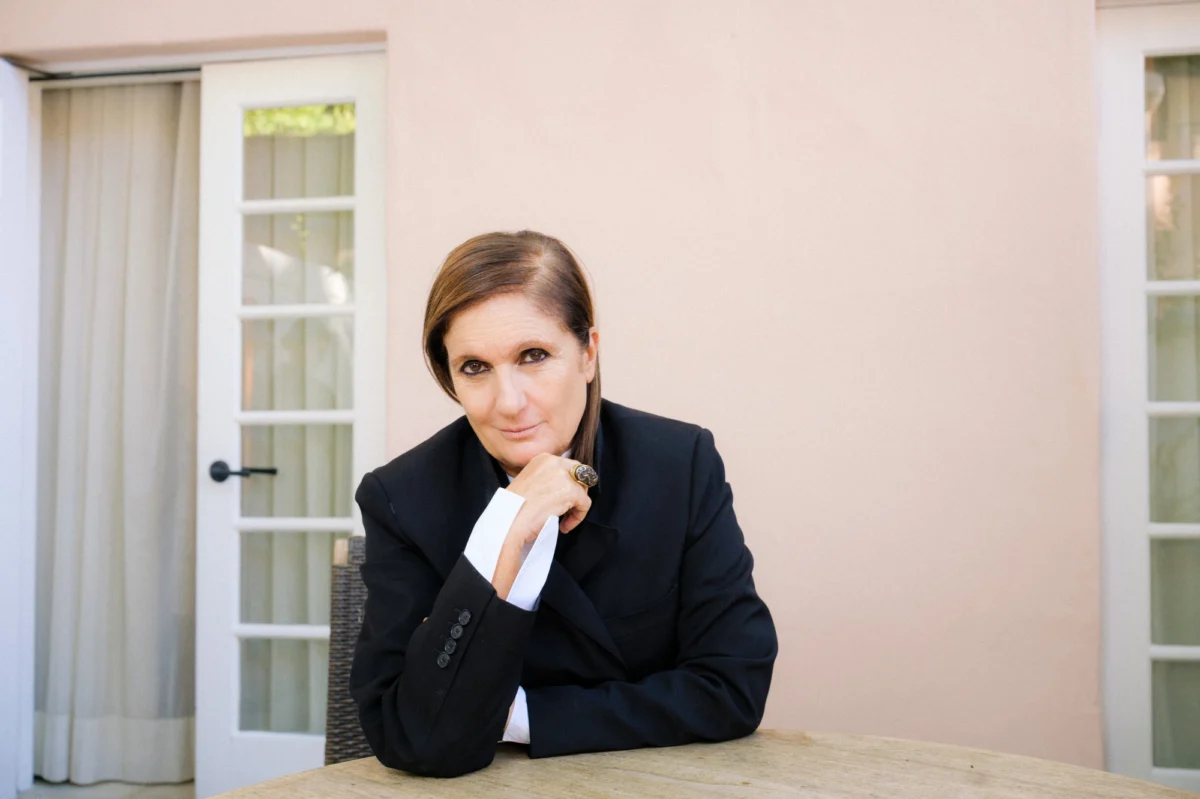
LOS ANGELES — In the sprawling, sunlight-drenched geography of the luxury fashion world, few career arcs are as poetic as that of Maria Grazia Chiuri. Sitting in a tucked-away, historic hotel in Los Angeles, the Italian designer finds herself in a state of reflection—not merely on the past, but on the enduring power of beginnings. This visit marks her first official trip to the United States since assuming her role as Chief Creative Officer at Fendi, a homecoming that feels less like a return and more like a profound, full-circle evolution.
It has been exactly one year and one day since her appointment was made public on October 14, 2025. For Chiuri, now 62, this move back to the Roman fashion house is the centerpiece of a storied career that has seen her define the aesthetics of some of the world’s most prestigious labels. Having spent 17 transformative years at Valentino and nine pioneering years at Christian Dior—where she famously became the first woman to lead the house’s women’s collections—her return to Fendi is not a retreat into nostalgia, but a forward-thinking reclamation of her roots.
A Legacy of Collective Creativity
"I am a completely different person," Chiuri says, her voice measured and contemplative. "I have different experiences, so probably I see the same place with different eyes."
Despite the decades of global acclaim, the core philosophy that defined her earliest days at Fendi remains the North Star of her practice. It is a belief captured in the Italian mantra “Meno io, più noi”—less "I," more "us." In an industry that often incentivizes the cult of the singular, visionary designer, Chiuri remains a staunch advocate for the collective.

She credits this mindset to her formative years under the tutelage of the five Fendi sisters: Anna, Carla, Paola, Franca, and Alda. "When I arrived at Fendi, I was very young, and the first thing I understood was that they spoke in the plural," she recalls. "It is a completely different approach in a world that sometimes promotes the ego of the designer."
This collaborative spirit is the bedrock of her current strategy. She views her role not as a solitary creative director, but as a curator of the expertise held within the house’s ateliers, studios, and network of master craftspeople. To Chiuri, a finished garment is never the result of one hand; it is the manifestation of a complex, shared intelligence.
Chronology: From Rome to the World and Back
To understand the weight of Chiuri’s homecoming, one must look at the timeline of her trajectory:
- 1989: A young Maria Grazia Chiuri joins Fendi, beginning her apprenticeship in an environment defined by the avant-garde spirit of the Fendi sisters and Karl Lagerfeld.
- 1990s: Working closely with Silvia Venturini Fendi, Chiuri plays a pivotal role in the development of the iconic Baguette bag, helping to turn it into a global cultural phenomenon.
- 1999–2016: Chiuri transitions to Valentino, where she and Pierpaolo Piccioli revitalize the house, turning it into a commercial and critical powerhouse.
- 2016–2025: She shatters glass ceilings at Christian Dior, becoming the first woman to lead the house’s women’s wear, introducing a feminist narrative to the brand’s haute couture and ready-to-wear collections.
- October 14, 2025: Fendi officially announces Chiuri as Chief Creative Officer, following the centenary of the house and the transition of Silvia Venturini Fendi to honorary president.
- 2026–Present: Chiuri begins her tenure by overseeing the creative direction of womenswear, menswear, accessories, and couture, while also spearheading the revitalization of Fendi Casa.
The Archival Spirit and Experimental Innovation
As Fendi moves past its 2025 centenary, Chiuri’s vision is firmly rooted in the archives—specifically the house’s mid-century penchant for radical experimentation. She cites the sisters’ 1965 decision to hire a then-unknown Karl Lagerfeld as a testament to their foresight. "They were so avant-garde to choose a designer who was unknown," she notes. "Karl Lagerfeld at the time was not as famous as he is now."

Chiuri is eager to rekindle that sense of daring. Her current obsession involves applying techniques once reserved for fur and leather—the traditional pillars of Fendi—to textiles and embroidery. She is experimenting with intarsia cashmere, the delicate tension of leather paired with chiffon, and elevated silk knitwear. Her goal is to strip away the rigidity often associated with luxury, opting instead for a sense of "softness and lightness" that feels relevant to the modern wardrobe.
The Evolution of the "It" Bag
Perhaps no accessory represents the tension between history and modernity better than the Fendi Baguette. Reflecting on its rise, Chiuri acknowledges the unintentional genius of the design, which initially faced a lukewarm reception. "At the beginning, the first embroidered Baguettes didn’t sell very much," she admits. "It was something new, and at first, only some people understood. But step by step, people appreciated them."
The bag’s eventual meteoric rise, bolstered by its appearance in Sex and the City, serves as a lesson for her current strategy: patience is the partner of innovation. This same philosophy is being applied to the reintroduction of the "Croissant" bag, an archival piece now updated with modern proportions to suit contemporary life. The bag, which launched at Fendi’s Rodeo Drive boutique in Los Angeles, represents her approach to heritage—taking what is known and comfortable and adjusting it for the realities of today.
Beyond Fashion: The Teatro della Cometa
Chiuri’s creative life is not confined to the atelier. In 2020, she and her family acquired the historic Teatro della Cometa in Rome, a project that took five years of meticulous restoration before its reopening in May 2025. The theater, designed by Tomaso Buzzi, was once a hub for arts patron Anna Laetitia Pecci-Blunt.

"This place is magic, the history of the place," Chiuri says. By working alongside her daughter, Rachele Regini, to curate the programming, Chiuri is creating a cross-disciplinary space where theater, dance, and music converge. It is a physical manifestation of her broader creative philosophy: a space for the "us" rather than the "I."
Implications for the Future of Fendi
What does this mean for the house of Fendi? Under Chiuri’s leadership, the brand is moving away from the cycle of constant, seasonal reinvention. Instead, she aims to build a modular wardrobe—a collection of pieces designed to be mixed and matched across seasons.
Her work with Fendi Casa is similarly focused on finding a "recognizable language" for the home, drawing on the house’s DNA of craftsmanship and material innovation. This is about building a legacy, not just a collection.
When asked what advice she would give to her younger self, the answer is remarkably simple: "Maria Grazia, please, you and your team must have the same mentality you had when you started. Don’t think about this market or that market. Do what you really love to do."

As she balances the heavy demands of leading a global luxury house with her desire for personal equilibrium, Chiuri remains anchored by her Roman roots. She never truly left, and now that she is back at the helm of the brand that launched her career, she is moving forward with the wisdom of the past.
"If you want to move into the future," she says, with the finality of someone who has seen the cycle turn many times, "you have to know very well the past." For Fendi, under the guidance of one of its own, that past is proving to be the most fertile ground for the future.
