

As the autumn’s frenetic calendar of exhibition openings begins to wane, the collective gaze of the international art world shifts—a familiar, rhythmic migration from the concrete canyons of New York to the storied, gray-skied galleries of London, and eventually toward the refined aesthetic bastions of Paris. In this transitional window, the Artforum editorial team tasked Lydia Eliza Traill with documenting the changing of the seasons on both sides of the Atlantic. Her mission: to dissect the "best and worst" of these twin metropoles, exploring how they define, sustain, and occasionally cannibalize their own cultural relevance.
The Myth of the Universal Center
"New York is still very much the center of the universe," an esteemed magazine editor remarked to me, the words echoing with a mixture of defiance and nostalgia in the lobby of the Chelsea Hotel. We had recently descended from the apartment of a long-term resident—a living artifact of the 1960s who had witnessed the hotel’s most volatile chapters, from the heroin-fueled haze and the violence of its past to the legendary, gritty lore surrounding figures like Janis Joplin.
Now, seated on a sterile, reupholstered couch in the lobby, watching a parade of platform-soled Stan Smith trainers march past the concierge desk, the statement felt like a relic. My interlocutor continued, "I don’t know why everyone doesn’t move to NYC; it literally has everything." Yet, from that very lobby, the impression was quite the opposite. The ever-accelerating, terminal diminution of New York’s cultural currency, and its subsequent, desperate retreat into its own mythology, felt not just present, but palpable.

Chronology of a Cultural Shift: From 9/11 Memorials to Chinatown
My exploration began during the somber, reflective week marking the anniversary of 9/11—a time when New York traditionally looks inward. I started with two of the season’s most prominent exhibitions: Thomas Ruff’s World Trade Center JPEGs at David Zwirner, and Jordan Wolfson’s self-titled show at Gagosian.
Wolfson’s presentation, a jarring, high-tech display of AI-rendered Pixar-style animations depicting homosocial Desert Storm troop barracks alongside graphic imagery of Cicciolina’s anatomy, provided a strange mirror to the city. It captured the quintessential spirit of contemporary America: a profound overreliance on data centers and consumer technology, masked by a thin, performative layer of mourning for national tragedy.
Contrasting this was the Metropolitan Museum’s Krasner/Pollock blockbuster. The exhibition served as an unintentional autopsy of the Cold War era. It bolstered the long-standing theory that the CIA’s midcentury cultural apparatus was the primary architect of Abstract Expressionism’s meteoric rise; the majority of the pre-1952 canvases on display appeared less like visionary breakthroughs and more like tepid, muddy experiments in paint.

Following the money at the uptown institutions, I pivoted downtown to see where it was conspicuously absent. This journey led me to a dive bar, where a fashion lecturer at Columbia University posed a question to an artist that cut to the quick of the city’s current malaise: "Have you given up on art yet? And when will you?"—a pointed jab at the financial precarity that defines the modern artist’s existence in a city that demands both total commitment and total solvency.
The Transatlantic Divide: Capitalist Critique and the "Nomenklatura"
In London, the social contract is markedly different. It is considered passé to appear as though one is striving for profit—or, for that matter, to actually achieve it. Because the London art scene is often populated by those who are already wealthy, the performative aspect of the "struggling artist" is nonexistent.
While this means that a work’s commitment to capitalist critique in London feels less inherently hypocritical than it does in the United States, it also results in a pervasive, quiet depression. "Tasteful" solo shows at institutions like Raven Row, Cabinet, or the ICA London frequently mirror the austere, self-contained strategies of German Kunstvereine, largely eschewing any engagement with the broader, chaotic zeitgeist.

There has been no London equivalent to the seminal Greater New York exhibition. Beyond the vibrant, insurgent UK rap scene, there is little appetite for a centralized cultural nomenklatura. Consequently, London’s most promising talents—names like Josiane M. H. Pozi, Coumba Samba, Solomon Garçon, Ruth Angel Edwards, and Chloée Maugile—often find themselves launched by small, nimble London enterprises only to be swiftly poached by American institutions. The UK, mired in its own institutional inertia, remains unable to figure out how to capitalize on its own raw, emerging genius.
The Chinatown "No Losers" Phenomenon
Returning to New York, I found myself at the opening of No Losers, a collaborative exhibition organized by the galleries Jenny’s and Tenko Presents in Chinatown. The evening was defined by a moment of cultural alienation: "You don’t know about Real Fine Arts?" I was asked, with a tone that suggested my ignorance was a failure of character.
It sparked a dream of a London art scene capable of self-historicizing—one that could force each successive generation to memorize its archive with the same fervor New Yorkers apply to the downtown scene. The past thirty years of London’s "downtown" equivalent remain largely undocumented, scattered across oral histories, out-of-print BANK magazine issues, and the digital archives of Contemporary Art Daily.

The exhibition at No Losers felt like a microcosm of this exclusionary, yet exhilarating, cycle. As teenage girls wandered through the space—fascinated by the spilled silicone ooze from an oversized bottle of poppers—the room felt like a strange collision of worlds. The space was, in fact, the office of No Agency, a modeling agency with an archive of Richard Kern’s controversial 2000s-era photography in the back room. The juxtaposition was dizzying: the high-minded conceptualism of the group show against the backdrop of an agency that once embodied the "eighteen-year-old-het-up-opportunism" of a bygone New York.
Implications: The Performance of Art
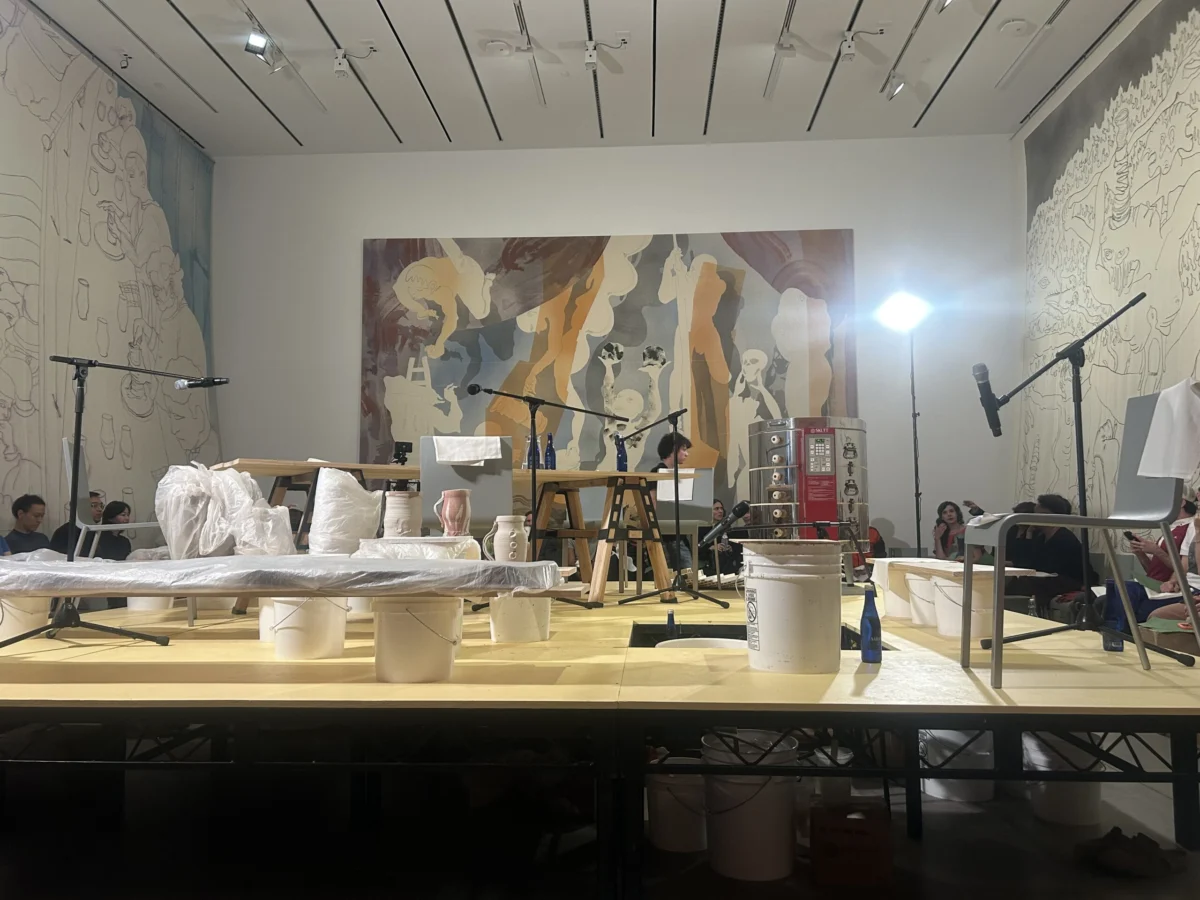
The final piece of this puzzle was De la Fourche au Four à la Fourchette, Broke the Plate, a play by Matthew Lutz-Kinoy staged at Amant in Williamsburg. The performance was a biting parody of post-Covid "back to the land" trends, mocking the farm-to-table obsession and the performative environmentalism of the contemporary art class.
Watching the curators and gallery owners themselves act out roles—a chef obsessed with "relational aesthetics" and a front-of-house model-ceramicist—was a revelation. The play fluctuated between self-deprecation and absolute self-satisfaction. It was a performance of the very people who define the scene, critiquing their own privilege while simultaneously embodying it.

The New York art world is currently defined by this peculiar, recursive loop: a constant mining of its own archive, a performative self-critique, and an accelerated pace that keeps it just ahead of its European counterparts. The question for the city is not whether it will survive, but whether it can continue to justify its own exclusivity. Can it continue to lampoon its own power? Can it continue to get away with the joke? As long as the audience—even the uninitiated, wandering teenager—is watching, the machinery will keep running.
Conclusion: A City in Perpetual Motion
What is "downtown" in New York? It is not a place, but a state of mind—a theater where the roles of gallerist, artist, and socialite blur into a single, cohesive performance. While London struggles with the inertia of its own history, New York thrives on the friction of its current, messy, and often pretentious reality. The city is a place where you are expected to be in on the joke, even when the joke is at your own expense. As the autumn fades into winter, the New York art world remains what it has always been: a thrashing, brilliant, and ultimately exhausting machine that is, for better or worse, still the only game in town.
