

Introduction: A Relic of Bohemian New York
The Hotel Chelsea is more than a building; it is a monument to the intersection of art, chaos, and the ephemeral nature of New York City fame. For decades, its red-brick facade has stood as a fortress for the avant-garde, the struggling genius, and the transient soul. Among its current custodians of history is filmmaker and producer Steve Willis, a man who has not merely inhabited these rooms since 1994, but has curated them into a living museum of his own artistic journey and the spectral echoes of his predecessors.
Willis, known for his work directing music videos for legends like Patti LaBelle and Mary J. Blige, as well as his expertise in choreographing grand-scale fountain shows for venues like the Bellagio, occupies a unique position in the building’s lore. His living space, comprised of two facing studios, serves as an archive—a place where the soap dish of Janis Joplin still rests, and where the memories of icons like Patti Smith and Kris Kristofferson remain etched into the architecture.
The Chronology of a Creative Sanctuary
Steve Willis’s residency at the Hotel Chelsea began during an era of significant transition for both the artist and the neighborhood. When he first arrived in 1994, Chelsea was a landscape of uncertainty.
- 1994: Willis moves into his first one-bedroom apartment at the Hotel Chelsea. The space, equipped with a fireplace and balcony, was famously occupied by Janis Joplin in the late 1960s. At this time, the surrounding neighborhood was a "no-man’s-land," defined by the gritty atmosphere of dive bars like Rawhide and the pervasive sense of a city on the edge.
- The Mid-90s: Under the stewardship of legendary manager Stanley Bard—often described as the building’s unofficial "casting director"—the hotel served as a low-cost, high-inspiration haven for creative professionals. Willis, then producing Mariah Carey’s "Anytime You Need a Friend," transitioned from hotel guest to long-term resident at Bard’s suggestion.
- 1996: Seeking more space for his expanding collection of artifacts, Willis rented a second studio directly across the hall. This expansion allowed him to further manifest his "pack rat" aesthetic, turning the two units into a cohesive, highly personalized environment.
- Present Day: Willis continues to reside in the space, serving as a bridge between the hotel’s storied, bohemian past and its modern iteration. His work continues to evolve, from high-end fountain choreography to documentary filmmaking, such as his collaboration with Rebecca Romijn on Wet Dreams.
Supporting Data: The Anatomy of a Collector’s Home
The interior of Willis’s apartment is a study in maximalism and intentional curation. Unlike the sterile, modern renovations that have sanitized much of Manhattan, Willis’s home feels like a Victorian cabinet of curiosities crossed with a mid-century set design.
The Aesthetics of the "Volcano Room"
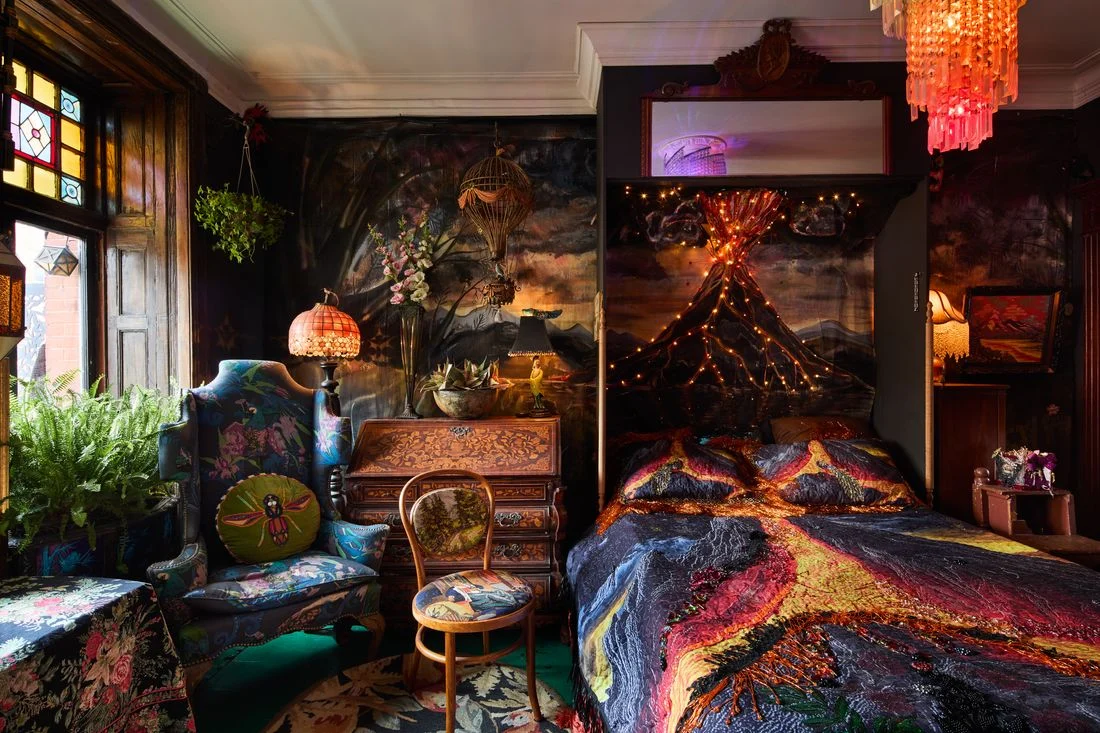
The centerpiece of his living space is the "Volcano Room," defined by a mural Willis painted himself as a nod to his Off-Broadway production concerning the life of the Peruvian singer Yma Sumac. The room is a testament to the "thrift-store chic" ethos:
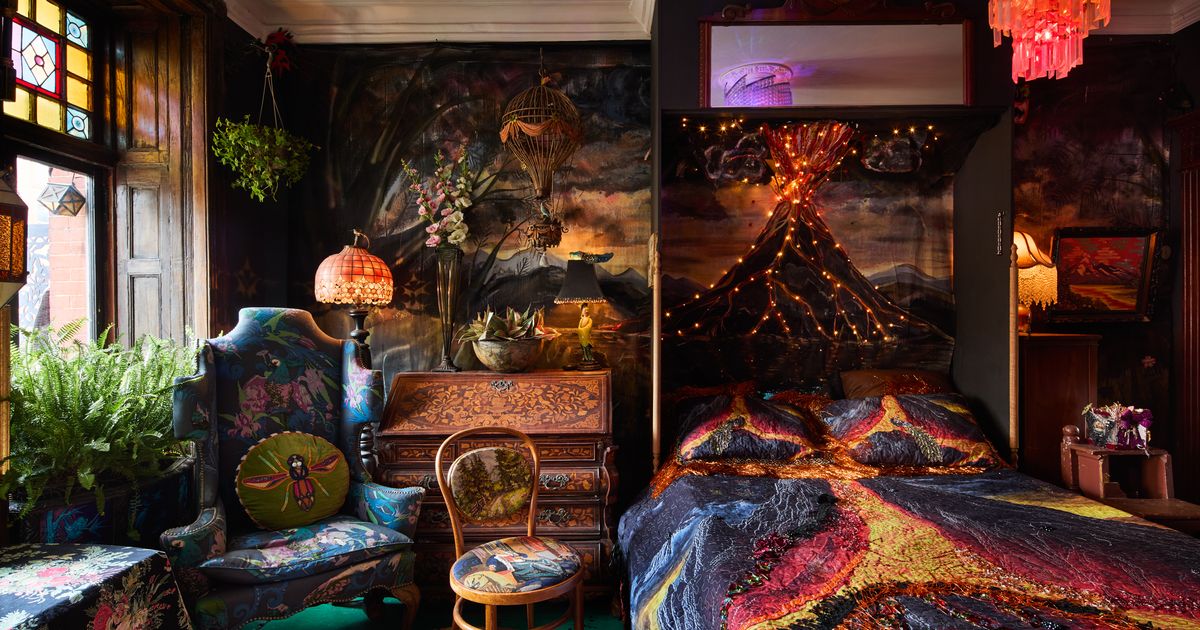
- The Furniture: An inlaid desk sourced from the City Opera Thrift Shop, a lacquer chest originating from his family’s time in Japan during the 1970s, and a chaise lounge acquired via eBay.
- The Personal Touch: The decor is heavily accented by pieces with sentimental value—a 1960s elephant statue belonging to his mother, and chairs embroidered by his friend, actress Rebecca Romijn.
- The Lighting: Vintage chandeliers augmented with colored lightbulbs to create a theatrical atmosphere that reflects his professional background in stage and fountain choreography.
Archival Preservation
Willis characterizes himself as his family’s archivist. His home is a repository of items that hold specific historical weight:
- Joplin Relics: A soap dish and toothbrush holder belonging to the rock icon.
- Repurposed Antiques: A Victorian wall unit serving as a bathroom door frame; a fireplace mantel from a thrift store treated with trompe-l’œil painting.
- The "Freud Study" Comparison: Guests have noted the intellectual, slightly claustrophobic intensity of the space, often likening it to a classic, cluttered study of a 20th-century psychoanalyst.
The "Bard Era" and the Philosophy of the Chelsea
The success of Willis’s tenure is inextricably linked to the management style of the late Stanley Bard. Bard operated the hotel not as a corporation, but as a patron. He invited artists to live within the walls, often allowing them to "pilfer" furniture from the hotel’s own basement storage.
This environment encouraged a sense of ownership among residents that is rare in modern New York. Willis speaks of stripping away layers of white paint to reveal the original dark woodwork of the 19th-century architecture, essentially performing a restoration that mirrored the restoration of his own professional life. For Willis, the Hotel Chelsea was not just a place to sleep; it was a collaborative project where the walls, the furniture, and the history were all raw materials for his own artistic expression.
Implications: The Gentrification of Memory
The story of Steve Willis at the Hotel Chelsea raises critical questions about the nature of urban preservation. As the neighborhood of Chelsea has transformed from a "no-man’s-land" into one of the most expensive zip codes in the United States, the Hotel Chelsea itself has undergone extensive, controversial renovations.
The survival of a resident like Willis—someone who maintains the "old" spirit of the building through his collection of flea-market finds and his refusal to modernize his decor—serves as a vital link to the city’s identity.

The Cost of Authenticity
Willis’s living situation is an outlier. The financial barriers to maintaining such a lifestyle in contemporary New York are immense. However, his story highlights that "luxury" is not always defined by marble countertops or smart-home technology. True luxury, in the context of the Hotel Chelsea, is the ability to live surrounded by objects that have a history, a narrative, and a soul.
The Role of the "Pack Rat"
Willis’s self-identification as a "pack rat" is, in reality, a form of radical preservation. In a city that moves at the speed of light, where real estate is turned over every few years, the accumulation of objects that survive decades is an act of defiance. His apartment serves as a sanctuary for the "old lady in heaven" whose plastic-covered sofa he inherited, and for the ghosts of musicians who once sang in his living room.
Conclusion: A Legacy Carved in Fabric and Paint
Steve Willis does not just live in a room; he lives in a poem. His home, a sprawling collection of thrifted treasures, theatrical set pieces, and historical artifacts, stands as a reminder of what the Hotel Chelsea was and what it continues to struggle to remain: a home for those who create, those who curate, and those who dare to live in the past while working in the future.
As long as the toothbrush holder of a rock icon sits on his vanity and the murals of forgotten divas adorn his walls, the spirit of the old Hotel Chelsea remains alive. Willis proves that while buildings change and neighborhoods shift, the memories held within four walls can be preserved—provided there is someone with the vision and the heart to keep them.
