

In the annals of medical parasitology, few cases are as simultaneously fascinating and discomforting as the ocular infestation of Thelazia callipaeda. Often referred to as "oriental eye worm," this parasite represents a rare but striking example of how nature utilizes interspecies cooperation to ensure its own propagation. A recent case report published in the New England Journal of Medicine (2026) has once again thrust this condition into the spotlight, providing a visceral reminder of the complex, biological "hitchhiking" strategies employed by microscopic organisms to colonize the human eye.
For the patient in this recent clinical encounter, the experience was one of growing ocular discomfort and irritation—a symptom profile that eventually led to the extraction of multiple worms, some reaching up to 20 millimeters in length. While the psychological toll of such an infestation is undeniable, the biological reality of how these worms navigate from one host to another is a masterclass in evolutionary adaptation.
The Biological Mechanism: A Hitchhiker’s Guide to the Eyeball
The life cycle of T. callipaeda is a sophisticated, multi-stage journey that relies heavily on a specialized "flying nanny." The parasite does not simply crawl from host to host; it utilizes the behavioral patterns of common flies that are naturally drawn to the moisture and nutrient-rich secretions of the mammalian eye.
The Role of the Intermediate Host
The flies act as both a nursery and a transport vessel. When a fly lands on the eye of an infested animal or human to feed on tears and ocular secretions, it inadvertently consumes the parasite’s first-stage larvae. Once inside the fly, the larvae undergo a significant transformation. They molt twice, transitioning into third-stage larvae—the infective stage. During this phase, they migrate from the fly’s gut to its mouthparts, essentially positioning themselves for a swift exit at the next "watery" destination.
The Colonization Process
When the fly next lands on a suitable host, the third-stage larvae disembark, entering the conjunctival sac of the eye. Here, they settle into a "permanent peeper residence." Upon reaching this final destination, they undergo a third and final molt, developing into mature adults. These adults then mate directly on the surface of the eye, continuing the cycle by releasing their offspring into the host’s tear film, where they wait to be picked up by the next thirsty insect.
Chronology: From Initial Irritation to Clinical Resolution
The case documented in the 2026 New England Journal of Medicine report offers a clear timeline of how such an infestation presents and is subsequently resolved in a clinical setting.
- Onset of Symptoms: The patient presented with chronic ocular irritation, a sensation of a foreign body in the eye, and lacrimation (excessive tearing). These symptoms are the hallmark of Thelazia infections, caused by the physical movement of the worms across the delicate tissues of the conjunctiva and cornea.
- Clinical Examination: Upon examination, physicians observed the presence of translucent, thread-like organisms moving within the ocular space. This visual confirmation is usually sufficient for a diagnosis, given the distinct morphology of the worms.
- Mechanical Extraction: Unlike many other parasitic infections that require systemic pharmacological intervention, T. callipaeda is primarily managed through physical removal. Using fine surgical forceps, clinicians carefully extracted the worms from the eye. The procedure, while delicate, is curative.
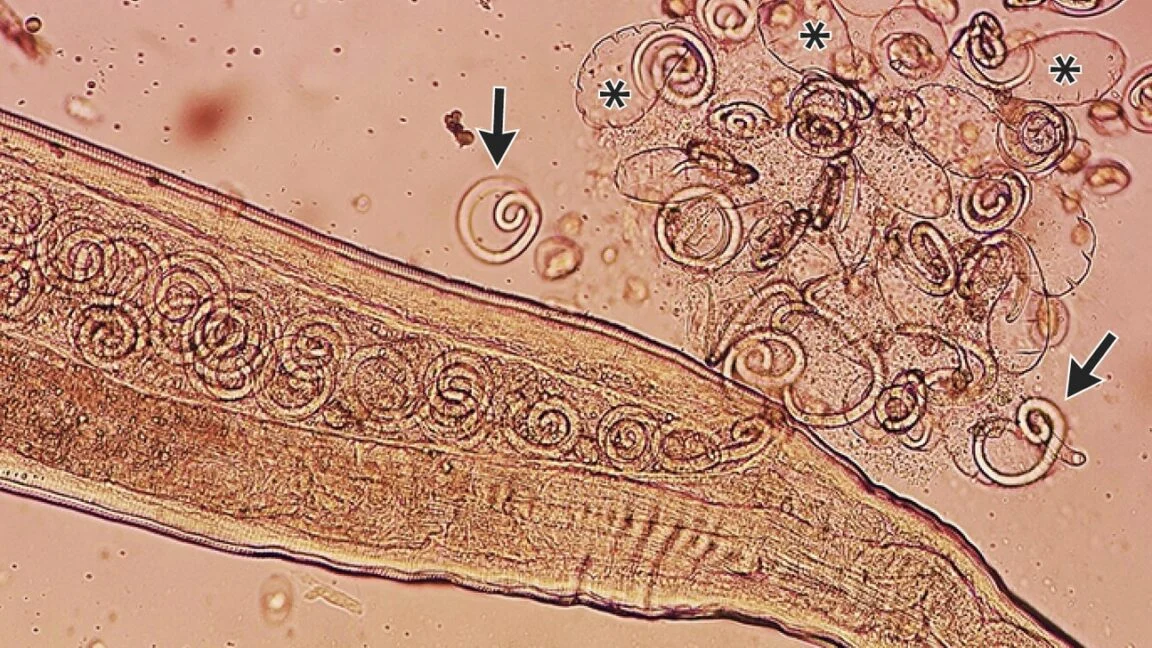
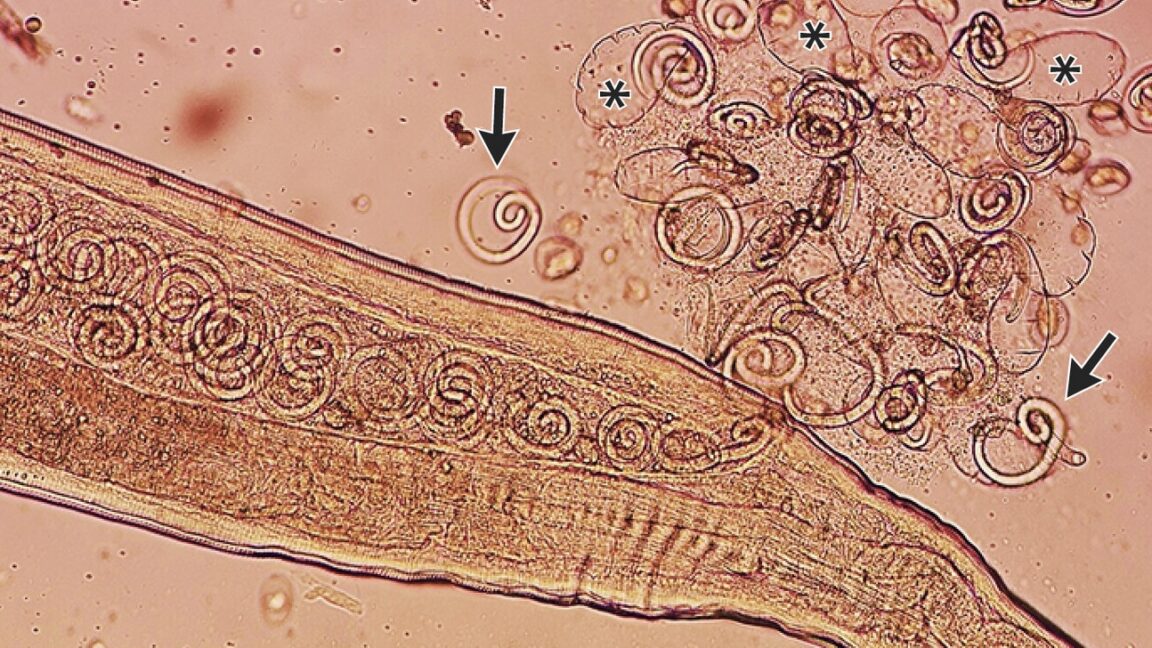
- Biological Observation: Post-extraction analysis revealed the presence of both male and female worms. The females were notably plump, carrying embryonated eggs. In a stark demonstration of the species’ reproductive strategy, researchers observed coiled first-stage larvae literally bursting from the uteri of the female worms after they had been removed from the host.
- Follow-up and Recovery: A follow-up examination conducted two months post-procedure confirmed that the patient was entirely symptom-free. No systemic antiparasitic medication was required, and the removal of the adult worms proved sufficient to end the infection, effectively interrupting the local reproductive cycle.
Supporting Data: Understanding the Morphology
The microscopic analysis of the extracted worms provided critical insights into the sexual dimorphism of the species.
Female Reproductive Strategy
T. callipaeda is ovoviviparous. This means the female does not lay external eggs that require a period of incubation in the environment; instead, the embryos develop into larvae within the female’s body. This ensures that when the larvae are released into the tear film, they are already prepared to be ingested by a fly. The density of these larvae within the female’s uterus is high, allowing for a massive dispersal of offspring through a single host.
Male Identification
Male worms were identified through their distinct physical characteristics, specifically the ventrally curved posterior ends. These are equipped with copulatory spicules—needle-like structures that function as intromittent organs. These structures are essential for the male to successfully mate with the female while both are navigating the constantly shifting, moist environment of the ocular surface.
Clinical Implications and Public Health
The T. callipaeda infection, while geographically localized in many instances, serves as a poignant reminder of the importance of vector control and ocular hygiene.
The Need for Awareness
In regions where the species of fly capable of transmitting Thelazia is prevalent, awareness is the first line of defense. The infection is not limited to humans; it is a zoonotic disease, frequently found in dogs, cats, and various wild carnivores. Consequently, the "reservoir" of the parasite in the environment is vast, making total eradication nearly impossible.
Diagnostic Vigilance
For clinicians, the primary implication is the need for diagnostic vigilance. Eye irritation is a common complaint, often dismissed as dry eye or mild conjunctivitis. When standard treatments for these conditions fail, and the patient has a history of outdoor exposure in endemic areas, the possibility of helminthic infection should be considered.
Treatment Paradigm
The success of mechanical removal in this case highlights a favorable clinical outcome. Because the worms live superficially in the conjunctival sac rather than burrowing deep into the tissue of the globe, surgical extraction—while intimidating to the patient—is a highly effective and low-risk intervention. The lack of need for systemic antiparasitic drugs is a significant advantage, as it avoids the potential side effects associated with systemic anthelmintics.
Expert Perspectives and Future Research
The New England Journal of Medicine report underscores the collaborative nature of modern medical science. By documenting these cases, the global medical community can better map the spread of vector-borne diseases that are increasingly crossing the threshold from veterinary to human medicine.
As urbanization continues to encroach upon wild habitats, the interaction between humans and the flies that carry these parasites is likely to increase. Further research into the sensory mechanisms that allow these flies to locate eyes—and the subsequent behavioral cues of the larvae—could lead to better prevention strategies.
Addressing the Psychological Component
Medical professionals involved in these cases often note that the patient’s psychological distress is significant. The sensation of "something moving" in the eye is a powerful stressor. Clinical protocols for Thelazia removal must therefore emphasize not just the physical extraction, but also the psychological reassurance of the patient. The knowledge that the condition is fully curable and that the parasites do not cause permanent systemic damage is vital for patient recovery.
Conclusion: A Lesson in Biological Persistence
The saga of T. callipaeda is a testament to the evolutionary tenacity of parasites. By hijacking the fundamental needs of a fly—the need for moisture—these worms have secured a niche that is protected from the host’s internal immune system and perfectly positioned for transmission.
While the prospect of "eyeball worms" is a frequent subject of horror in popular culture, the reality, as demonstrated by the 2026 case, is a manageable medical condition. Through precise identification, careful mechanical removal, and a clear understanding of the parasite’s life cycle, the clinical community continues to effectively treat this ancient and persistent ocular invader. As we move further into the decade, the continued documentation of such cases will remain a vital tool in the broader effort to understand the complex, ever-evolving relationships between humans, vectors, and the parasites that call us home.
