

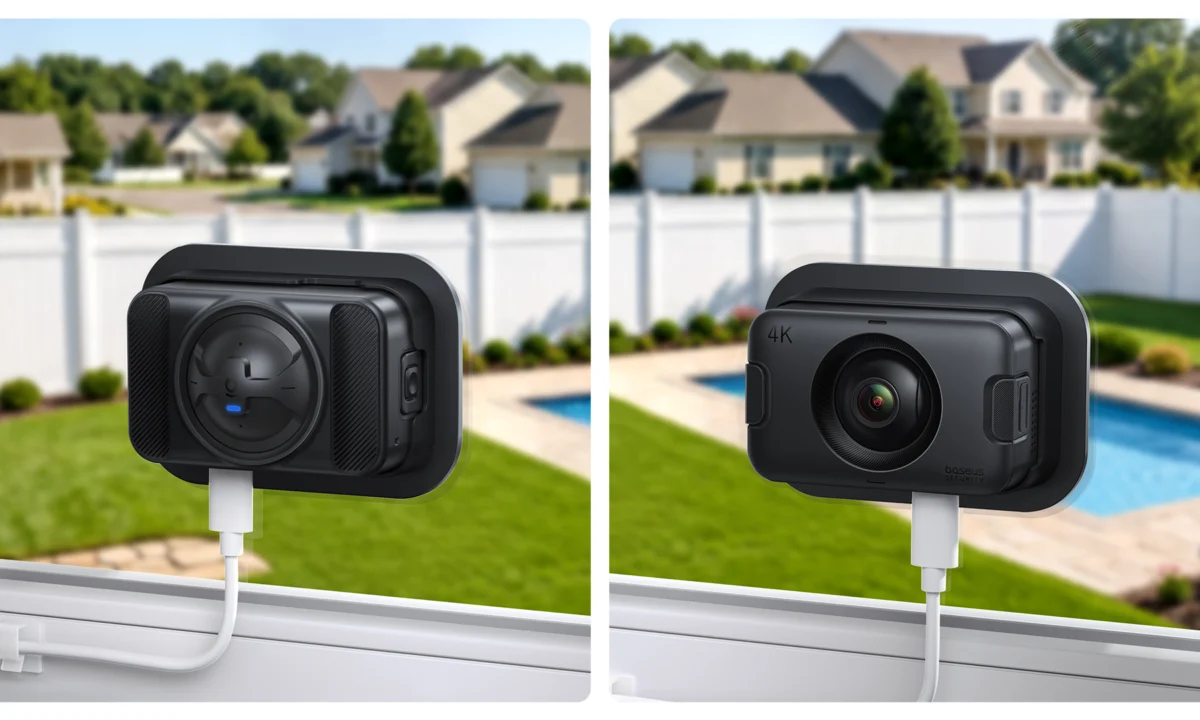
For millions of renters and apartment dwellers, the dream of a comprehensive home security system is often thwarted by the realities of lease agreements. Traditional outdoor security cameras require permanent installation, involving power drills, wall mounting, and complex wiring that is strictly prohibited by most landlords. Even when users opt for indoor cameras placed near windows, they are frequently met with the "glass dilemma": infrared reflections, glare, and poor visibility that render the footage useless after the sun goes down.
Baseus is stepping into this gap with the launch of the PrimeSentinel W1, a specialized security camera designed to bypass these limitations entirely. Priced at $69.99, the device offers a clever, non-invasive solution that promises to bring high-end, 4K-quality monitoring to those who previously had to settle for compromised security setups.
Main Facts: A New Standard for Window-Facing Surveillance
The Baseus PrimeSentinel W1 is fundamentally designed to bridge the gap between indoor convenience and outdoor coverage. Its core architecture revolves around a high-resolution 4K Starlight sensor paired with an ultra-wide F1.0 aperture. This combination is engineered to excel in low-light environments, allowing the camera to capture full-color video even at night without relying on traditional, reflection-prone infrared (IR) LEDs.

Key Specifications:
- Resolution: 4K Ultra-HD imaging.
- Optics: F1.0 aperture for superior light intake.
- Installation: Tool-free, nano-adhesive magnetic mount.
- Connectivity: Dual-band Wi-Fi (2.4GHz and 5GHz).
- Storage: Local support for microSD cards up to 512GB.
- Versatility: Reversible magnetic mounting for indoor/outdoor toggling.
- Pricing: $69.99 USD.
The device is specifically optimized for glass-through recording, utilizing an anti-reflection internal housing design that minimizes the ghosting effects often seen when placing a lens against a pane.
Chronology of the Launch
The announcement of the PrimeSentinel W1 comes at a time when the consumer smart home market is shifting toward "renter-friendly" technology.
- October 2026 (Launch Phase): Baseus officially unveiled the product to the North American market, positioning it as the flagship entry in their "PrimeSentinel" series.
- October 20, 2026 (Expansion): The company confirmed that the rollout will expand into European markets, following the initial U.S. launch.
- Strategic Positioning: The timing of the launch aligns with a broader industry trend where major tech players are focusing on AI-enhanced, low-footprint devices. By targeting the intersection of privacy, convenience, and high-fidelity video, Baseus is attempting to capture the demographic that is currently underserved by traditional hardwired security camera manufacturers like Nest or Ring.
Supporting Data: Why Glass is a Challenge
To understand the engineering behind the W1, one must understand the physics of light transmission through glass. Most standard security cameras use infrared emitters to "see" in the dark. When these emitters are pointed through a window, the infrared light bounces off the glass surface, blinding the camera with a "whiteout" effect—essentially, the camera is looking at its own reflection.

Baseus’s choice of a high-sensitivity Starlight sensor with an F1.0 aperture is a deliberate technical choice. An F1.0 aperture is exceptionally large, allowing significantly more ambient light—such as streetlights, moonlight, or porch lights—to reach the sensor. By avoiding the need for active IR light, the camera eliminates the reflection issue at the source.
Furthermore, the mechanical design is just as critical as the optical one. The use of reusable nano-adhesive allows for a secure, semi-permanent bond to window glass, while the magnetic mount offers a "quick-adjust" capability. Users can tilt the camera 13 degrees horizontally and 25 degrees vertically, and with a 130-degree field of view, the total effective coverage reaches 156 degrees. The unique "flip-and-mount" feature—where the camera can be detached and flipped 180 degrees—serves as an elegant solution for those who want to use the same device for interior security when they are home and exterior security when they are away.
Official Responses and Industry Context
While Baseus has not released a formal manifesto, marketing materials accompanying the launch emphasize a "Security Without Compromise" philosophy. The company highlights that they are addressing the "renter’s anxiety" that often prevents individuals from installing security hardware.

Industry analysts observe that this move by Baseus is part of a larger trend of "AI-driven home living." As the smart home ecosystem evolves, consumers are looking for hardware that acts as a "companion" rather than a cumbersome utility. By integrating AI-based motion detection that sends alerts directly to a companion app, the W1 is not just a passive recorder but an active participant in home security.
Implications for the Security Market
The introduction of the PrimeSentinel W1 has several long-term implications for the home security industry:
1. The Death of the "Permanent" Requirement
The success of the W1 suggests that the era of drilling into exterior stucco or brick to mount cameras may be nearing its peak. As adhesive technology improves, manufacturers are likely to follow Baseus’s lead in creating products that are lightweight, magnetic, and completely reversible. This lowers the barrier to entry for millions of potential customers who live in managed properties.

2. The Rise of "Through-Glass" Optics
We can expect to see a surge in "through-glass" optimized cameras. As urbanization increases and more people move into high-rise apartments, the demand for balcony and window-based surveillance will grow. Competitors will likely be forced to move away from standard IR-based night vision if they want to remain relevant in this specific niche.
3. Shift Toward Local Privacy
By offering microSD support up to 512GB and 24/7 continuous recording, the PrimeSentinel W1 appeals to the privacy-conscious consumer. In an era where cloud-only subscriptions are becoming the norm, the ability to maintain a local, offline archive of footage is a major selling point.
4. Integration into the AI Ecosystem
The inclusion of AI-based activity alerts is a critical differentiator. It implies that the camera is performing on-device processing to differentiate between, for example, a swaying tree branch and a human intruder. This reduces the "alert fatigue" that plagues many current security camera owners, who are often bombarded with notifications every time a squirrel crosses their porch.

Future Outlook: A New Paradigm
The PrimeSentinel W1 represents more than just a new piece of hardware; it is a signal of shifting priorities. As smart home technology becomes more pervasive, the design of these devices must adapt to the physical constraints of our living spaces.
By focusing on the unique challenges of apartment living—the inability to drill, the nuisance of window glare, and the desire for high-quality, reliable surveillance—Baseus has carved out a compelling value proposition. If the W1 performs as advertised, it could set a new benchmark for how we conceive of residential security.
For the average renter, the days of choosing between a vulnerable home and an angry landlord may finally be over. Whether this leads to a broader adoption of AI-monitored, window-based security remains to be seen, but the PrimeSentinel W1 is undoubtedly a significant step toward a more accessible and inclusive future for home safety technology. As we look toward the end of 2026, it is clear that the evolution of the smart home is moving toward smaller, smarter, and more adaptable devices that fit seamlessly into the lives of the people who use them.
