

By Wyatt Gordon
Reporting for Greater Greater Washington
As the holiday season concluded and the nation turned its attention toward the new year, the Washington Metropolitan Area Transit Authority (WMATA) delivered a sobering gift to the capital region: a "doomsday budget." Facing a staggering $750 million funding gap for the 2025 fiscal year, the agency has signaled that, without immediate intervention from its jurisdictional partners, it will be forced to implement draconian service cuts as early as July.
This is not merely a budgetary hiccup; it is a structural crisis decades in the making. As the Greater Washington region navigates a post-pandemic economic landscape, the fragility of the Metro system—which serves five of the nation’s ten wealthiest counties—has been laid bare.
The Anatomy of the Fiscal Cliff
The term "fiscal cliff" in the context of WMATA refers to the exhaustion of federal pandemic relief funding that has, until now, masked the agency’s underlying financial instability. For years, these federal dollars served as a life-support system for the transit network, covering operational losses while ridership fluctuated. Now, those funds are depleted, and the system is left to face a reality where operating expenses far outpace self-generated revenue.
At the core of the issue is a fundamental design flaw: WMATA lacks a dedicated, reliable source of operating funding. While peer systems in cities like New York and London benefit from robust regional sales taxes or congestion pricing models, Washington’s Metro remains reliant on a patchwork of annual appropriations from the District of Columbia, Maryland, and Virginia. This creates a perpetual cycle of uncertainty, forcing the agency to scramble for survival every fiscal cycle.
A Chronology of Structural Neglect
To understand why the region is staring down the barrel of a 67% service reduction, one must look at the historical trajectory of the Metro.
- 1976: The Incomplete Foundation: WMATA was established during a golden age of American transit expansion. However, unlike its contemporaries—such as BART in San Francisco or MARTA in Atlanta—the Metro was built without a permanent, dedicated operating subsidy. It was designed to move federal commuters from the suburbs to the urban core, assuming that farebox recovery and ad-hoc local support would suffice.
- 2008: The PRIIA Milestone: The Passenger Rail Investment and Improvement Act (PRIIA) represented a rare moment of federal engagement, mandating a match for capital improvements. While this helped with infrastructure, it did nothing to address the structural deficit of day-to-day operations.
- 2018: The Capital Deal: In an attempt to stabilize the agency, the three jurisdictions struck a landmark deal providing $500 million annually in dedicated capital funding. However, the agreement included a 3% cap on the growth of operating assistance. While intended as a governance tool to prevent runaway costs, the cap was not indexed to inflation, effectively trapping the agency in a vice of rising costs and stagnant revenue.
- 2020–2023: The Pandemic Disruption: COVID-19 decimated the traditional commuter model. With a significant portion of the federal workforce pivoting to telework, Metrorail ridership plummeted. Even as off-peak and weekend ridership have rebounded to 90% of pre-pandemic levels, the core "9-to-5" commute remains stalled at 55%.
Supporting Data: The Math of Disintegration
The economic data paints a grim picture. Farebox revenue and ancillary income (advertising, parking) currently account for only 22% of WMATA’s budget. With the District of Columbia having the second-highest rate of remote work in the nation—one in four residents no longer commuting—the traditional revenue model has effectively collapsed.
Even if every federal worker were mandated to return to their desks tomorrow, it would only bridge a fraction of the gap. Experts estimate that a full return-to-office mandate would fail to address more than 75% of the projected annual deficits.
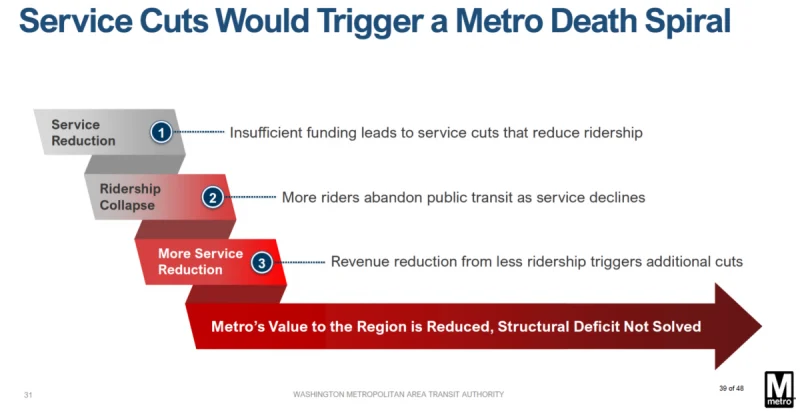
The "death spiral" scenario, as modeled by WMATA planners, is mathematically ruthless:
- Service Reductions: To close the $750 million hole, the agency must cut operating costs. Because the vast majority of these costs are tied to labor, service must be slashed.
- The Multiplier Effect: A 37% reduction in costs triggers a cascade of further ridership losses. Because fewer trains and buses lead to lower ridership, the agency would actually need to cut $947 million to realize a net savings of $750 million.
- The Resulting Service Levels: If the budget is not met, the number of Metrorail trips occurring every six minutes would drop from 81% to a mere 10%. All stations would shutter at 10:00 pm, 67 bus routes would be eliminated, and fares would climb by 20%.
Official Responses and Political Realities
The political response has been a mixture of alarm and finger-pointing. WMATA General Manager Randy Clarke has been clear that the agency’s hand is forced. Meanwhile, the jurisdictional partners are struggling with their own fiscal headaches.

Maryland’s Department of Transportation is currently navigating a $3.3 billion shortfall, severely limiting the state’s capacity to increase its contribution. In Virginia, Governor Glenn Youngkin has suggested that any additional transit funding could be contingent on unrelated legislative priorities, including a controversial $2 billion sports arena proposal in Potomac Yard—a station that would likely be on the chopping block under the "doomsday" plan.
Dr. Tracy Hadden Loh, a member of the WMATA board and chair of the Greater Greater Washington board, has characterized the situation as a moral and policy failure. "The DC region is at a precipice where we could emerge stronger than ever… or we could choose stagnation and decline," she warned. "If that happens, it won’t just be because the money isn’t there. It will be a policy choice."
John Hillegass of the Greater Washington Partnership echoes this sentiment, noting that the 3% cap established in 2018 has become a "noose" in the current inflationary environment. "We’ve never really figured out how to pay for WMATA as a region," Hillegass observed.
Implications for the Future
The implications of a gutted Metro system extend far beyond the inconvenience of longer wait times. A region built on the assumption of high-capacity, reliable transit cannot function if that transit is reduced to a skeleton service.
- Economic Stagnation: The DC region’s economic competitiveness is tethered to its ability to move people efficiently. Reduced service will likely exacerbate traffic congestion, increase carbon emissions, and deter businesses from keeping their headquarters in the metro area.
- Social Inequity: The burden of service cuts falls disproportionately on those who rely on the system for essential needs—the elderly, those with disabilities, and low-income workers who do not have the luxury of remote work.
- The Death Spiral Risk: If service is cut, riders leave. If riders leave, revenue drops further. If revenue drops, more cuts are required. Breaking this cycle requires a fundamental shift in how the region views the Metro: not as an optional service to be balanced like a household budget, but as an essential public utility that requires permanent, dedicated funding.
As the July deadline looms, the question for the region’s leadership is no longer about balancing a spreadsheet; it is about the long-term viability of the nation’s capital as a functional, equitable, and world-class metropolitan area. The "doomsday" budget is not just a warning—it is a mirror reflecting a region that has yet to commit to its own future.
