

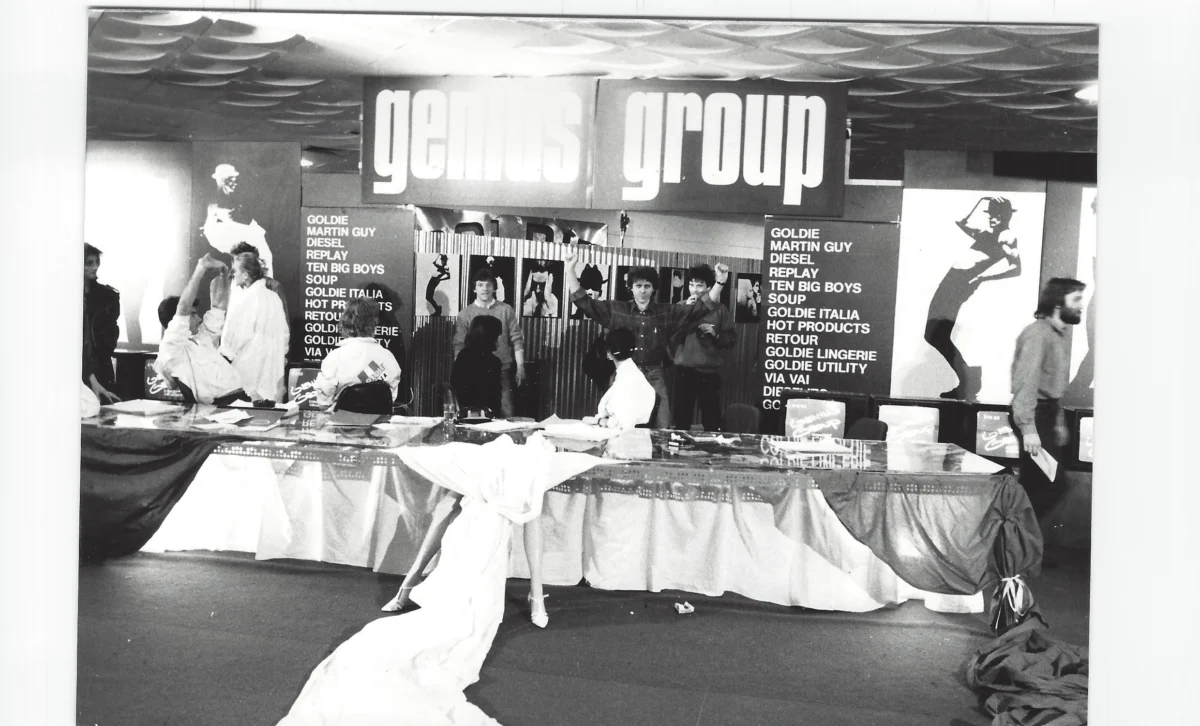
In the annals of fashion history, few moments have been as transformative—or as fleeting—as the period between 1981 and 1985 in the Veneto region of Italy. It was here that Adriano Goldschmied, often heralded as the "Godfather of Denim," orchestrated an experiment in radical creativity known as the "Genius Group."
To understand the Genius Group is to understand the Big Bang of contemporary denim. It was not merely a company; it was a living, breathing laboratory, a theater of operations where artists, technicians, and visionaries collided to dismantle the rigid structures of the apparel industry. With the passing of Goldschmied this past April at age 82, the industry has been forced to reflect on this unique "factory of ideas" that served as the crucible for brands like Diesel and Replay, and which ultimately turned the Italian province of Veneto into the world’s foremost "Denim Valley."
The Genesis of an Industry Catalyst
The story begins with a photograph. It is a classic 1980s tableau: nearly 90 people gathered in an Asolo theater, arranged with the rigid precision of a class photo, yet pulsating with an undeniable, kinetic energy. In the bottom right corner, a bold, hand-drawn graphic reads "Genius Troupe." At the center sits Adriano Goldschmied, not merely as a CEO, but as a coach surrounded by his roster. Many of those in the frame would go on to become the architects of the modern fashion landscape.
Goldschmied’s trajectory toward this moment began in 1974 with the launch of Daily Blue, the first brand to conceptualize jeans specifically for the female form. Having tasted success, he sought to scale that spirit of innovation. He envisioned a 360-degree operational machine—a synthesis of high-level pattern makers, product technicians, avant-garde artists, illustrators, and photographers. This was an entirely alien concept to the Italian textile industry of the era, which was largely defined by traditional manufacturing and conservative business models.
A Chronology of the Creative Explosion (1981–1985)
The existence of the Genius Group was relatively brief, yet its intensity was supernova-like.
- 1981: The official formation of the Genius Group. Goldschmied secures an industrial shed in the Veneto, transforming it into a collection of semi-autonomous creative booths.
- 1982–1983: The group begins to output at an unprecedented pace. Approximately 15 groundbreaking brands—including Goldie, Diesel, Replay, Ten Big Boys, BoBo Kaminsky, and Via Vai—are developed, each focusing on a distinct product niche.
- 1984: The Genius Group attains peak influence, participating in the prestigious MilanoVendeModa trade show. The group begins to pioneer experimental washes, stretch denim, and high-fashion-driven underwear and childrenswear.
- 1985: The "Big Bang" reaches its breaking point. Despite global distribution success, the internal infrastructure struggles to keep pace with the chaotic, rapid-fire creativity. The collective begins to splinter as key members, including Renzo Rosso and Claudio Buziol, acquire quotas for their respective labels and move toward independence.
Supporting Data: The Anatomy of a Fashion Factory
The Genius Group functioned as a "special R&D laboratory." Its operational philosophy was predicated on the rejection of competition. Because each designer and technician focused on a unique brand category, the environment was collaborative rather than cutthroat.
The Innovation Hub
The group’s legacy is defined by a series of technical breakthroughs that are now industry standards. Among their contributions:
- Denim Evolution: They perfected the art of vintage-wash denim and introduced the first viable iterations of stretch jeans.
- Diversification: By expanding into "fashion-driven" underwear and activewear, they essentially invented the lifestyle-brand concept that would dominate the 1990s and 2000s.
- The Veneto Ecosystem: By centralizing these talents, Goldschmied turned Asolo into an epicenter for laundries, textile labs, and manufacturing facilities, creating a "Denim Valley" that drew international attention from the likes of Marithé and François Girbaud.
The Human Element
The work culture was famously grueling yet intoxicating. Collaborators recall working 18-hour days, fueled by a shared, near-obsessive passion. Venucia De Russi, a veteran pattern maker, remembers arriving at the studio in the morning and often leaving at 3:00 a.m. the following day. "I knew when I started, but not when I would finish," she remarked.
Valter Celato, who managed the group’s graphic identity, described the atmosphere as a chaotic, free-form workspace. "There were 40 to 50 people coming and going every day," he noted. "If someone had a stroke of inspiration at 10:00 p.m., they would work all night, and you’d find them sleeping on a couch the next morning."
Official Perspectives and Industry Echoes
The impact of the Genius Group extended well beyond the borders of Italy. French design pioneers Marithé and François Girbaud, who witnessed the movement from across the Alps, noted that while the French textile industry was fading, Goldschmied’s collective was "at the forefront of a movement that we… had not known how to pursue."
Renzo Rosso, now a titan of the industry, and Enzo Fusco, the president of FGF Industry, both cut their teeth in this crucible. For Fusco, Goldschmied was more than a boss; he was a "catalyst and a visionary."
"Adriano was the one who reinvented jeans and sensed things before others did," Fusco said. "Everything he did—a booth, a catwalk show, a marketing campaign—had a different take. Having worked with him was a source of pride."
Perhaps the most significant external influence on Goldschmied was Franca Sozzani, the late editor-in-chief of Vogue Italia. She pushed him to abandon safe, conventional paths, encouraging him to lean into the subversive, artistic side of fashion—a philosophy that eventually brought icons like Malcolm McLaren into the Genius Group’s orbit.
Implications: The Legacy of Controlled Chaos
Why did the Genius Group eventually succumb to the very forces it helped create? The answer lies in the inherent tension between "art" and "industry."
As Goldschmied himself famously put it, "It was like a gigantic fire, but we could not bring enough wood on the fire and control it." The very freedom that allowed the group to innovate simultaneously eroded its ability to maintain a sustainable, rigid production hierarchy. The brands grew so successful that they outgrew the collective structure. When Renzo Rosso took full control of Diesel and others followed suit, the "Genius Group" dissolved, leaving behind a legacy that has yet to be truly replicated.
The implications for today’s fashion industry are profound. In an era of data-driven design and hyper-optimized supply chains, the story of the Genius Group serves as a poignant reminder of the power of serendipity. They proved that innovation does not happen in a silo; it happens in a community.
Many have attempted to recreate the "Genius" magic—the mix of high-level artistry and industrial output—but they have largely failed. The missing ingredient was never just the capital or the technology; it was Goldschmied’s unique vision, his uncanny ability to attract talent, and his refusal to prioritize profit over the "explosion of creativity."
Today, as denim continues to evolve in a world of sustainability and digital manufacturing, the shadow of the Genius Group looms large. It remains the gold standard for what happens when you remove the barriers between a dreamer and an industrialist, proving that while a business may have a lifespan, a revolution is permanent.
