

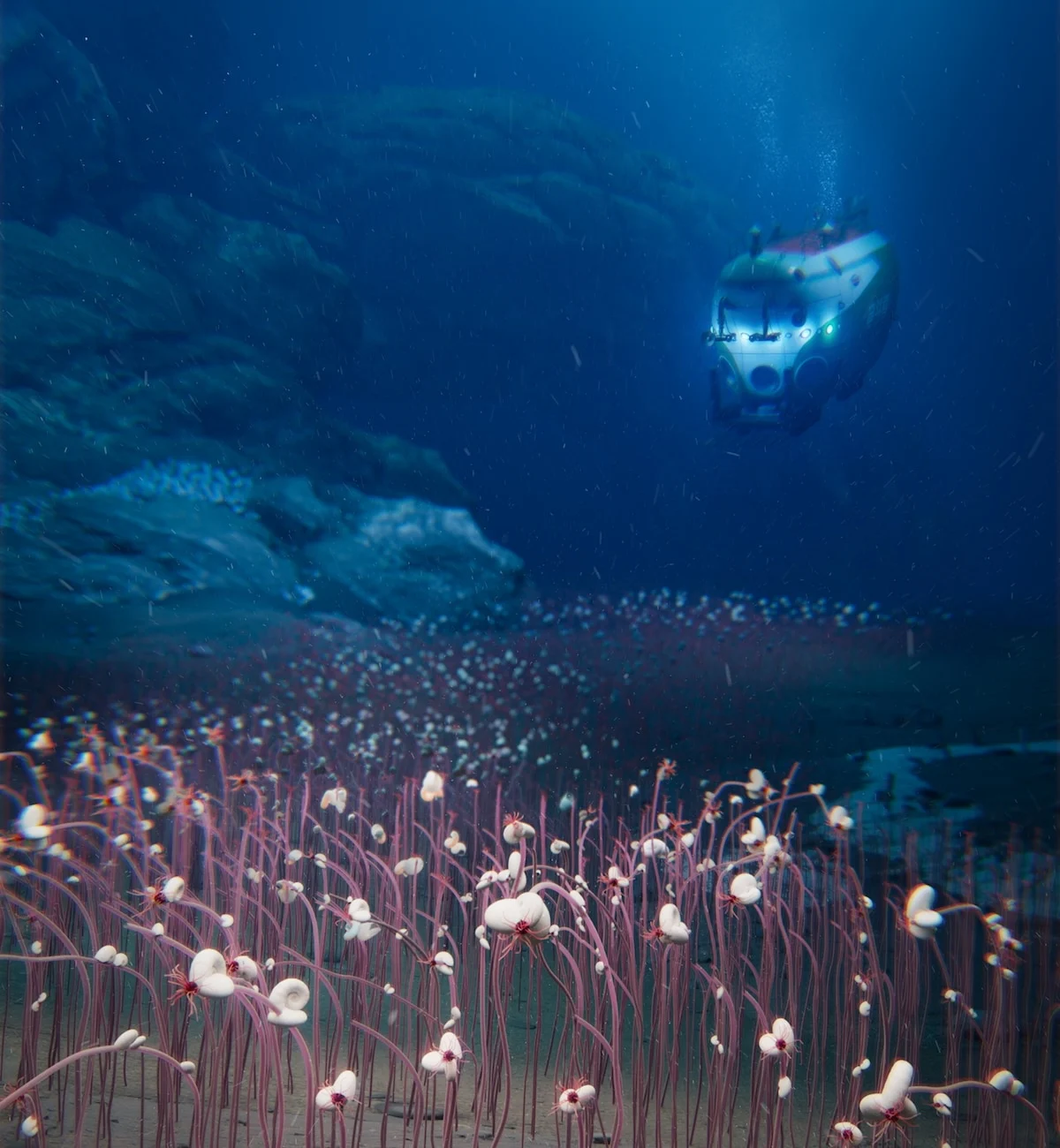
In a revelation that fundamentally shifts our understanding of biological limits, researchers have uncovered an expansive, thriving ecosystem nearly six miles beneath the surface of the Pacific Ocean. The discovery, made by a team using the Chinese manned submersible Fendouzhe, highlights a vibrant community of mollusks, tubeworms, and crustaceans flourishing in the extreme conditions of the Mariana, Kuril-Kamchatka, and western Aleutian Trenches.
This study, published in the journal Nature, marks the identification of the deepest and most extensive chemosynthesis-based communities ever recorded. Far from the barren, “alien” landscape once imagined by early deep-sea explorers, these hadal trenches—the deepest parts of the ocean—are revealed to be complex, life-sustaining habitats that challenge existing models of deep-ocean carbon cycling.
The Discovery: A Vibrant Oasis in the Deep
The Fendouzhe submersible, operated by the Institute of Deep-sea Science and Engineering (IDSSE) under the Chinese Academy of Sciences, completed 23 dives into the Mariana Trench last year alone. During these descents, researchers captured high-definition footage of an unexpected sight: thousands of bivalves, tubeworms growing up to a foot in length, and various invertebrates, including sea lilies, sea cucumbers, and spiky crustaceans.
“What makes our discovery groundbreaking is not just its greater depth—it’s the astonishing abundance and diversity of chemosynthetic life we observed,” said Mengran Du, a marine geochemist with the IDSSE and co-author of the study. “Unlike isolated pockets of organisms, this community thrives like a vibrant oasis in the vast desert of the deep sea.”
The community stretches across a staggering distance of over 1,500 miles, existing at depths ranging from 3.6 to 5.92 miles below sea level. At these depths, the pressure is immense, and total darkness is absolute. Yet, these animals do not require the sun’s energy. Instead, they rely on chemosynthesis—a process where organisms convert chemical energy, specifically from methane and hydrogen sulfide, into the sustenance required for life.
Chronology of Exploration: From "Desolate" to Thriving
The history of exploring the hadal zone is brief and fraught with technological difficulty. For decades, the deepest trenches were viewed as biological graveyards, largely because the logistical challenges of sending equipment to such depths made sustained study impossible.
- 1960: The first human expedition to the floor of the Mariana Trench took place, offering a fleeting, low-visibility glimpse into the deep.
- 2012: Filmmaker and explorer James Cameron made a historic solo dive to the bottom. Upon his return, he famously described the landscape as “desolate” and “alien,” a sentiment that reflected the scientific consensus at the time: that life was sparse and localized.
- 2024-2025: The Fendouzhe expedition utilized advanced submersible technology to conduct repeated, systematic dives. By focusing on the geological fault lines where methane-rich fluids seep through the seafloor, the team moved beyond the “spot-check” approach of previous decades.
- July 2025: The formal publication of the findings in Nature confirmed that these communities are not rare anomalies but are widespread across the Pacific’s major trench systems.
Supporting Data: How Life Thrives in the Dark
The research team identified the mechanism behind this unexpected biological success: a symbiotic relationship between local geology and microbiology. Isotopic analysis performed on the samples and environmental data collected by the Fendouzhe revealed that the seafloor is permeated by hydrogen sulfide-rich and methane-rich fluids.
These fluids are transported along deep geological faults that traverse the sediment layers of the trenches. Microbes in the sediment convert organic matter into methane, which then feeds the microbial mats. These mats act as the foundation of the food web, providing a steady nutrient source for the larger invertebrates, such as the tubeworms that cluster in these nutrient-rich zones.
The study reports that the community is not merely surviving but thriving. The presence of such a diverse array of life, including complex predators like crustaceans and scavengers like sea cucumbers, suggests that the carbon cycle in the hadal zone is significantly more active than previous models had accounted for.
Official Responses and Scientific Context
The scientific community has reacted with profound interest, as the study provides “compelling evidence” that the deep-sea floor is a far more interconnected environment than previously believed. Lead author Xiatong Peng noted that the geological similarities between the Mariana, Kuril-Kamchatka, and Aleutian trenches suggest that similar chemosynthetic communities may exist throughout the world’s hadal zones.

“Given geological similarities with other hadal trenches, such chemosynthesis-based communities might be more widespread than previously anticipated,” Peng explained.
The implications are not limited to biology; they extend into the fields of geology and climate science. If these trenches serve as massive, previously unknown sinks for microbial carbon, the global understanding of how the ocean regulates carbon must be re-evaluated. The discovery serves as a reminder that the deep ocean is not a static void but a dynamic, functioning part of the planetary ecosystem.
Implications for Global Policy and Deep-Sea Mining
The discovery comes at a critical juncture in international environmental policy. As nations and private corporations debate the merits and risks of deep-sea mining for minerals like cobalt, nickel, and manganese, the presence of such complex, fragile, and deep-reaching ecosystems provides a stark warning.
The International Seabed Authority (ISA) is currently in the process of drafting regulations for deep-sea mining. However, environmentalists and ocean scientists are urging caution, arguing that we cannot responsibly regulate an industry in an environment we are only beginning to understand.
“Mining the little-explored ocean floor could destroy fragile marine ecosystems in one of the last wild zones on the planet,” researchers have warned. The discovery of these thriving oases suggests that the seafloor is home to biological diversity that may be uniquely adapted to high-pressure, chemical-rich environments—conditions that could be irreversibly altered by the industrial disturbance of the sediment layers.
Furthermore, the discovery raises questions about the “unknowns” remaining in the deep sea. If life can flourish 6 miles down, supported by nothing but the chemistry of the Earth’s crust, it forces a reconsideration of the boundaries of habitability. It also provides a tantalizing analog for astrobiologists: if life can exist in the dark, high-pressure, chemical-rich depths of Earth’s trenches, similar processes could potentially support life in the subsurface oceans of icy moons like Europa or Enceladus.
Conclusion: A Hidden World Unveiled
The Fendouzhe expedition has effectively pulled back the curtain on one of the final frontiers on Earth. By documenting a massive, flourishing, and complex ecosystem in the depths of the Pacific, the researchers have fundamentally shifted the paradigm from “desolate” to “diverse.”
As we look toward the future of ocean exploration and conservation, the discovery serves as a humbling reminder of our limited knowledge of the planet. We have spent centuries looking to the stars to find life in the dark, while beneath the waves of our own oceans, a vibrant, chemical-fueled world has been thriving in the shadows, waiting to be understood.
For now, the focus shifts to protecting these newly discovered habitats. With the global appetite for deep-sea minerals increasing, the scientific community must work to ensure that our pursuit of progress does not come at the cost of destroying the very mysteries we are only just beginning to unravel. The deep-sea oases of the Mariana Trench are no longer hidden, but their long-term survival remains as fragile as the ecosystem itself.
