

LONDON — Dr. Martens, the storied British footwear brand that transitioned from a post-war workwear staple to a global symbol of subcultural rebellion, is officially entering the third and most ambitious stage of its multi-year turnaround strategy. Following a period of stabilization and a rigorous shift toward a consumer-centric business model, the company has announced that Fiscal Year 2027 (FY27) will be defined by a concerted effort to scale the business globally, supported by a return to profit growth and a refined approach to wholesale and retail distribution.
In its latest financial disclosures for the year ended March 29, the company revealed a nuanced performance: while total revenue saw a slight contraction, pre-tax profits climbed by nearly 10 percent. This divergence underscores a successful internal "reset" aimed at prioritizing brand health over sheer volume, particularly in the challenging North American market.
Chronology: The Three-Phase Transformation
The journey to Dr. Martens’ current position has been a methodical, three-year progression designed to insulate the brand from the volatility of the global footwear market and the specific challenges it faced following its IPO.
Phase 1: Fiscal Year 2025 – Stabilization
The first phase of the turnaround was characterized by "stopping the bleed." Dr. Martens focused on inventory management and stabilizing its operational foundation. During this period, the brand dealt with significant logistical hurdles in the United States and sought to rationalize its supply chain. The goal was to ensure that the core "Icons"—the 1460 boot and 1461 shoe—remained the bedrock of the business while the company cleaned up its balance sheet.
Phase 2: Fiscal Year 2026 – Consumer-First Pivot
In the most recent fiscal year, the focus shifted toward the end-user. The "Consumer First" strategy involved a deeper dive into data analytics to understand purchasing patterns and a deliberate move to enhance the Direct-to-Consumer (DTC) experience. This phase saw the brand tightening its control over how and where its products were sold, significantly reducing its reliance on third-party retailers that relied heavily on discounting.
Phase 3: Fiscal Year 2027 – Scaling the Business
As the company looks toward FY27, CEO Ije Nwokorie has signaled that the infrastructure is now in place to accelerate growth. This phase will be defined by increased brand investment, retail store upgrades, and the expansion of wholesale partnerships that align with the brand’s premium positioning. The focus is no longer just on maintaining the status quo, but on leveraging a leaner, more efficient operating model to capture new market share.
Supporting Data: Financial Performance and Regional Dynamics
The financial results for the year ended March 29 provide the data-driven justification for the company’s optimistic outlook for FY27.
Profitability vs. Revenue
Dr. Martens reported a profit before tax of £32.7 million, representing a 9.7 percent increase from the £29.8 million recorded in the previous year. This growth in profitability occurred despite a 1.5 percent decline in total revenue, which fell to £764.9 million from £776.3 million.
The increase in profit amidst a revenue dip is a clear indicator of improved operational efficiency and a more profitable "sales mix." By selling fewer boots at a discount and more products at full price through its own channels, the brand has managed to squeeze higher margins out of a smaller revenue base.
Regional Breakdown
- The Americas: This region emerged as the standout performer. The focus here has been on "cleaning up" the marketplace. Dr. Martens successfully reduced its reliance on off-price wholesale channels in the U.S. by 31 percent. This move, while impacting short-term revenue, has significantly bolstered brand equity.
- EMEA (Europe, Middle East, and Africa): The region showed resilient wholesale growth. Dr. Martens has also expanded its footprint here through new distribution partnerships, particularly in the United Arab Emirates.
- APAC (Asia Pacific): Revenue remained "broadly flat." While the region presents a massive long-term opportunity, particularly in China and Japan, the company is navigating a complex post-pandemic recovery and changing consumer sentiments in these markets. New partnerships in the Philippines are expected to provide a tailwind in the coming year.
Product Innovation: Beyond the 1460 Boot
A critical component of the scaling strategy is the diversification of the product portfolio. While the 1460 boot remains the brand’s "North Star," Dr. Martens is successfully expanding into new silhouettes and price points.
The Rise of Casualization
The brand noted significant growth in its Lowell, Buzz, and Zebzag lines. These styles represent a shift toward "casualization"—shoes that offer the durability of a Dr. Martens boot but with the versatility of a loafer or a mule. The Zebzag, in particular, has gained traction among younger consumers looking for comfortable, slip-on options that still carry the brand’s "DNA."
Premiumization and Accessories
In a notable trend, the company reported that its fastest-growing price category in the DTC channel consists of products priced over £220. This suggests that the Dr. Martens customer is willing to pay a premium for high-quality materials, limited editions, and specialized designs.
Furthermore, the brand has identified bags and accessories as a long-term growth lever. By treating leather goods with the same design rigor as its footwear, Dr. Martens aims to become a lifestyle brand rather than just a shoe company.
Success in Innovation: The 1460 Rain Boot
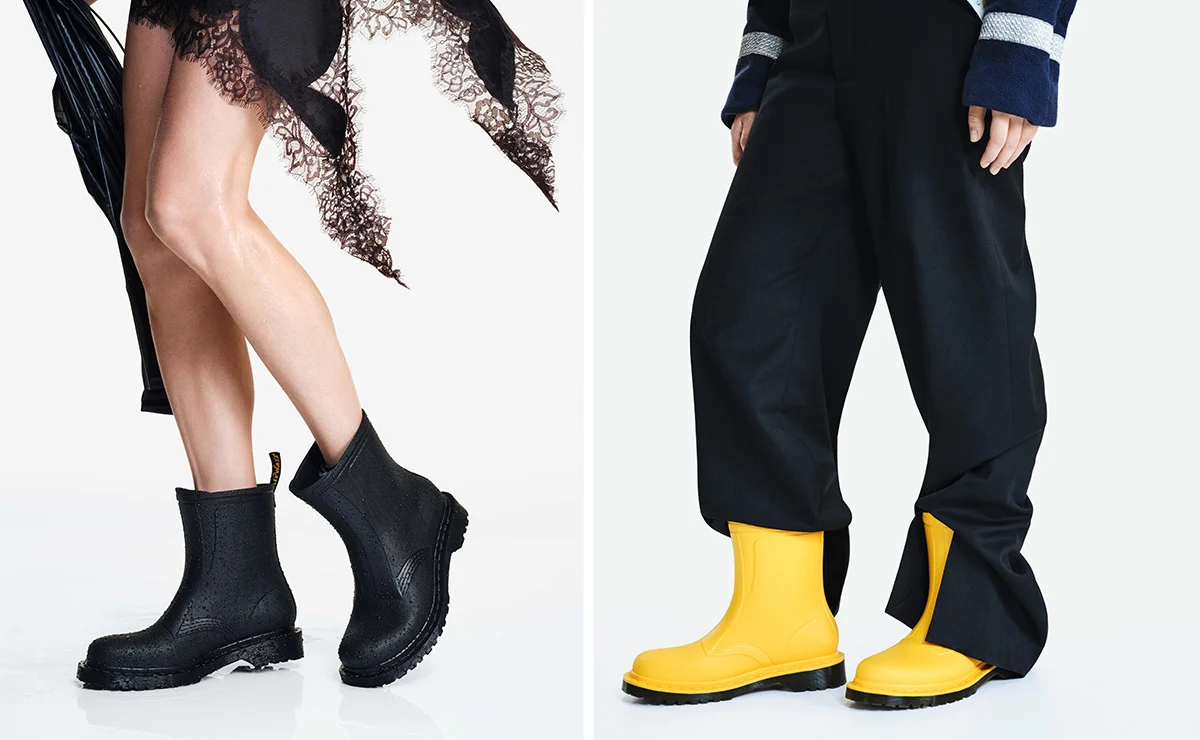
November saw the launch of the 1460 Rain Boot, the brand’s first foray into the waterproof category. The product saw immediate success in the U.S. DTC channel during the fourth quarter. By solving a functional need—footwear for inclement weather—while maintaining the iconic aesthetic, Dr. Martens has opened a new seasonal revenue stream.
Official Responses: Leadership on Strategy and Outlook
CEO Ije Nwokorie emphasized that the "operating model reset" is largely complete, giving the leadership team the confidence to lean into the next phase of the strategy.
"In FY27, we will lean in with increased investment in the brand and targeted retail store upgrades, as well as continuing to build strong wholesale partner relationships to support demand at scale," Nwokorie stated. He highlighted that the company now has "good visibility" of its wholesale order books, a luxury it did not have during the height of the post-IPO volatility.
However, the company remains pragmatic about the external environment. In an official statement, the firm noted: “We are currently navigating an unpredictable trading environment, with geopolitical uncertainty impacting consumer confidence, and against this backdrop are focused on executing our strategy.”
The leadership also acknowledged that the transition isn’t without its "headwinds." Specifically, the ongoing execution of the new retail strategy—which involves moving away from certain legacy locations and upgrading others—may cause short-term revenue fluctuations as the footprint is optimized.
Implications: Legal Rulings and Market Positioning
Two major factors will influence the brand’s trajectory heading into 2027: a significant U.S. legal ruling and the brand’s high-fashion collaborations.
The Impact of U.S. Tariffs
The U.S. Supreme Court recently struck down certain tariffs related to the International Emergency Economic Powers Act (IEEPA). This has direct financial implications for Dr. Martens. The company has recognized the full amount of incurred duties as an operating expense within "adjusting items." By removing the tariff impact from the underlying cost of sales and inventory balances, the company ensures that its year-on-year performance remains comparable and transparent for investors. This accounting clarity is vital as the brand seeks to regain the full confidence of the public markets.
The "Halo Effect" of Collaborations
High-profile collaborations continue to serve as a marketing engine for the brand. The recent partnership with Marc Jacobs to reimagine the Kiki Boot was cited as a "standout success." These collaborations allow Dr. Martens to sit at the intersection of luxury fashion and street culture, maintaining its "cool factor" while the core business focuses on volume and scaling.
The Path Forward
As Dr. Martens moves toward FY27, the focus is squarely on "operational leverage." By maintaining a disciplined cost base and focusing on full-price sales, the company expects to deliver further strong growth in profit before tax.
The transition from a "turnaround" story to a "growth" story is never seamless, but Dr. Martens appears to have successfully navigated the most treacherous part of its journey. With a reduced reliance on discounting, a stronger grip on the U.S. market, and a product pipeline that extends far beyond the traditional black boot, the brand is positioning itself as a resilient player in the global premium footwear market. For investors and consumers alike, the message is clear: the doctor is in, and the business is ready to scale.
