

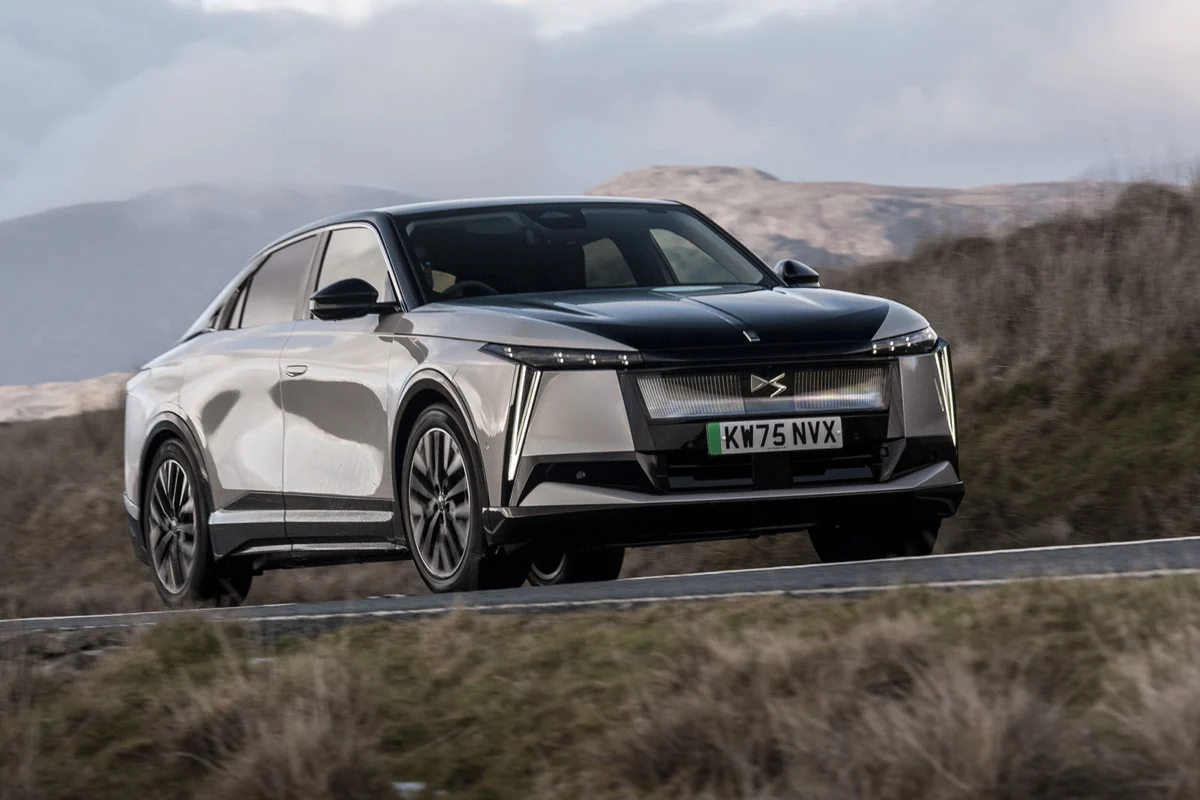
In the automotive landscape, few brands have attempted a pivot as radical as DS Automobiles. Having successfully shed its roots as a premium sub-brand of Citroën to emerge as a standalone, Paris-inspired fashion house, DS seeks to occupy a space where "automotive" meets "haute couture." The brand’s philosophy is clear: a car should be curated with the same attention to detail as a luxury timepiece or a bespoke designer handbag.
Yet, when the new DS N°8—the brand’s flagship attempt to challenge the established German and Japanese guard—arrived for testing, the experience proved to be a masterclass in contradictions. While it certainly manages to turn heads, the N°8 forces a difficult question: can a car survive on style alone when the substance occasionally falls short of the premium benchmark?
The Anatomy of Ambition: Material Quality and Interior Design
DS Automobiles has staked its reputation on a distinctively Parisian aesthetic, emphasizing "le luxe à la française." Entering the cabin of the N°8, one is immediately struck by the brand’s obsession with decorative flair. The interior is replete with knurled-finish dials, sophisticated stitching, and rich textures that clearly aim to evoke the sensory experience of a high-end boutique.
However, beneath the surface of this avant-garde design, the N°8 reveals a troubling inconsistency. While the leather and brightwork trims provide a genuine sheen of luxury, they are frequently juxtaposed with plastic mouldings that feel decidedly pedestrian. For a vehicle positioning itself against the likes of the BMW iX, the Lexus RZ, or the Mercedes-Benz EQE SUV, these lapses in perceived quality are impossible to ignore.
It must be noted that our test vehicle arrived in a lower-tier trim, which may have exacerbated the contrast between the high-end accents and the more basic plastic elements. Yet, even allowing for trim-level variances, the baseline for "premium" in this segment demands a level of material consistency that the N°8 occasionally fails to achieve. Where its rivals maintain a uniform standard of tactile excellence, the DS leaves the driver occasionally questioning where the budget was allocated.
The Quartic Steering Wheel: An Unlikely Triumph
If the cabin’s material quality is a subject of debate, the N°8’s most controversial design choice—its steering wheel—is a surprising success story. Eschewing the traditional circular rim, DS has opted for a "quartic" design: a four-sided, near-square geometry that feels more like an architectural statement than a control interface.
Historically, automotive manufacturers have struggled to reinvent the steering wheel. Tesla’s yoke and various flattened designs from BMW and Lexus have often been criticized for being gimmicky or fundamentally impractical. However, the N°8’s execution is surprisingly intuitive. By omitting spokes at the traditional "quarter to three" positions, the rim allows for a cleaner, more natural grip. The squared-off corners actually assist the driver during aggressive maneuvering, providing tactile landmarks that make it easier to judge the wheel’s orientation during tight turns. Unlike some of its peers, which require a steep learning curve, the N°8’s steering wheel feels organic and purposeful the longer one spends in the driver’s seat.
Usability vs. Minimalism: The Digital Dilemma
Modern luxury interior design is currently obsessed with "decluttering," and the DS N°8 is no exception. In its quest for a clean, minimalist aesthetic, DS has relegated almost all HVAC controls to the 16-inch central touchscreen. While this creates a sleek, high-tech look, it inevitably complicates the driving experience.
There is a distinct shortage of permanent physical switchgear. While DS has retained a physical knob for door mirror adjustment—a choice that is both practical and, cleverly, doubles as the controller for the head-up display—the lack of tactile feedback for climate control remains a point of frustration.
Chronology of the DS N°8 Development
The development of the N°8 represents the culmination of a decade-long transition for the DS brand.
- 2014: DS Automobiles officially separates from Citroën to become a standalone brand.
- 2017–2020: The brand launches the DS 7 and DS 3, establishing its "Parisian luxury" design language.
- 2022: Development of the N°8 architecture begins, focusing on electrification and a move toward the high-end "luxury goods" segment.
- 2024: First prototypes of the N°8 are subjected to intensive road testing, with a focus on interior ergonomics and the refinement of the digital interface.
- Late 2024/Early 2025: Official market release, marking the brand’s most ambitious attempt to enter the premium EV crossover market.
Supporting Data: Dimensions and Performance Constraints
When evaluating the N°8 against its primary competitors, the data provides a clear picture of the trade-offs made in the name of style.
| Feature | DS N°8 | BMW iX3 | Difference |
|---|---|---|---|
| Boot Capacity | 620 Litres | 510 Litres | +110 L (Theoretically) |
| Rear Leg Room | 720mm | 760mm | -40mm |
| Rear Head Room | 900mm | 975mm | -75mm |
While the 620-litre boot capacity appears segment-leading on paper, the practical reality is hampered by a heavily tapering tailgate. This aesthetic choice significantly limits the vertical height of the cargo area, making it less versatile for bulky items than a more traditional SUV shape. Furthermore, the rear cabin measurements reveal a stark reality: adult passengers will find the rear quarters tight. For a vehicle of this size, the interior packaging lacks the expansive, airy feel that buyers in this price bracket have come to expect.
Multimedia and Graphical Interface: A Welcome Evolution
In the past, DS has been criticized for overly animated, confusing, and "over-stylized" digital displays. Recognizing this, the brand has taken a pragmatic approach with the N°8. The digital gauge cluster is significantly clearer and more concise than previous iterations, and the 16-inch widescreen display is far more intuitive.
The system shares DNA with the infotainment platforms found in the Peugeot e-3008 and the Citroën ë-C5 Aircross, which is a testament to the benefits of the Stellantis group’s shared technology. However, usability could be improved. The upper toolbar icons on the screen are often too small to hit accurately while driving, particularly when attempting to navigate smartphone mirroring. The inclusion of an "i-Toggle" style programmable shortcut system—similar to the one seen in recent Peugeot models—would be a welcome addition to streamline the user experience.
Official Responses and Strategic Vision
In recent communications, DS design leads have defended the "fashion-first" approach of the N°8. The brand argues that it is not chasing the utilitarian metrics of its German rivals but is instead targeting a demographic that values aesthetic differentiation. According to DS, the interior is intended to be a "lounge" rather than a "cockpit," with the physical constraints of the rear seats and boot seen as secondary to the overall "artistic experience."
However, industry analysts suggest that this strategy is a high-stakes gamble. By prioritizing the "luxury good" persona over core automotive utility, DS risks alienating the very demographic that is most likely to transition from legacy premium brands.
Implications: Can Style Outweigh Utility?
The implications for the DS N°8 are significant. As an electric vehicle, the N°8 enters a market where efficiency, space, and technology are the primary metrics for success. By choosing to prioritize fashion-forward design over interior volume and material consistency, DS has created a vehicle that is arguably more "interesting" than its competitors, but also more flawed.
The N°8 is not a car for the pragmatist. It is a car for the individualist who values the silhouette of a vehicle and the cleverness of a quartic steering wheel over the ability to fit a large suitcase or accommodate four six-foot adults in total comfort.
If DS is to succeed in its long-term ambition to become a true global luxury powerhouse, it must reconcile this tension. The N°8 is a compelling proof-of-concept for a design-led brand, but it remains a work in progress. For now, the Parisian fashion house has delivered a vehicle that is undeniably beautiful, occasionally brilliant, and—much like a high-fashion accessory—sometimes frustratingly impractical. The question remains whether the market is willing to forgive these shortcomings in exchange for the cachet of the DS badge.
