

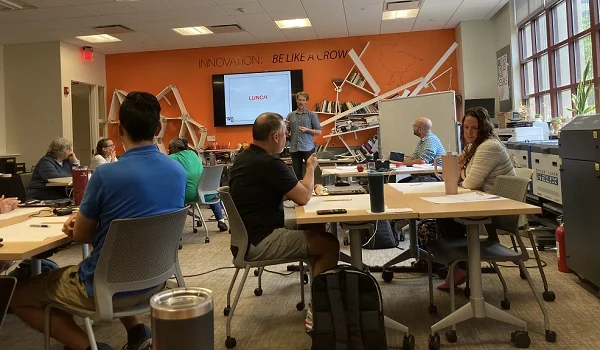
In the rapidly evolving landscape of 21st-century education, the traditional classroom model—often defined by passive listening and rote memorization—is facing a significant disruption. At the forefront of this shift is an innovative partnership between Montclair State University’s (MSU) MIX Lab and the Picatinny Arsenal, a U.S. Army research facility. This past August, this collaboration manifested in a high-intensity, hands-on workshop designed to equip New Jersey educators with the skills, tools, and pedagogical frameworks necessary to bring 3D printing and advanced digital design into K-12 classrooms.
Led by MSU professors Jason Frasca and Iain Kerr, the workshop serves as more than just a technical training session. It represents a fundamental rethinking of how teachers can cultivate creativity, autonomy, and problem-solving skills in their students. By bridging the gap between analog ideation and digital fabrication, these educators are learning how to empower the next generation of innovators.
The Core Mission: Bridging the STEM/STEAM Gap
The collaboration between the Picatinny Arsenal and the MIX Lab is built on a shared commitment to fostering STEM (science, technology, engineering, and math) and STEAM (which adds arts into the curriculum) education across New Jersey. Recognizing that high school students require more than just access to hardware, the Picatinny Arsenal has moved beyond simply donating 3D printers and supporting robotics teams. They have invested in the human capital—the teachers—who act as the primary catalysts for student success.
“Picatinny Arsenal supports STEM and STEAM education in New Jersey K-12 school systems by providing 3D printers and support for 3D printing and robotics teams in high schools,” Frasca noted during the session. “They engaged us many years ago to teach the teachers how to use their 3D printers.”
However, the curriculum has expanded significantly since those initial sessions. Today, the focus is on "teaching the teachers" how to use computer-aided design (CAD) software as a medium for creativity rather than merely a technical utility. The objective is to move away from the traditional, tool-heavy instructional model—which often stalls innovation for months—toward an agile, project-based approach that empowers students to manifest their ideas into physical reality rapidly.
A Chronology of the Workshop: From Analog to Digital
The workshop’s design reflects a carefully curated pedagogical journey, moving from physical movement to digital manifestation.
Morning Session: Establishing the "Muscle Memory"
The day began not with a computer screen, but with a physical exercise. Iain Kerr led the educators through rudimentary design tasks that required them to use their entire bodies to map out spatial concepts. This approach is rooted in the belief that bridging the gap between the analog and the digital allows creators to ground themselves in their designs.
By drawing simple geometric shapes—rectangles, circles, and lines—on paper before translating them into CAD software, the teachers developed a form of "muscle memory." This cognitive bridge allows them to engage with complex software on a deeper level. Instead of staring at an intimidating, blank digital canvas, they are able to visualize how to translate a 2D sketch into a 3D physical object.
The 25-Minute Rule: Rapid Prototyping
Frasca highlighted a common pitfall in standard CAD instruction: the tendency to teach every single tool in the software suite over several months before allowing a student to create anything. The MIX Lab’s methodology is the polar opposite.
“Our approach is to, within 25 minutes, get everybody actually creating something that they could 3D-print,” Frasca explained. By starting with a basic cube and teaching how to manipulate it into a sphere or a more complex form, the instructors demonstrate that a single object can be evolved into virtually anything. This rapid success builds confidence and shifts the focus from "learning the software" to "solving a design problem."
Afternoon Session: Agency and Exploration
In the afternoon, the focus shifted toward independence. Kerr emphasized that the goal of the modern educator should be to foster student autonomy. Instead of providing step-by-step instructions for every feature, the workshop encouraged teachers to learn how to hunt for tools independently.
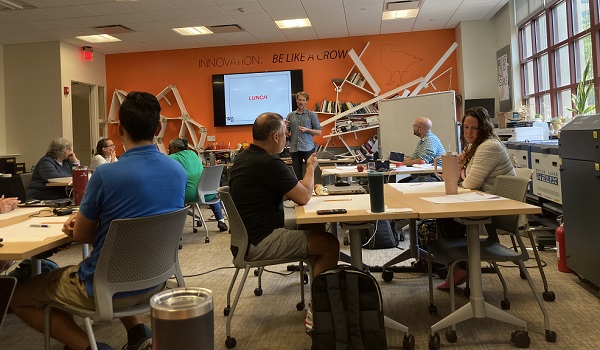
The discussion touched on advanced features like "lofting"—a technique that allows for the creation of complex, organic shapes. Kerr challenged the teachers to embrace a non-linear design process, encouraging them to keep multiple tools and tabs open simultaneously. By validating that there is "not one right way to create a design, but multiple ways," the workshop aimed to dismantle the fear of making mistakes, replacing it with a spirit of exploration.
Supporting Data and Pedagogical Philosophy
The underlying philosophy of the workshop is centered on the concept of "novelty." Frasca argues that traditional paths toward innovation, which rely solely on ideation, are inherently limited.
“We can only ideate what we know, what you’ve already seen and been exposed to,” Frasca explained. To create something truly novel or unique, one needs a framework that pushes the creator beyond their existing mental library. The MIX Lab provides this framework through design software. By learning to operate within these digital parameters, teachers—and eventually their students—are taught to design beyond what they can initially imagine.
Furthermore, the workshop promotes the "gallery walk" as a vital pedagogical tool. By moving around the room to examine each other’s creations, teachers practice peer-to-peer feedback. This creates a classroom environment where students learn from one another’s techniques and successes, turning the classroom into a collaborative studio rather than a competitive testing ground.
Official Perspectives: The Role of Picatinny Arsenal
The partnership with the Picatinny Arsenal is critical to the scale and success of this initiative. By funding the attendance of these educators, the Arsenal ensures that the benefits of the workshop reach a broad range of schools, particularly those that might lack the resources for advanced professional development.
This investment is an extension of the Arsenal’s long-term goal: to cultivate a pipeline of students who are proficient in the tools of the modern industrial and technological world. By supporting these teachers, the Arsenal is effectively seeding the future workforce of New Jersey with individuals who are not just users of technology, but creators and innovators.
Implications: The Future of the Classroom
The implications of this workshop for the New Jersey K-12 landscape are profound. When teachers shift from being "gatekeepers of information" to "facilitators of design," the power dynamic in the classroom changes. Students are given agency—the ability to choose their own design paths, test their theories, and fail safely within the digital space before committing to a 3D print.
Empowering Student Autonomy
The core takeaway for the participating educators was the importance of autonomy. By modeling this behavior, the teachers are learning how to step back and allow their students to navigate the design process independently. This shift is essential for teaching 21st-century skills: critical thinking, agility, and the ability to pivot when a design fails.
A New Standard for Teacher Training
The success of the MIX Lab/Picatinny workshop suggests that professional development for teachers needs to be more than just "how-to" sessions. It must be immersive, experiential, and focused on the broader philosophy of innovation. As these teachers return to their respective districts, they carry with them not just a set of CAD skills, but a new methodology for teaching that prizes creativity as a measurable, teachable skill.
In conclusion, the work being done at Montclair State University is a vital piece of a larger puzzle. As industries continue to integrate 3D printing and additive manufacturing into their core operations, the ability to "think in 3D" will become as fundamental as reading or writing. By bridging the gap between high-level research and K-12 instruction, the MIX Lab and the Picatinny Arsenal are ensuring that New Jersey students are not just keeping pace with the future—they are designing it.
