

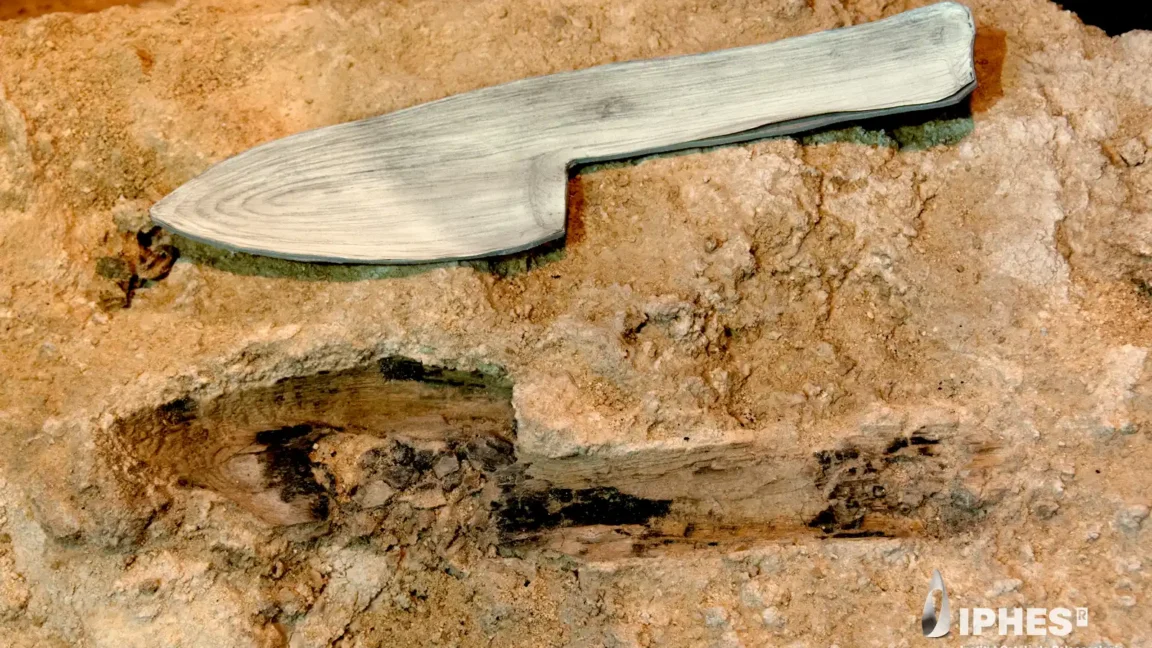
For centuries, our understanding of the Paleolithic era has been defined by the materials that endure. The very term "Stone Age" reflects the bias of the archaeological record: we define our ancestors by the lithic tools that survived the relentless decay of time. However, a groundbreaking discovery at the Abric Romaní rock shelter in Capellades, near Barcelona, is shattering this perception. By analyzing 597 wooden artifacts—preserved not as wood, but as precise mineralized "ghosts"—archaeologists have unveiled a sophisticated world of Neanderthal craftsmanship that suggests our extinct cousins were far more complex, industrious, and organized than previously imagined.
The Preservation Miracle: Travertine as a Time Capsule
The primary obstacle to studying the Paleolithic is the fragility of organic material. Wood, bone, and fiber typically succumb to rot within decades or centuries. At Abric Romaní, however, nature provided a unique solution. The shelter is situated at the base of a towering travertine cliff. This limestone, deposited over eons by calcium-rich spring water, acted as a geologic preservative.
As mineral-laden water dripped across the site’s living floors, it coated logs, branches, leaves, and, most importantly, the tools discarded by Neanderthals in a hard, lime-like crust. Over tens of thousands of years, the organic material inside these casts eventually decayed, leaving behind hollow, negative molds. These molds are not mere impressions; they are high-fidelity "negatives" that capture the very texture of the wood, allowing modern researchers to observe the fine grain and cellular structure of tools used as early as 62,000 years ago.
Chronology of Discovery: A Decades-Long Excavation
The site at Abric Romaní has been under continuous, meticulous investigation since 1983. Because the artifacts are essentially "empty space" encased in fragile stone, the excavation team, led by experts from the Catalan Institute of Human Paleoecology and Social Evolution (IPHES-CERCA), had to pioneer an entirely new methodology.
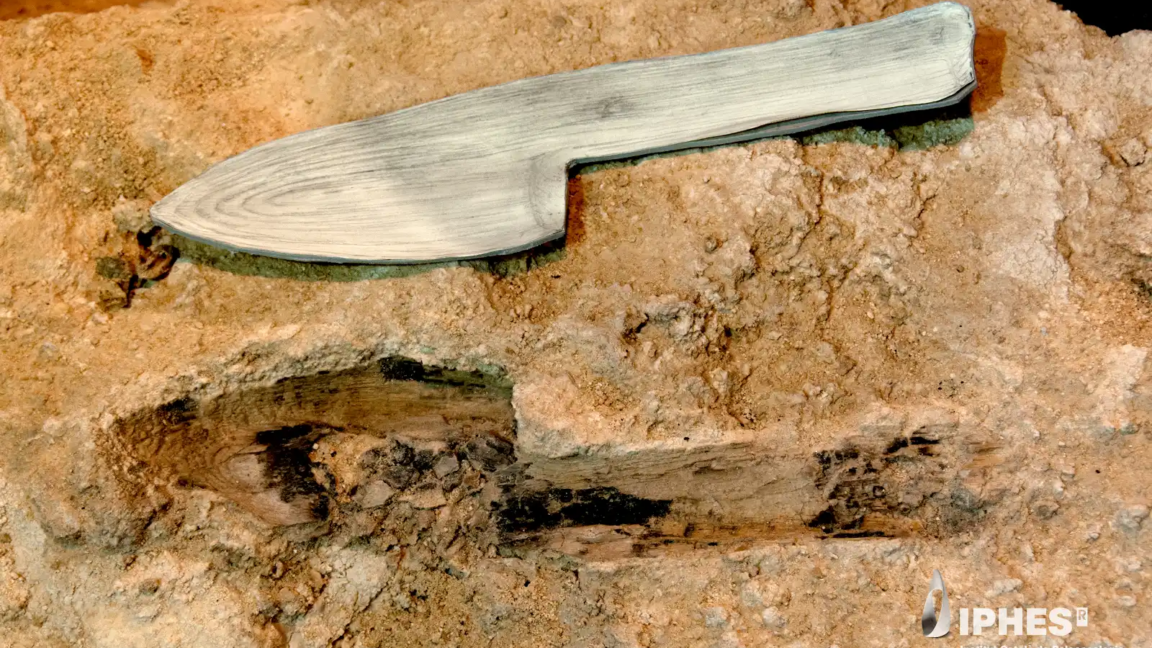
Each potential artifact is first mapped, photographed, and carefully outlined within the sediment. Restoration specialists then consolidate the surrounding crust to prevent collapse before delicate extraction begins. In the early years of the project, researchers filled these voids with resin or plaster to create physical positive casts. Today, the process has entered the digital age: using advanced 3D scanning and photogrammetry, the team digitizes the voids to produce 3D-printed replicas. This non-invasive technique allows for exhaustive study without risking the destruction of the original limestone molds, which are now being preserved for future generations of scientists.
Supporting Data: The Anatomy of a Neanderthal Toolkit
The catalog of 597 remains provides a startlingly clear window into the daily life of a Neanderthal group. While the majority of the items were natural debris—fallen branches and Scots pine firewood—13 distinct objects show clear evidence of intentional modification. These tools were not simply picked up; they were engineered.
The Household and the Habitat
Among the most significant finds were four shallow trays crafted from juniper bark. Measuring up to 55 by 20 centimeters, these trays are strikingly similar to the "coolamons" used by Aboriginal Australians for food preparation and the transport of embers. Their presence near hearths suggests a level of domestic management that mirrors much later human societies.
Evidence also suggests complex structural planning. The team identified crossed poles that likely formed the framework of a tripod, potentially used for food processing. Even more compelling is the discovery of a five-meter-long, branchless pole found in the rear of the shelter. Based on the site’s layout—where small, spaced-out hearths (roughly 50 centimeters in diameter) were maintained along the back wall—researchers believe these poles supported windbreaks or temporary huts. These "sleeping hearths," positioned to provide warmth and protection from predators, suggest that Neanderthals were not aimless wanderers, but individuals who structured their living spaces with intention and foresight.

Hunting Gear and the First Known Club
The team’s findings confirm that Neanderthal ingenuity extended to the hunt. A 2.45-meter-long spear was recovered near the skeletal remains of red deer. A detailed cast of the spear’s point revealed an impact fracture pattern identical to those found on modern ethnographic spears—damage consistent with striking dense bone or cartilage.
Perhaps the most astonishing discovery is a wooden club. Carved from a single piece of timber, the object features a 16-centimeter handle and a pointed, triangular head. A sharp, right-angle shoulder at the junction of the handle and head suggests a sophisticated design intended to prevent the hand from slipping during a strike. Aside from a 400,000-year-old find at Kalambo Falls in Zambia, no other object of this kind has been identified from this era. While its exact use—whether for hunting, defense, or social signaling—remains a subject of debate, its existence confirms that Neanderthals possessed the capacity for complex tool design that was previously assumed to be the exclusive domain of Homo sapiens.
Official Perspectives: Shifting the Paradigm
M. Gema Chacón, a lead archaeologist at IPHES-CERCA and co-author of the study, emphasizes that these findings represent a fundamental shift in our understanding of human evolution. "We have a sample of wooden tools for different subsistence activities, not only hunting," Chacón notes. The consistent presence of these tools across multiple archaeological layers suggests that woodworking was a daily, routine practice, not an occasional necessity.
Chacón’s work challenges the long-held "dumber cousin" narrative. By selecting specific woods for specific tasks—Scots pine for its ease of work and quick drying, and fibrous juniper bark for vessels—Neanderthals demonstrated a profound knowledge of material science. "When they went to look for wood, it was like when they went to look for stone; they knew exactly what they wanted to make," she explains. "This implies not only planning, but a bit of complexity in the brain to organize your activities."

Implications: The Missing History of Wood
The study, published in Science Advances, serves as a cautionary tale for the archaeological community. The fact that these tools were identified only after decades of careful excavation highlights the potential for massive losses in other sites. Many archaeologists, operating under tighter budgets and more aggressive excavation timelines, may have unknowingly discarded or ignored what they perceived to be "natural" debris, failing to recognize the subtle traces of human modification.
"I hear from colleagues telling me, ‘perhaps we found something that we thought was wood, we excavated it, we took pictures, but we didn’t keep it,’" says Chacón. "Now they say perhaps it could be a tool."
The implications are clear: the "Stone Age" is a misnomer born of our own inability to see the past. If the record at Abric Romaní is any indication, the Neanderthal world was teeming with wooden architecture, complex culinary tools, and specialized weaponry. As we refine our ability to detect these "invisible" artifacts, we are likely to find that the gulf between Neanderthal cognition and our own is far narrower than we ever dared to imagine. The history of human development is not just written in stone; it is carved into wood, and it is finally beginning to reveal itself.
