

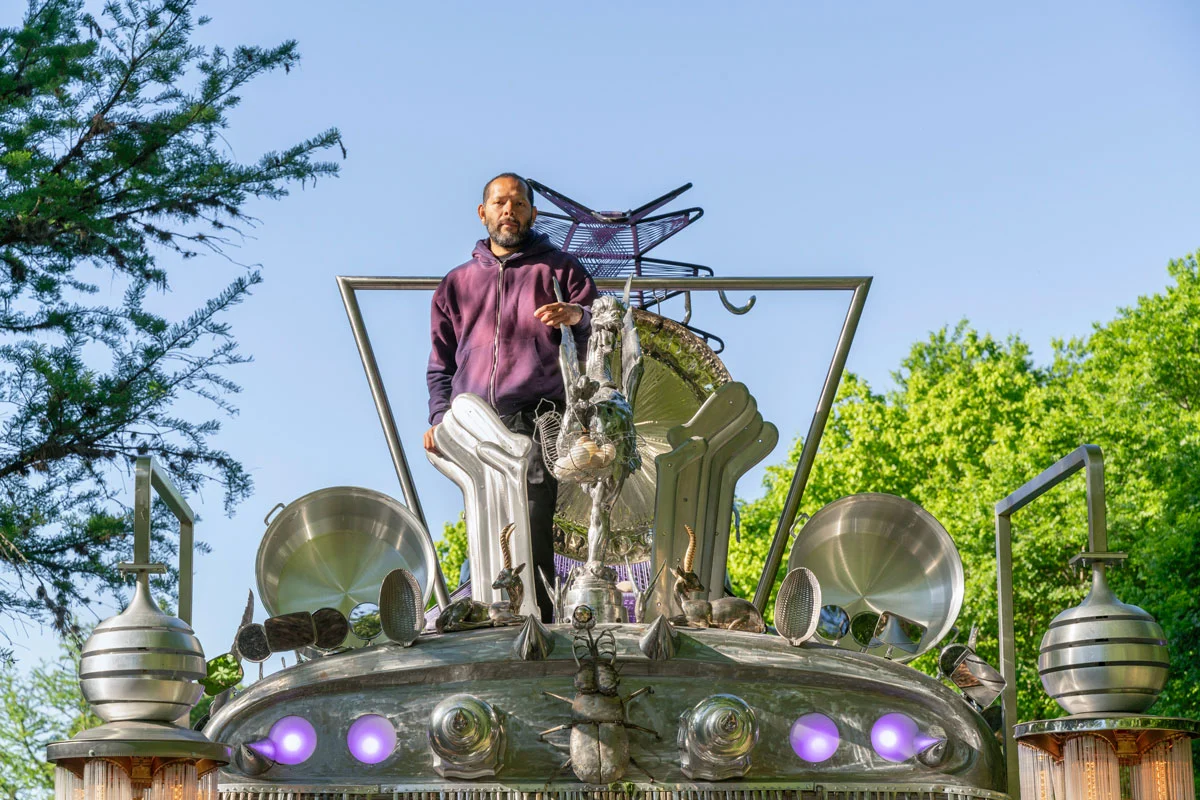
In the heart of New York City’s Morningside Heights, the imposing Gothic architecture of the Cathedral of St. John the Divine serves as a beacon of history and faith. Yet, as the winter of 2026 approaches, this venerable space will undergo a profound transformation, becoming the site of a radical, immersive act of public art and collective healing. Creative Time, the acclaimed public arts organization, has announced that it has commissioned visionary artist Guadalupe Maravilla to transform the Cathedral’s Synod Hall into Consejos de las Estrellas (Advice of the Stars), a sprawling sculptural installation that promises to redefine the role of the artist as both a creator and a caregiver.
Presented in collaboration with the Clemente Soto Vélez Cultural and Educational Center, the exhibition is scheduled to run from December 17, 2026, to February 7, 2027. More than a mere exhibition of objects, the project is conceived as a “sanctuary space”—a destination for communal gathering, quiet reflection, and, crucially, a form of respite during a season that is as much defined by social isolation and vulnerability as it is by holiday celebration.
A Convergence of Art, Trauma, and Healing
At the core of Consejos de las Estrellas is the singular, deeply personal practice of Guadalupe Maravilla. Born in San Salvador, Maravilla’s biography is inextricably linked to the history of the 1980s civil war in El Salvador. As an unaccompanied minor, he traversed the treacherous journey to the United States, a harrowing experience that would later be compounded by a diagnosis of cancer in his adult life. Maravilla views these two milestones—the trauma of migration and the trauma of illness—not as separate events, but as deeply interconnected threads in his personal narrative of survival and recovery.
His work, which has been exhibited globally, often functions as a “healing instrument.” By integrating the sonic properties of gongs with ornate, sculptural forms, Maravilla creates environments where the act of viewing art is replaced by the act of experiencing vibrations. In Consejos de las Estrellas, this practice reaches a new level of ambition. The installation will bring together nearly 100 sculptures and textile works, creating a labyrinthine environment that commands the vast architecture of the Synod Hall.
Perhaps most striking is the inclusion of Mariposa Relámpago, the artist’s famous, meticulously customized school bus. This mobile work of art, which has traveled from Mexico to Boston, and through the landscapes of Texas, serves as a poignant symbol of the migrant journey. Its presence within the sacred walls of the Cathedral acts as a physical bridge between the political realities of the border and the spiritual potential of the sanctuary.
Chronology of the Project: From Concept to Cathedral
The development of Consejos de las Estrellas represents a significant investment of time and logistical planning by Creative Time. While the public will experience the work in late 2026, the project has been in deep conversation with the Cathedral and community partners for years.
- Initial Conception: The project grew out of an ongoing dialogue between Maravilla and the curatorial team at Creative Time, who sought to challenge the traditional boundaries of public art in a post-pandemic era.
- The Collaboration: The inclusion of the Clemente Soto Vélez Cultural and Educational Center underscores the project’s dedication to grassroots organizing. By grounding the installation in a partnership with an organization known for its commitment to the Puerto Rican and Latinx communities of the Lower East Side, the project ensures that the “sanctuary” extends beyond the physical confines of the Cathedral.
- Logistical Integration: Throughout 2026, the Cathedral will act as a staging ground for the installation, with the massive collection of sculptures and the Mariposa Relámpago bus being carefully curated to respect the historic integrity of the Synod Hall while simultaneously reorienting the space toward the needs of the community.
- Exhibition Period (Dec 17, 2026 – Feb 7, 2027): The project is intentionally timed to bridge the end of the calendar year and the beginning of the new, a period frequently marked by high rates of depression and economic strain.
Supporting Data: The Mechanics of the Sanctuary
The installation is designed to be a functional site of mutual aid. Recognizing that for many, the winter holidays are a time of profound absence—caused by grief, illness, or the separation of families due to immigration status—Maravilla has structured the space to prioritize service over spectacle.
- The Sound Baths: Throughout the exhibition, Maravilla will perform weekly sound baths. These are not merely performances; they are sessions designed to use sound as a therapeutic modality, reflecting the intersection of art and holistic healing.
- Mutual Aid Hub: The Cathedral will serve as a donation center. Food, clothing, and toys collected throughout the exhibition will be systematically redistributed through partnerships with local community organizations. This effectively turns the Cathedral into a logistics hub for those in need, validating the artist’s belief that art should provide tangible, material support.
- The Scale of the Work: With nearly 100 sculptures, the sheer density of the installation is intended to create a “womb-like” environment. The use of textiles and found objects acts as a sensory buffer against the harsh winter climate outside, reinforcing the metaphor of “coming in from the cold.”
Official Responses and Institutional Vision
The partnership between Creative Time and the Cathedral of St. John the Divine has been characterized by a shared commitment to the intersection of social justice and the arts.
Jean Cooney, the Director of Creative Time, emphasized the holistic nature of the commission in her official statement. “Both in the way he approaches his work and moves through the world, Guadalupe Maravilla embodies a commitment to care and creates the conditions for healing as an offering to all,” Cooney said. “Consejos de las Estrellas is a beautiful and timely coalescence of Maravilla’s practice, a choreography of his visual work across mediums, his profoundly moving work as a sound healer, and his deep commitment to community.”
For the Cathedral, the exhibition represents a modern iteration of its historic mandate. Laura Bosley, the Cathedral’s executive director for programming, noted that the mission of the house of worship has always been to serve as a center for “intellectual light.”
“Consejos de las Estrellas beautifully embodies that mission,” Bosley remarked. “It creates space for meaningful conversation, reflection, and unity at an increasingly tumultuous moment in our country. It affirms the Cathedral’s commitment to community and reminds us that collective healing has the power to strengthen one’s belief systems and open the door to new beginnings.”
Implications for the Future of Public Art
The significance of Consejos de las Estrellas lies in its refusal to be passive. In an era where public art is often scrutinized for its environmental impact or its ability to “activate” a space for tourism, Maravilla’s work asks for something different: it asks for intimacy.
The Artist’s Perspective
In his own words, Maravilla clarifies the intent: “I’m creating a sculptural installation that will serve as a healing instrument and a place to find warmth and belonging when the holidays deepen the feeling of absence. It’s a place to come in from the cold, connect with others, and feel supported.” By framing the project through the lens of “absence”—the absence of health, the absence of home, the absence of loved ones—Maravilla centers the marginalized experience.
A New Model for Institutional Collaboration
The exhibition serves as a case study for how major cultural institutions can leverage their space and resources to act as genuine community anchors. By moving beyond the static display of objects, Creative Time and the Cathedral are suggesting a new standard for artistic commissions: one that measures success not just by attendance figures, but by the tangible impact on the community’s well-being.
As we look toward the winter of 2026, the Synod Hall at the Cathedral of St. John the Divine will cease to be merely a room for events. Instead, it will be a living, breathing instrument of empathy. Whether through the resonant tones of the gongs, the quiet history embedded in the Mariposa Relámpago, or the simple act of receiving a meal or a toy, visitors will be invited to participate in a collective reclamation of their own humanity. Consejos de las Estrellas reminds us that in times of societal division, the most radical act an artist can perform is to hold space for the healing of the stranger.
