

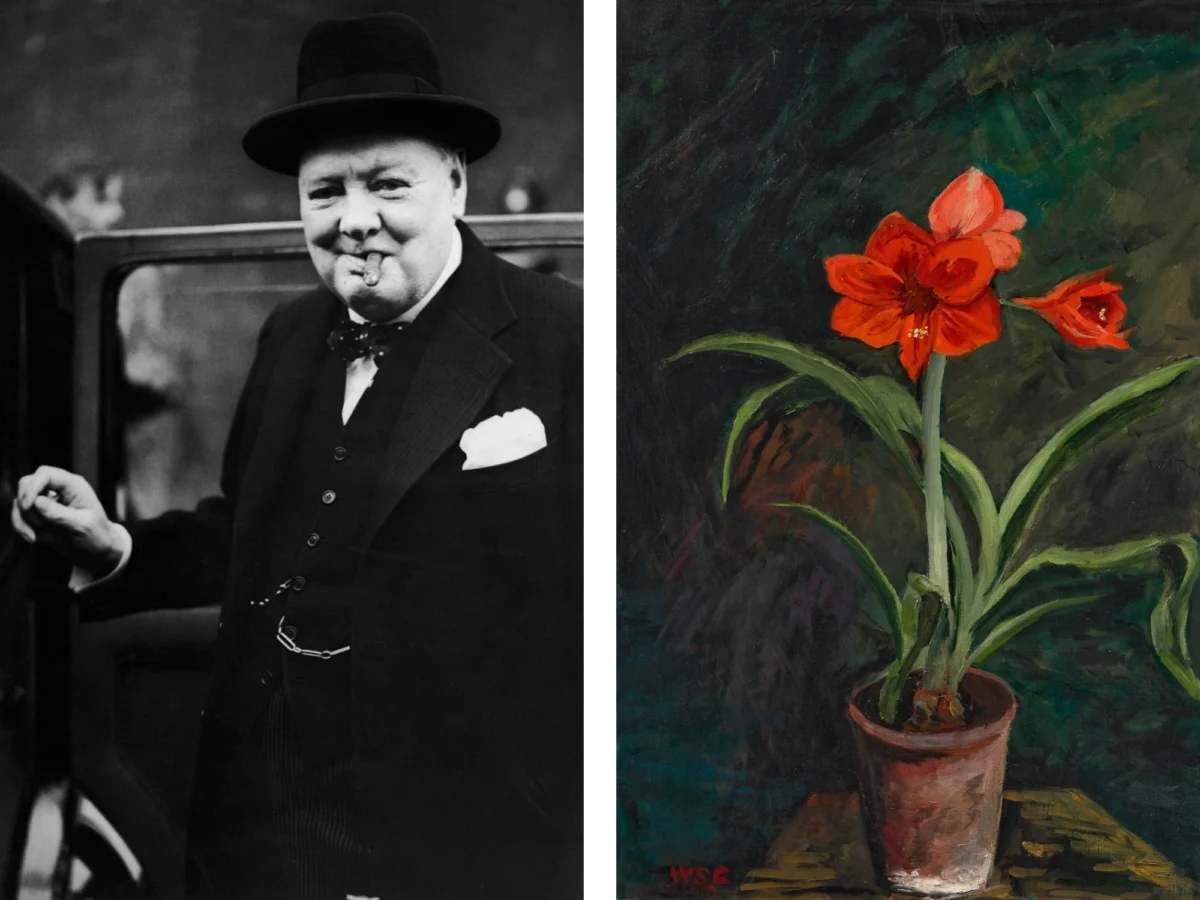
A rare and intimate window into the private world of Sir Winston Churchill is set to go under the hammer this October. Christie’s has announced that Amaryllis Lily (1948), a vibrant still-life painting by the former British Prime Minister, will headline its "Modern British and Irish Art Evening Sale" in London on October 21. Carrying a presale estimate of £300,000 to £500,000 ($396,000 to $661,000), the work represents more than just an aesthetic exercise; it is a testament to the restorative power of art for a statesman who bore the weight of the 20th century on his shoulders.
The painting, which features a striking red amaryllis belladonna—popularly known as the "March lily"—standing in a simple pot against a somber, dark backdrop, is currently owned by the Churchill Fellowship. Proceeds from the auction are earmarked for the fellowship’s "Making Space for the Arts" initiative, a program designed to foster creative endeavors and provide resources for artists.
A Chronicle of Craft: The Evolution of Churchill the Painter
To understand the significance of Amaryllis Lily, one must trace the chronology of Churchill’s artistic development, a journey that began in the middle of his life, providing a vital psychological refuge from the turbulence of politics.
The Genesis of a Hobby (1915–1930)
Churchill did not pick up a brush until he was in his forties. Following the disastrous Dardanelles campaign in 1915 and his subsequent resignation as First Lord of the Admiralty, Churchill fell into a deep depression. It was during a family holiday in Hoe Farm, Surrey, that his sister-in-law, Lady Gwendeline Bertie, handed him a paintbrush. He found that painting offered him a form of "mental gymnastics" that his political life could not provide. He became obsessed with the challenge of light and shadow, famously declaring, "If it weren’t for painting, I couldn’t live; I couldn’t bear the strain of things."
The Nicholson Influence (1930s)
The 1930s marked a pivotal era in Churchill’s development as he deepened his friendship with the celebrated British painter William Nicholson. It was during this decade that Churchill honed his technique, moving away from the impressionistic landscapes of his earlier years toward more disciplined, structured compositions. Nicholson, who frequently visited Churchill’s family estate, Chartwell Manor in Kent, acted as a formal mentor. In a correspondence with art historian John Rothenstein, Churchill explicitly acknowledged this debt, identifying Nicholson as the individual who "taught me most about painting."
The Mastery of Still Life (1940s–1950s)
By 1948, the year Amaryllis Lily was painted, Churchill was a seasoned artist. He had navigated the Second World War and lost his position as Prime Minister, leaving him with more time to retreat to the studio he had constructed in his garden at Chartwell. This period saw a shift in his focus toward still-life painting. Unlike the sweeping landscapes of Morocco or the French Riviera, which required grand brushwork, still lifes demanded a "restrained composition and bold use of color," according to experts.
The Provenance and Philanthropy of the Piece
The history of Amaryllis Lily is as storied as the man who painted it. Following its completion in 1948, the work remained within the Churchill family for decades. Sir Winston gifted the painting to his daughter, Lady Mary Soames, who cherished the piece until 1995. Recognizing the cultural and philanthropic potential of her father’s work, Lady Soames donated the painting to the Churchill Fellowship.
For nearly three decades, the painting has served as a symbol of the Fellowship’s commitment to the values Churchill championed. The decision to auction the work now, in the heart of London’s art market, is a calculated move to ensure the legacy of his creativity continues to fund the next generation of creators.
"Proceeds from the sale will be used to support the Churchill Fellowship’s ‘Making Space for the Arts’ program," the organization noted in a press release. This initiative aims to expand access to creative workshops and scholarships, directly linking the former Prime Minister’s personal passion for the arts to the institutional support of modern artists.
Expert Analysis: A Sophisticated Composition
Pippa Jacomb, head of Christie’s Modern British and Irish Art evening sale, provided a professional assessment of the work’s technical merit.
" Amaryllis Lily is a striking example of Winston Churchill’s skill as a painter, demonstrating his sophisticated understanding of color and composition," Jacomb stated. "Painted in 1948, the work reflects the important influence of William Nicholson, particularly in its restrained composition and bold use of color, while also revealing the confidence Churchill developed as a still-life painter."
Critics point to the contrast in the painting as evidence of this growing confidence. The vibrant, almost aggressive red of the amaryllis petals against the muted, dark background creates a tension that is characteristic of the late-1940s works produced in the Chartwell studio. It represents a man who, having stepped back from the front lines of global conflict, turned his attention to the delicate, controlled environment of the domestic sphere.
The Broader Market: Churchill at Auction
The sale of Amaryllis Lily arrives during a period of sustained interest in Churchill’s artistic output. While his political legacy is subject to endless historical debate, his value as an artist has seen a meteoric rise.
In 2021, the global art market witnessed a historic moment when Christie’s sold Tower of the Koutoubia Mosque (1943)—a painting famously gifted by Churchill to U.S. President Franklin D. Roosevelt—for a record-breaking £8.29 million. That sale fundamentally shifted the market’s perception of Churchill’s work, moving it from a "celebrity curiosity" into the realm of high-value investment art.
While Amaryllis Lily is not expected to touch the record set by the Koutoubia masterpiece, its conservative estimate of £300,000–£500,000 may well be surpassed. In recent years, works with strong provenance—particularly those that remained in the family or were associated with specific historical moments—have routinely outperformed their low estimates.
Implications: The Intersection of History and Art
The auction of Amaryllis Lily raises broader questions about the role of historical artifacts in the 21st-century art market. As Churchill’s personal items continue to fetch record prices, the art world is forced to grapple with the tension between the historical significance of the individual and the aesthetic merit of the work.
The "Sunday Painter" Dilemma
For years, the art establishment was dismissive of Churchill, often labeling him a "Sunday painter." However, contemporary critics have begun to re-evaluate his work on its own terms, free from the shadow of his political career. The upcoming Christie’s sale is part of a deliberate effort to solidify his reputation as a genuine contributor to the British artistic canon.
The Ethics of Deaccessioning
The move by the Churchill Fellowship to auction the painting has prompted minor discourse regarding the ethics of institutional deaccessioning. However, because the proceeds are being directed toward a cause directly linked to the subject’s own life—the promotion of the arts—the decision is widely viewed by curators and collectors as a responsible stewardship of the asset. By converting a static canvas into a dynamic funding stream for modern programs, the Fellowship ensures that Churchill’s legacy remains relevant and active.
Conclusion: A Legacy Painted in Red
As the October 21 sale approaches, eyes will be on Christie’s to see if the appetite for "Churchilliana" remains as robust as it was in 2021. Amaryllis Lily is more than a painting; it is a bridge between a man known for his iron resolve in wartime and a man who found his only peace in the delicate application of oil to canvas.
Whether it sells for the lower estimate or sparks a bidding war, the sale serves as a reminder that history is rarely captured in a single medium. Behind the speeches and the strategy rooms, there was a man who found in the petals of an amaryllis the same bold color and complexity that he demanded of the world around him. In the quiet halls of Christie’s, that red bloom will soon have a new home, and its sale will ensure that the creative spirit of the man who painted it will continue to flourish for years to come.
