

By Viknesh Vijayenthiran | March 19, 2025
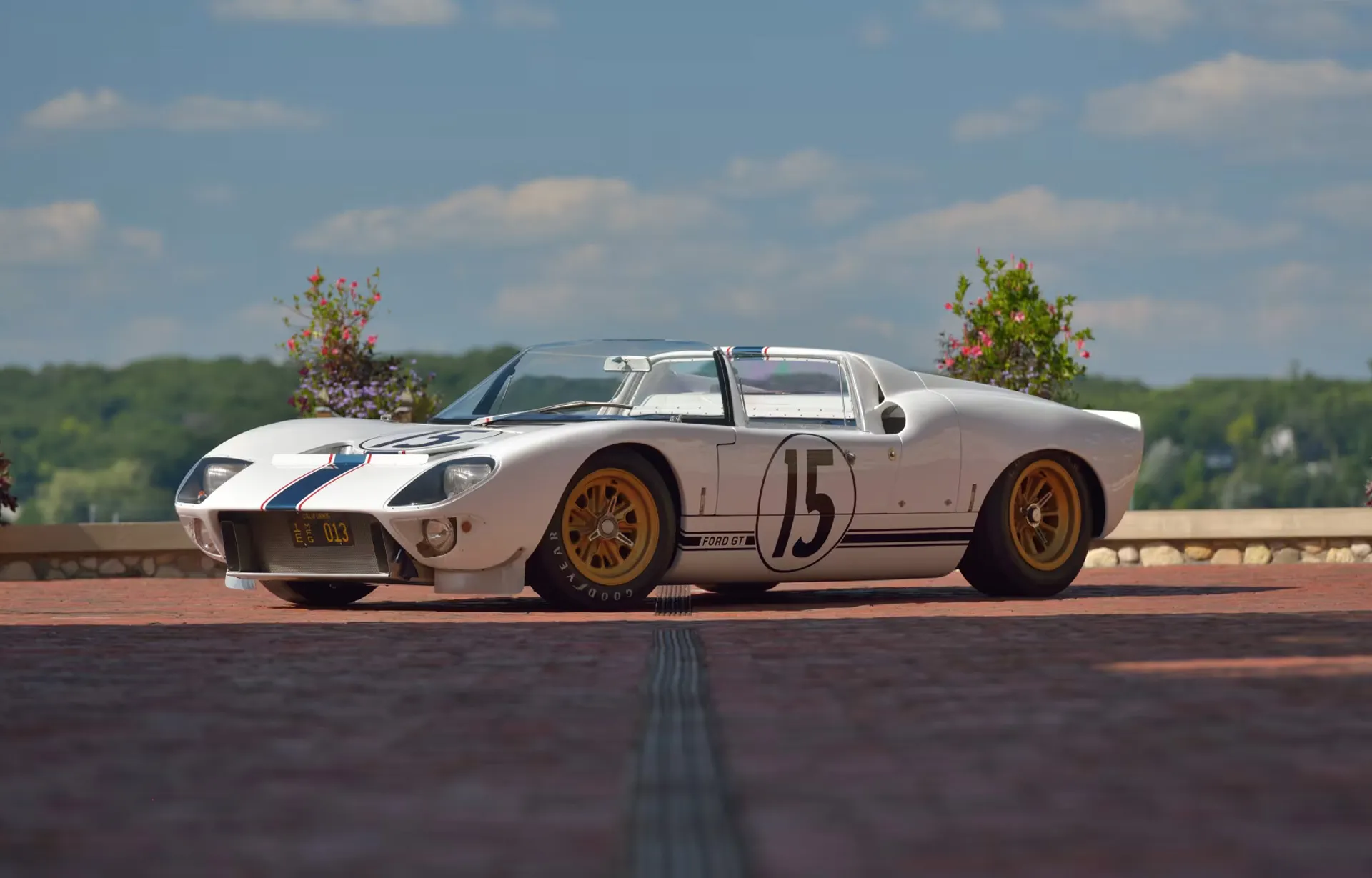
For collectors of automotive history, the Ford GT40 represents the pinnacle of American endurance racing ambition. It was the machine built with a singular, iron-willed objective: to topple Ferrari at the 24 Hours of Le Mans. While the production GT40s are legendary in their own right, the true soul of the program lies in the early prototypes. This May, a piece of that history—chassis GT/109, a 1965 Ford GT40 Roadster prototype—will cross the block at the prestigious Mecum Indianapolis auction, scheduled for May 9–17.
This is more than a car; it is a mechanical time capsule, a rare survivor from an era of brutal engineering, experimental testing, and high-stakes international motorsport.
The Main Facts: A Rarity Among Rarities
The upcoming auction marks a rare opportunity to acquire a vehicle of profound historical significance. Chassis GT/109 is one of only 12 original GT40 prototypes constructed between 1964 and 1965. Of those 12, only five were built as open-top Roadsters.
What elevates GT/109 above its peers is its specific pedigree: it is the only roadster prototype to have actually competed in the 24 Hours of Le Mans. While many of its siblings were lost to the scrap heap—a common fate for experimental prototypes of the mid-60s—GT/109 has endured, preserved through meticulous restoration to return to its original 1965 Le Mans livery.
Chronology: The Life and Times of GT/109
The Crucible of Le Mans (1965)
The early 1960s were characterized by a desperate, rapid-fire development cycle at Ford. The company was pouring millions into a project that had yet to see a checkered flag. GT/109 was completed in 1965 and entered into the world’s most grueling endurance race. Driven by the veteran French duo Maurice Trintignant and Guy Ligier, the car carried the hopes of the Shelby American effort.

However, the race was cruel to the prototype. Despite its promise, GT/109 was forced into retirement after just 11 laps due to gearbox failure. It was a stinging disappointment, but it served as a vital data point in the ongoing refinement of the GT40 platform.
Development and Diversification
Following its brief stint at Le Mans, the car’s life took a turn toward the experimental. It was returned to the Shelby American facility for a rebuild, but Ford’s priorities shifted rapidly. GT/109 transitioned from a race car to a test mule. Over the following years, it played a pivotal role in the development of Kar Kraft’s experimental automatic transmission, Ford’s Weber-carbureted four-cam Indy engine, and various advanced braking and suspension systems. It became the laboratory on wheels that allowed Ford to refine the components that would eventually make the GT40 a champion.
The Customizer Connection (1968–2013)
By 1968, the car had served its purpose for Ford and was sold. It eventually found its way into the hands of legendary Californian car customizer Dean Jeffries. Jeffries, a man known for his influence on the hot rod and movie car scene, held onto the machine for decades, preserving a car that might otherwise have been destroyed in the company’s periodic purges of "obsolete" test equipment.
The Mecum Era
In 2013, Dana Mecum, founder of Mecum Auctions, acquired the vehicle from Jeffries’ son. Recognizing the immense historical value of the chassis, he commissioned a comprehensive restoration, returning GT/109 to the exact specifications it held when it lined up on the grid at Le Mans in 1965.
Supporting Data: Why GT/109 Stands Alone
To understand the rarity of GT/109, one must look at the attrition rate of the GT40 program. The initial prototypes, such as GT/101 (the car displayed at the 1964 New York International Auto Show) and GT/102, were subjected to rigorous crash testing and subsequently scrapped. It was common practice for Ford to discard these chassis once their data had been extracted.
GT/109 is one of only two surviving roadster prototypes in existence. Its counterpart, GT/108, was sold at auction in 2019 for a staggering $7,650,000. That figure provides a benchmark for what investors might expect when the gavel falls in Indianapolis.

The technical specifications of the restored GT/109 are a testament to the era’s "big block" philosophy. It features a rebuilt HiPo 289-cubic-inch V-8 engine, complemented by a rare Ford/Shelby experimental intake manifold. Perhaps the most iconic feature is the "Bundle of Snakes" exhaust system—a complex, hand-fabricated header configuration that remains one of the most recognizable and visceral auditory signatures in automotive history. The 5-speed manual transmission has also been fully overhauled to ensure the vehicle remains mechanically sound.
Official Perspectives and Auction History
The sale of GT/109 is a high-profile event that has been building anticipation for years. This is the third time the car has been presented at a Mecum auction; it previously appeared in 2018 and 2020. On both occasions, the vehicle failed to meet its reserve price, leading to a "pass" on the auction block.
The decision to bring it back to the auction block suggests a confidence in the current market for blue-chip, investment-grade racing machinery. Collectors today are increasingly focused on provenance—the documented history of a vehicle—and few cars can boast a provenance as rich as GT/109. From its time in the Shelby shop to its life as a development mule for Kar Kraft, it is a document of Ford’s "total performance" era.
Implications: The Market for Automotive Icons
The upcoming auction in Indianapolis serves as a barometer for the high-end collector market. With the recent appreciation of 1960s endurance racers, the potential sale of GT/109 could set a new standard for prototype valuations.
For the prospective buyer, this is not merely a purchase; it is a stewardship. Whoever wins the bid will become the caretaker of a machine that helped define the identity of the Ford Motor Company. The implications of this sale go beyond the dollar amount—they speak to the enduring allure of the GT40. Even 60 years later, the sight of a roadster prototype, with its low-slung profile and raw, unadulterated engine note, captures the imagination of enthusiasts worldwide.
As the automotive world prepares for the Mecum event in May, all eyes will be on chassis GT/109. Will this be the year the prototype finds a new home, or will it return to the collection of its current owner? Regardless of the outcome, the legend of the Ford GT40 continues to grow, fueled by the surviving relics that dared to push the limits of speed and engineering.
