

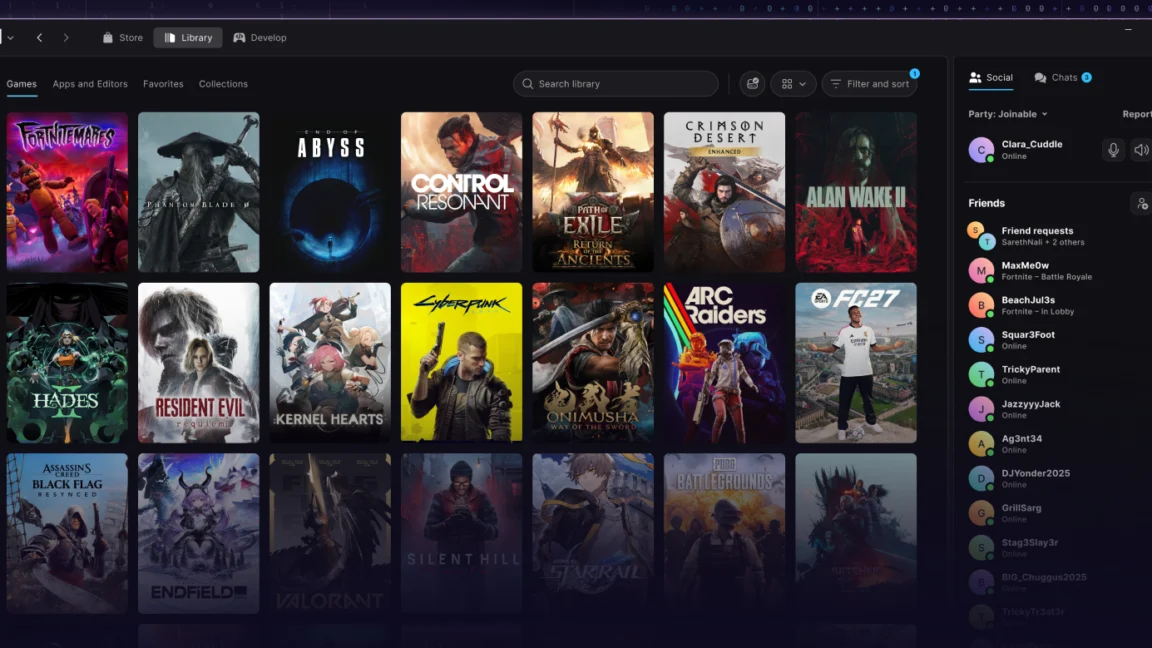
Nearly eight years after Epic Games first challenged Valve’s Steam dominance by launching its own storefront, the Fortnite creator is pivoting to a radical new strategy. Moving beyond competitive pricing models and exclusive titles, Epic has unveiled a completely reimagined Epic Games Launcher—one it claims was built primarily through a process it jokingly refers to as "vibe coding," but which is, in reality, a landmark case study in AI-assisted software engineering.
Main Facts: A Total Rewrite
The Epic Games Store (EGS) has long faced criticism regarding its client’s performance. Users frequently cited slow startup times, bloated resource consumption, and a clunky interface compared to the highly optimized, albeit aging, architecture of Steam.
In a surprising announcement this week, Epic Games released a public "Preview" build of its new launcher. The company’s marketing has been intentionally irreverent, claiming, "Programming is hard. So, instead of doing that, we vibe coded a new Epic Games Launcher that’s way faster and more responsive than the current one."
Despite the tongue-in-cheek terminology, the underlying reality is a serious technological migration. Martin Keely, General Manager and VP of the Epic Games Store, confirmed that the team started from a blank slate. Rather than attempting to patch or refactor the legacy code—which had grown increasingly cumbersome over the last decade—the team utilized AI as a primary tool to architect and write the new client from the ground up in a modern tech stack.
Chronology: From Legacy Bloat to AI-Driven Agility
To understand why Epic has taken such a drastic route, one must look at the historical trajectory of the Epic Games Launcher.
- 2018: The Epic Games Store launches with a "minimum viable product" philosophy, focusing on revenue splits for developers rather than feature parity with Steam.
- 2019–2024: The launcher undergoes iterative updates. As more features (cloud saves, achievements, social overlays) are added, the "tech debt"—the hidden cost of quick-and-dirty coding solutions—mounts. The application becomes notoriously slow to launch and resource-heavy.
- Early 2025: Internal discussions at Epic shift toward the necessity of a "ground-up" rebuild. The team recognizes that traditional software development cycles would take years to reach the level of responsiveness they desire.
- Late 2025–Early 2026: The engineering team begins experimenting with AI-integrated development environments. They decide to abandon the legacy codebase entirely.
- October 2026: Epic Games publicly releases the "Preview" build of the new launcher, signaling a new era of AI-accelerated deployment.
Supporting Data: The Quest for Milliseconds
Epic’s primary benchmark for success has been the elusive "cold start" speed—the time it takes from clicking the icon to seeing the Store page ready for interaction.
In technical testing, the results are notable. The new launcher consistently opens several seconds faster than the current iteration of Steam. When testing "system tray restore" times—the act of bringing the window back from the background—Epic claims a speed advantage over its competitor.
However, the data reveals a nuanced reality. While the startup speed is objectively faster, some metrics, such as the claimed 0.06-second improvement in tray restoration, are nearly imperceptible to the average user. Yet, the cumulative effect of these micro-optimizations creates an experience that feels significantly more "snappy." By utilizing a different tech stack, Epic has successfully shed the "bloatware" perception that plagued the previous version, proving that AI-assisted code generation can effectively optimize for performance if guided by experienced human architects.
Official Responses: What is "Vibe Coding"?
The term "vibe coding" has become a point of contention and curiosity in the developer community. In an interview with IGN, Martin Keely clarified that the term is an attempt to simplify a complex, high-efficiency workflow.
"Using AI made us more efficient," Keely stated. "It allowed a small team to rewrite the entire code base. We didn’t just replicate the functionality; we re-engineered the logic to be leaner and faster. It gave us the ability to launch it simultaneously across platforms, supporting Windows, Mac, and, crucially, a Linux version."
Keely’s response underscores a pivotal shift in the software industry: the move away from manual, line-by-line coding toward AI-assisted architectural design. "We wanted to look at the functionality that existed in the current launcher and replicate that, but not the code itself," Keely added. This distinction is vital—Epic wanted the behavior of the old app without the technical debt of the old app.
Implications: The Future of Game Development
The implications of this move by Epic Games extend far beyond the gaming industry. It serves as a bellwether for the future of large-scale application development.
1. The Death of Legacy Refactoring
For years, companies have spent millions of dollars "refactoring" legacy code—trying to clean up old, messy codebases. Epic’s success in rewriting its entire client suggests that it may soon be cheaper and faster to simply "AI-generate" a new application from scratch based on the requirements of the old one, rather than attempting to maintain the old one.
2. The Rise of Small-Team Dominance
The fact that a "small team" was able to perform this rewrite suggests a massive shift in human capital requirements. If AI tools can handle the heavy lifting of boilerplate code and architectural implementation, the demand for "coder-monkeys" (entry-level developers focused on rote tasks) may plummet, while the demand for high-level system architects who can direct AI models will skyrocket.
3. Cross-Platform Parity
One of the most exciting aspects of the announcement is the commitment to a Linux version. Historically, Linux support for gaming launchers has been an afterthought, often neglected due to the high cost of maintenance. If AI-assisted development allows Epic to maintain parity across Windows, Mac, and Linux without a massive increase in headcount, we may see a resurgence in cross-platform desktop software that doesn’t rely solely on Electron or web-wrapper technologies.
4. A New Competitive Frontier
Steam has long held the throne through sheer inertia—its massive library and social features keep users locked in. However, if Epic can maintain this speed advantage, it creates a "frictionless" experience. For a user, the difference between waiting two seconds or six seconds to open a store might seem trivial, but in the attention economy, these small friction points are exactly how user loyalty is won or lost.
Conclusion: A High-Stakes Gamble
Epic Games is betting that by focusing on the "vibe"—the feel, speed, and responsiveness of the user experience—they can entice users to migrate away from the entrenched ecosystem of Valve.
While the "vibe coding" moniker may be a marketing gimmick, the results are grounded in a very real, very efficient technological shift. As AI tools become more integrated into the software development lifecycle, Epic’s latest project stands as a bold proof-of-concept. It demonstrates that the future of desktop applications won’t be defined by who has the largest legacy code base, but by who can most effectively leverage new tools to create the most agile, responsive, and platform-agnostic experiences.
Whether this will be enough to finally topple Steam remains to be seen, but the gauntlet has been thrown. The era of "vibe coding" has arrived, and it is moving at the speed of light.
