

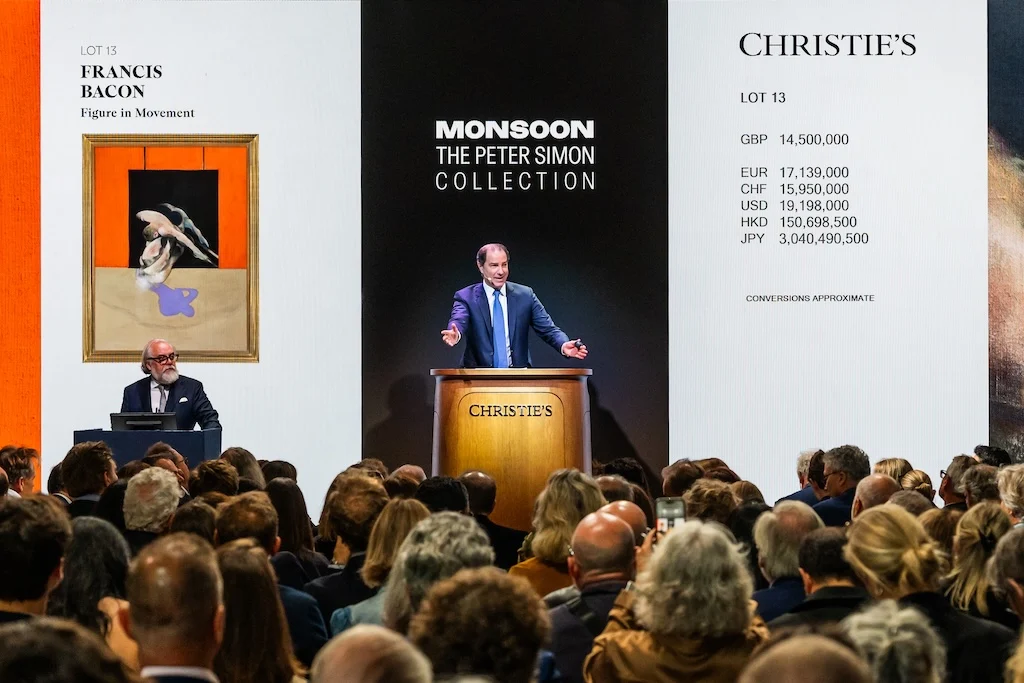
The London art scene witnessed a high-stakes, multi-million-pound spectacle this week as Christie’s orchestrated two consecutive evening auctions that collectively realized £218.6 million ($289.4 million). The results, which more than doubled the house’s totals from the same period last year, provided a much-needed shot of adrenaline to an art market that has been navigating a period of uncertainty. Coinciding with the bustling atmosphere of Frieze London and Frieze Masters, the auctions served as a barometer for global collector sentiment ahead of the crucial New York sales slated for November.
The evening was defined by a split performance: the high-octane success of "Monsoon: The Peter Simon Collection," followed by a more nuanced, sometimes uneven, 20th- and 21st-century evening sale. While records were shattered and blue-chip masterpieces found new homes, market analysts were quick to temper their enthusiasm, pointing to the structural scaffolding of third-party guarantees that underpinned the night’s most significant transactions.
A Chronology of the Evening: From "Monsoon" to Midnight
The festivities commenced under a cloud of administrative confusion. While the "Monsoon: The Peter Simon Collection" was scheduled for a 6:00 p.m. start, Christie’s own live-auction website displayed conflicting information, listing a 7:00 p.m. commencement for some users. This led to palpable frustration among several high-profile market professionals, including an advisor to a global roster of blue-chip clients, who arrived under the impression that the sale would be held later. It remains an open question whether this digital hiccup caused potential bidders to miss the window for key lots.
Despite the confusion, the auction room was packed to capacity as the gavel dropped on the Simon collection. Assembled by the British retail titan and longtime ARTnews Top 200 collector Peter Simon, the collection was widely viewed by insiders as the primary draw of the London week. The sale was a masterclass in curation, achieving a staggering 98 percent sell-through rate by lot and 99 percent by value. Only one of the 41 lots failed to find a buyer, cementing the collection’s status as the highest-value single-owner sale ever staged at Christie’s London, totaling £107.5 million ($142.3 million).
Following a short intermission that seemed to recharge the room’s energy, the 20th- and 21st-century evening sale commenced. The mood, however, proved more volatile. Early momentum was buoyed by strong performances from Josef Albers and a notable result for René Magritte’s Le seize septembre, which soared to £3.26 million ($4.3 million)—well above its £1.8 million high estimate. However, the energy fluctuated as the night wore on. By 8:52 p.m., as a string of works by Cy Twombly, George Condo, Alberto Giacometti, and Lucian Freud failed to spark interest, the room began to thin, with the elite crowd of collectors and dealers drifting toward the exits.

Supporting Data: Records and Realizations
The statistical performance of the evening was marked by seven new auction records, underscoring a deep appetite for specific, high-quality works despite a broader, more selective market.
The Record Breakers
The most surprising surge of the night came from Russian avant-garde painter Liubov Popova. Her Painterly Architectonic incited a bidding war that lasted nearly eight minutes, ultimately hammering at £7.64 million ($10.1 million)—more than triple its high estimate of £2.5 million. Other notable records included:
- Bridget Riley: Streak 2 reached £5.21 million ($6.9 million).
- David Bomberg: San Miguel, Toledo, Afternoon brought £3.26 million ($4.32 million), a result that drew cheers from the floor.
- Portia Zvavahera and Barbara Hepworth: Both artists saw new benchmarks established for their work.
The Blue-Chip Performers
While the records captured the headlines, the top-tier lots largely held their own. Francis Bacon’s Figure in Movement acted as the anchor for the Simon collection, fetching £17.19 million ($22.8 million). Piet Mondrian’s Composition A, with Double Line and Yellow also performed strongly, realizing £9.71 million ($12.86 million).
The undisputed star of the evening, however, was Wassily Kandinsky’s early masterpiece Das bunte Leben (Colorful Life). Described by auctioneer Adrien Meyer as "the most important early work by the artist to ever come to auction," the painting commanded a price of £31.6 million ($41.8 million). Having been restituted to the heirs of Hedwig Lewenstein-Weyermann only last year, the work saw intense competition among Christie’s specialists, ultimately being secured by specialist Maria Los.
Official Responses and Market Analysis
The perspective on these results depends heavily on whom you ask. Philip Hoffman, chairman and founder of the Fine Art Group, offered a sober assessment in the immediate aftermath. While he acknowledged the sales as a "clear indication of a solid market," he warned against reading the results as an unqualified endorsement of the current climate.

"These auctions are staged, managed, and already pumped up to the max for the best guarantees they can get," Hoffman remarked to ARTnews. His caution stems from the heavy reliance on financial engineering; 29 of the 41 lots in the Simon evening sale were backed by third-party guarantees. This mechanism effectively transfers the risk from the auction house to a third party, ensuring a minimum price before the first bid is even cast. Consequently, the "success" of such a sale is often baked into the pre-auction preparations.
Hoffman noted that buyers at Frieze Masters had been conspicuously holding back capital, clearly waiting to deploy their liquidity at these specific auction events. He views the upcoming sale of the Antonio Homem Sonnabend collection—expected to exceed $50 million and offered without the safety net of guarantees—as the true test of the market’s underlying health.
Implications for the Future
The implications of the London results are twofold. First, they prove that the "trophy" end of the market remains robust. Collectors are still willing to compete aggressively for rare, historically significant works—evidenced by the fierce bidding for the Kandinsky and the Popova. When the provenance is impeccable and the work is "fresh to the market," the economic headwinds that have dampened the mid-market seem to dissipate.
Second, the disparity between the high-performing lots and those that failed to sell suggests a market that is increasingly bifurcated. The "mute" response to several high-value lots toward the end of the evening, as well as the withdrawal of interest for works by established contemporary names, suggests that even wealthy buyers are becoming more discerning. They are no longer buying across the board; they are buying with surgical precision.
As Christie’s looks toward the New York auctions on November 17, the London results provide a sense of stability. The house has successfully navigated a high-pressure week, demonstrating that the appetite for top-tier art is intact. However, the reliance on guarantees and the selective nature of the bidding suggest that the art market is not merely "recovering"—it is recalibrating. For the next phase of the auction season, the industry will be watching closely to see if that recalibration can survive the absence of third-party guarantees, as the market looks for a more organic, unvarnished reading of collector demand.
